Paul,
Did you ever run the turbo compound Mazda with the gearbox shown in
the pictures? If you did, were the results published? Looks like a
neat project but it probably consumed lots of time and money.
Gary Knutson
Not yet. The box cost a bunch. I spent so much money on that I had
none left over for dyno time :) It is actually cheaper to use a
turbo compound system from a mass produced truck engine. Detroit
Diesel DD15. Almost bolt on with a three rotor. You would no happen
to have access to a dyno would you.
Paul Lamar
Paul,
Do you have a plan for dyno testing a turbo compound setup? Are all
the parts and a suitable test engine available? How about a exhaust
system, etc.
I do have access to a well instrumented and equipped test cell but
my "run time" is somewhat limited. A test would have to be laid out
and documented and as much of the hookup stuff done ahead of time as
possible. The facility is local (to me).
Let me know what you might have in mind. It would be an interesting
test!
Gary Knutson
I have a simple plan. Run 500 RPM increments for one minute each
with out the TC and measure and record the fuel flow and HP. Then
repeat with the TC.
I have a stock 3 rotor but it is not complete and running. It has
the stock turbo's. It needs a Motec installed. We can get help on
that because Jim Medere of Racing Beat has done it several times.
I don't currently have a Motec. He sells them I think.
We can buy the DD15 TC system new for about $4000. I can rig a cog
belt drive from the DD15 gear box out put to the 3 rotor out put
shaft if I have dwg of the dyno bell housing bolt pattern. I would
entail cutting slots in a stock Mazda bell housing for the belt to
pass through. The belt HP would be in the range of 30 HP plus or
minus 20. The DD15 GB puts out 1800 RPM or so max when the turbine is
going 40,000 RPM. That means would would have to step it up 1 to 3 or
so.
I can fly up there and spend the time hooking things up. I think the
data output from the Motec would be all we need. We would have to
monitor engine temperature of course and RPM but even that the Motec
would know.
I would probably be cheaper for me to deliver the engine than
crating and shipping. Which would run about $1000 as I just had a 400
pound engine shipped from Or and that is what it cost.
1500 miles at 20 MPG and $4 a gallon is $300 each way.
Paul Lamar
Paul,
Am I missing something here? I thought you were located at the
Santa Paula Airport near Ventura. I'm in Laguna Niguel and the dyno
is in Huntington Beach. If I'm correct on your location, things
aren't all that far apart.
This dyno, unlike a Superflow or similar, mounts the engine on
adjustable stands. It uses a CV coupling that bolts to a flywheel or
adapter plate on the flywheel end of the output shaft. A short drive
shaft couples the engine to the absorption unit. No bell housing is
involved. The dyno had a built in starter.
As the output end is exposed, it should be possible to install a
driven pulley from the TC unit.
Any required engine mounting plates and the coupling adapter should
be made ahead of time. I can supply pictures and dimensions for the
parts.
I can look around and see if I can find a "loaner" Motec. I can't
promise anything there.
From your description, it sounds like you would run with a
turbocharged engine, is that correct?
The cost of the TC system is a pretty big hit for a test. I suppose
that it could be reused if all went as planned. The belt drive won't
be that bad. I assume that the TC unit could be mounted on the
engine.
Anyway, lots to think about. I hope I cleared up some of the
"travel" concerns.
Gary Knutson
I was missing something :) That's great. I thought for some reason
you were in the Detrot area. Come on up to SZP and see my
collection. Email me before you come so I can get out to the hangar.
That $4000 includes the DD15 turbo. If we use the sequential turbos
on the 3 rotor we won't need the DD15 turbo. In theory we wont get
as much HP out of the blow down turbine due to a bit of energy loss
in the second 3 rotor turbo. I would be ecstatic with just a 5%
improvement in the BSFC. That would drop the rotary BSFC from .47 to
.446 more than demonstrating the potential.
Paul Lamar
Paul,
I may take you up on that offer. I "escaped" from Livonia at the end
of 1987. :-)
Which way would make the most sense - Mazda turbos and the DD15
without the turbo or the other way around? The DD15 looks like a
nice package. Would there be drawbacks to using it complete?
As I mentioned, this could be a interesting & helpful project. Who
knows, it might even be a bit of a money maker. I will look forward
to hearing more of your thoughts on things.
Gary Knutson -- Any movement on this great idea? Marc
Not yet.
Paul Lamar
The DD15 is from a diesel and would be happier with the lower exhaust
temps down stream of the tubocharger(s) on the Mazda. It would make
sense to replace the stock turbo set with a single turbo with the
highest temp materials. A thought on controlling T I T: Tap excess
air from the compresser (and use an additional small compessor if
nessesary due to back pressure) to bypass the engine to increase mass
flow to the turbines while cooling exhaust enough for turbines to
last.
Murry I. Rozansky
A few pieces of data:
The SS temp limit of the power turbine is 650C [1200F] for good durability.
Some quick mass flow & pressure calculations will tell you if the DDC
turbomachinery suites your application.
You'll want a few minutes thermal stabilization time (lots of thermal mass
in those castings) for a good measurement, especially on a calculated value
like BSFC. Good error accounting will let you know when you're seeing real
changes.
Cummins Turbo Technologies (Holset) makes the turbocompound unit. The
aftermarket guys like helping people with neat applications. Give them a
call in the UK.
/Zach
We don't care long term. We just want to demonstrate a significant drop
in the BSFC.
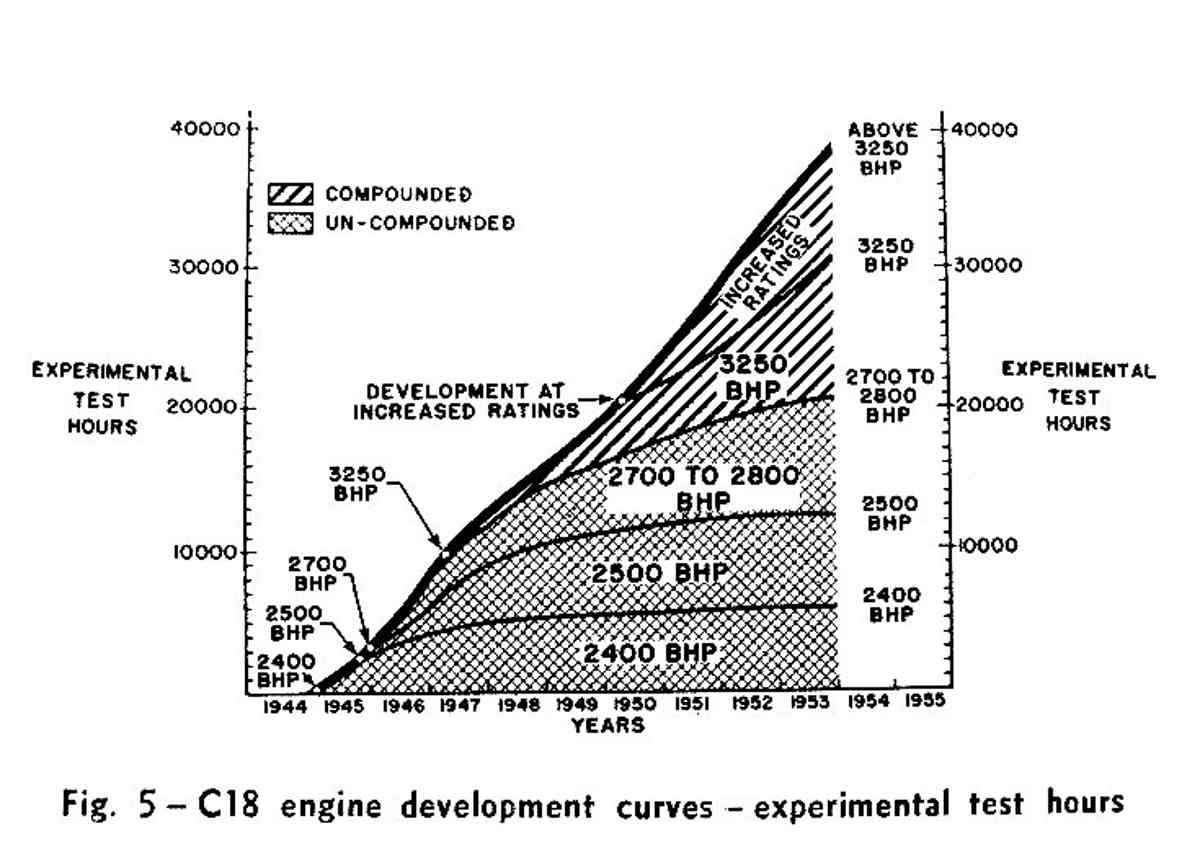
Long term will come later. This chart illustrated the development of
the R3350 TC. As you can
see the potential was increasing in a linear manner.
Paul Lamar
The Rotary Engine News Letter. Powered by Linux.
ACRE NL web site.
http://www.rotaryeng.net
You Tube
http://tinyurl.com/beqqxas
Copyright 1998-2013 All world wide rights reserved.