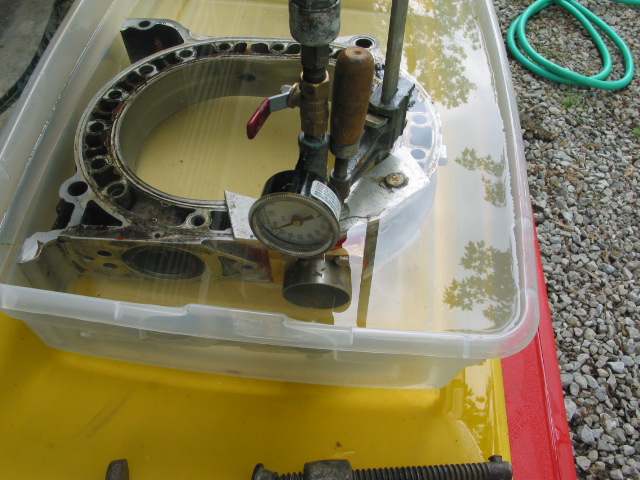
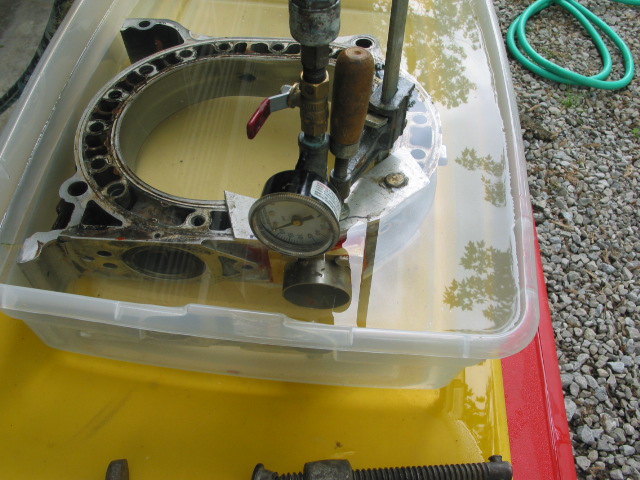
Removing the o ring block revealed sealant that had gone fairly
brittle. Crappy stuff. I suspect a little vibration loosened
something and thus the leak.
Here are some photos of the cleaned port and re seal with black RTV.
Lewis Bjork
I don't think black is the right stuff to use. Red RTV is usually
500 F.
What does it say on the container?
Also I would etch the aluminum to get a better seal.
BTW I hope you are mixing two cycle oil with the fuel and not
injecting the crap out of the "crankcase". It looks like you are
doing that in one of the pictures or is that a sensor?
2 cycle oil in the fuel does a better job as it gets everywhere
inside the engine and not just down stream from the injector hole. 2
cycle oil burns cleanly leaving no residue unlike crankcase oil.
Paul Lamar
The Rotary Engine News Letter. Powered by Linux. ACRE NL web site.
http://www.rotaryeng.net You Tube
http://tinyurl.com/beqqxas
Copyright 1998-2013 All world wide rights reserved.
Paul,
FWIW, Coolant can also find its way up the threads of the 4 bolts.
On my 20B, I had to counter-sink a couple and add button-head screws
with o-rings to finally get all the small leaks stopped.
Coolant can (will) leak at the joint of the sealing plate and the
outer rotor housing surface. This proved to be a challenge to obtain
a leak-proof seal. I used Ultra grey RTV. Important to let it sit 24
hrs in order to fully cure before pressure testing else the air/water
will force its way through the soft RTV and create a leak where there
was none. Don't get in a hurry with this step.
Mark S.
Great idea. I will add that to the procedure. Jeff can do that
operation when he machines the sealing blocks. You deserve most of
the credit for the success of the welded P-port having welded the
first one.
Mcmaster Car has Teflon coated 10-32 screws that also will probably
seal.
The RX8 p-port video on you tube is now over 80,000 hits.
Paul Lamar
-----------------------------------------------------
These screws come with the O-ring seal.
Paul Lamar
A tapered counter bore for the seal to sit down in helps. The bolt
head then contacts the bore at its outer diameter and does not crush
the seal. A problem with the pan head screws can be the full
threads. The coolant can then leak past the inner part of the thread.
Newer Bettis hydraulic actuators seem to have a problem with this. A
better solution is to use copper washers.
Dale Davies
I remember sealing the tubes. I had to do it several times and tested
the housings under water at 60 psi.
Don't know what thermal cycling will do after the engine runs.
Joe Berki
Limo EZ
The Rotary Engine News Letter. Powered by Linux. ACRE NL web site.
http://www.rotaryeng.net You Tube
http://tinyurl.com/beqqxas
Copyright 1998-2013 All world wide rights reserved.