Hi!: did I tell you about this Non-Wankel Rotary Combustion
Engine that provedbeing a sound design, as it works
perfectly?Enjoy it, salut +
Jose Gros-Aymerich E-28033 Madrid, Spain
http://www.youtube.com/watch?v=sKrWB3aJeaU
Not a rotary engine. The blades reciprocate.
Paul Lamar
==============================================================
By Kenichi Yamamoto from his book "Rotary Engine" 1981
1.3 REQUIREMENTS FOR A PRACTICAL ROTARY ENGINE
Although various types of rotary engines have been
developed to date, there are few that do not qualify as internal
combustion engines or do not qualify as a practical engine even
if they satisfy the qualifications of an internal combustion
engine.
The requirements for a rotary engine to be qualified
as a practical internal combustion engine can be summed up in
the following five items. The practicality of various ideas on
rotary engines can be judged by evaluating them by these
criteria:
(1) Every moving part, including the timing mechanism, should
make a rotating motion. A mechanism having a reciprocating
inertia will increase mechanical noise and vibration, and will
work against high speed and high revolution. [In addition
mechanisms that reciprocate generate reversing loads. Reversing
loads lead to reversing stresses. Reversing stresses lead to
metal fatigue and limited life. The Wankel rotary engine has no
reversing stresses therefor the life of the major parts such as the
eccentric shaft and rotor are unlimited unlike, crankshafts,
connecting
rods, pistons and poppet valves. Paul Lamar] Accordingly,
structures
that require intake and exhaust valves and mechanisms using the
rotors
oscillatory motion are not desirable.
(2) Gas seals or the working chamber should be three
dimension-ally reliable. The gas seal mechanism of a rotary
engine should be constituted by connecting the individual seals
three dimension-ally. Among the many ideas we come across are
those that don't show such three dimensional thoughts.
(3) Appropriate gas exchange of intake and exhaust should
take place. Together with having a mechanism that can correctly
open and close the ports, sufficient time for intake and exhaust
should be provided especially for high speed and high
revolution. Among the ideas on rotary engines, there are some
that ignore this point.
(4) Every component part should have the strength to endure
high speed and high pressure. As the component parts are
exposed to high pressure, high sliding velocity and high heat
load, every part should have sufficient allowance in size and in
shape.
(5) Sufficient cooling and lubrication should be provided.
In order to qualify as an internal combustion engine, although
this is related to above (4), durability against high heat load,
high sliding velocity, etc. are required. Therefore, the
structure should be simple, and the ideas on rotor cooling,
lubrication of seal parts, and oil seal structure should be
those that are given adequate thought.
Also, it is desirable for a practical rotary engine to
have a simple and compact structure. When we evaluate the
various type's of rotary engines devised to date in view of the
above mentioned requirements, the NSU Wankel type rotary engine
is the engine that best satisfies the above mentioned
requirements.
==========================================================
Hi Paul!: thanks for your interest, page 4 of the 1981 edition
ofthe K Yamamoto book, figs 1.17, 1.18 and 1.19, shows theMallory
Co.rotary engine, a design that looks to me close to the one by
Mr.Jean Claud Lefeuvre, it's just a development of the vane pump,
andyes, I'd said it rotates and doesn't reciprocate.
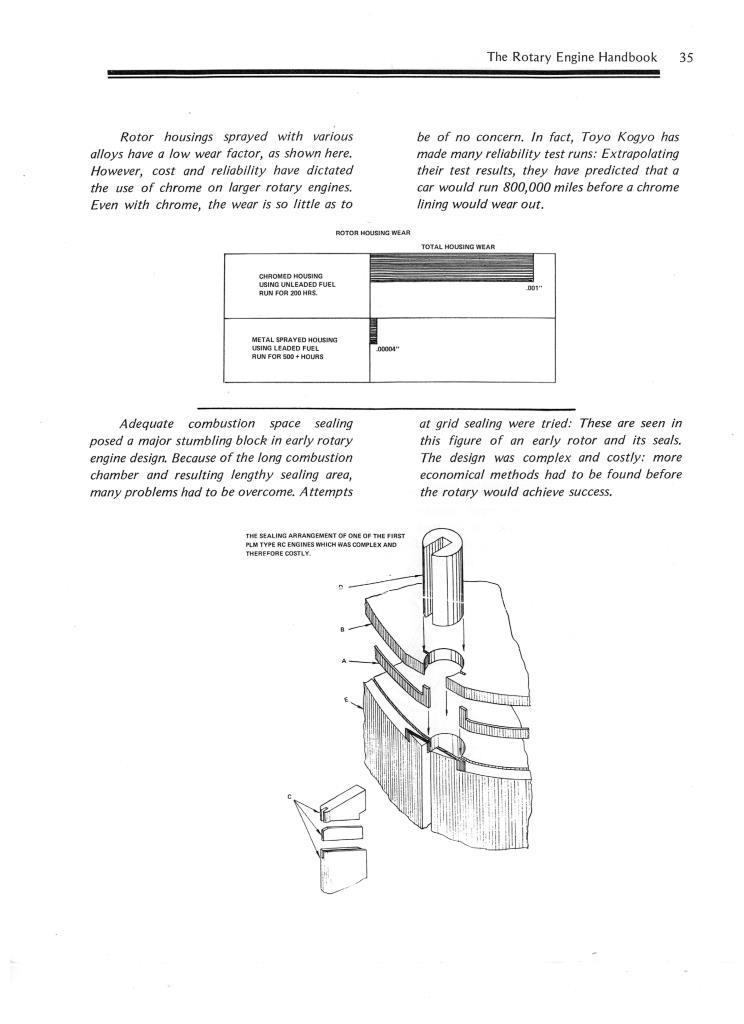
An additional question: as you can see in the attached chart
from the 1974 book by Edward McGovern, 'The Rotary Engine
Handbook', wear of trochoid surface was greatly reduced if leaded
gas was burnt inside the Wankel RCE; as Lead acts a solid state
lubricating agent, I'm wondering if putting a Molybdenum Oil
additive in the oil that is going to be used for lubrication in
the Wankel engine would have the same action of enlarging the
lifespan of engine. I don't know it this would fool the plug, and
I have no data about the use of Molybdenum additives for 2-Stroke
engines, but in my first car, a Seat (fiat) 127, with a 903 cc (55
c.i.) 4 cylinder engine, giving47 HP (DIN) -37 kw, I added one
Molykote A can in every oil exchange,and the car ended giving 52
mpg, 4.5 lit/100 km.
Any feedback on this would be of interest, as I've contracted
the overhaul and reparation of a 1987 13B Mazda engine for use in
my 1975 AMC Pacer X car.Best regards, salut +
Jose Gros-Aymerich E-28033 Madrid, Spain