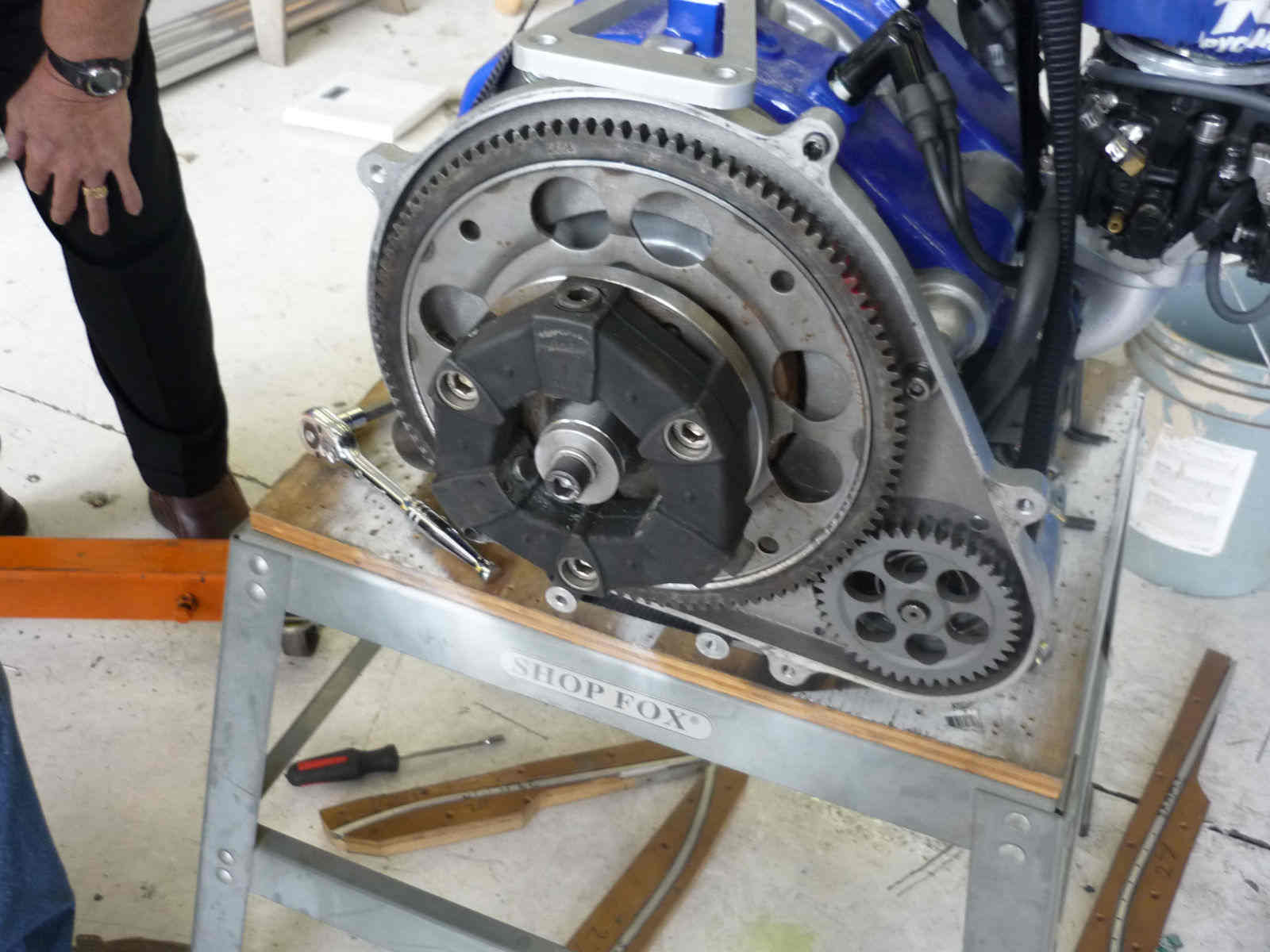
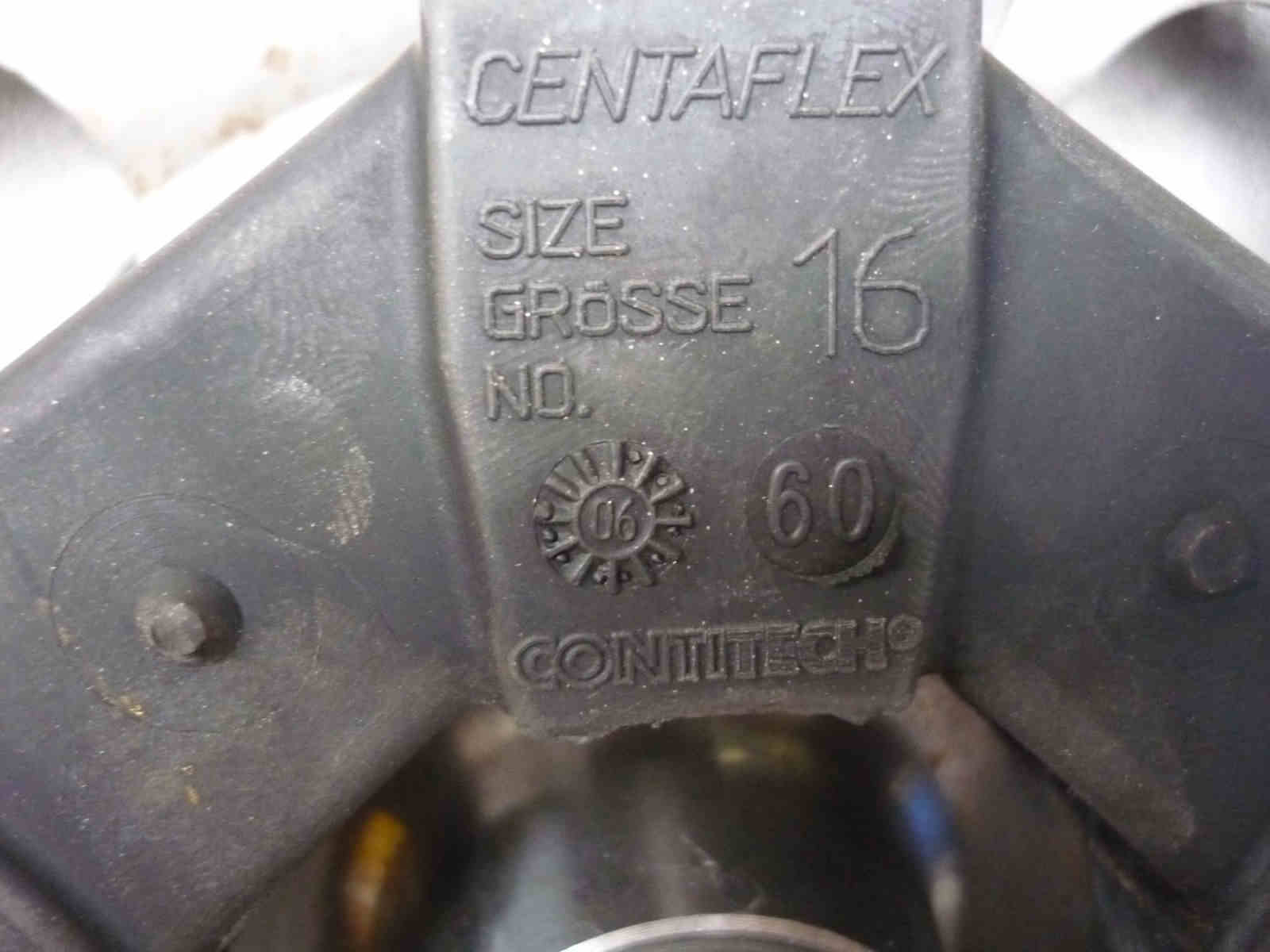
Paul, (I am not an engineer...nor do I claim anything mechanical
skills.... question for you and the group)
Molt Taylor's Flying Car.... utilized a ??? Centrifugal clutch on
the drive shaft .... with ball bearings (?) About five of them are
still in existence and flying today.........
Why would not a modern version of that clutch work on the Rotary
engine?
Paul,
Been reading in depth about the rotary VERY interesting engine for
an aircraft. The turbo compounding takes this to the next level.
Barron
That is my next project. Chris's bell housing put the project over
the top. It eases adapting the DD15 TC system to a 3 rotor.
I was planning on using the Mazdatrix dyno but that would not mate
with Chris's bell housing so I need to build another prop dyno. I
will use one of these ideas.
Paul Lamar
How is the PSRU development going, you could test the new unit
with the turbo-compound and kill two birds with one stone.
Graeme Riley
Paul,
What HP is your psru designed for? Can it handle 350+ hp for
takeoff and 300 hp continuous?
Mark S.
You mean the one Milo is working on? It is based on a recycled six
cylinder lycoming crank shaft. It uses stock Ford six pinion
planetaries.
It has mostly to do with the weight of the prop.
With carbon blades it would be no problem.
Paul Lamar
Paul,
My experience has been that the weak link isn't necessarily the
planets, but something else, like the rivets holding the flex
plate adapter to the hub, or the weld/pin attaching the sun gear to
the input shaft, etc. I was curious as to the design spec for this
box. I know you're trying to keep it light, but there's a limit to
where you are willing to go.
Mark S.
Has anybody pulled down one of Tracy's psru's that has some time
on it. I'm aware of Dave's sun gear issues I was wondering how the
rest of the unit was holding up. Dave did you install a second pin
in the sun gear, If so have you inspected it since? Just curious as
to the results. Graeme Riley
It is showing some weakness in the higher 3 rotor HP levels. The
flex plate is cracking.
IMHO it is due to the lack of an effective torsional damper. In
effect capturing the rubber bushing in an enclosed metal box like
Tracy has done is no damper at all.
They don't work as one might think. If you totally enclose a
rubber bushing (as Tracy has done) it no it longer operates as
rubber. It acts as a solid. Rubber is no more compressible than
hydraulic fluid.
I am building this combo flex plate and damper for the 3 rotor
turbo compound engine I am working on. .090 4130 would be fine for
a 2 rotor. For a 3 rotor p-port or turbo I would use .125" thick
4130
Motor cycle style rubber bushings can be made with red RTV in a
Teflon mold. Good to 500 F.
Paul Lamar
I have been reading about a psru developed for the R1200 bmw
motorcycle engine that is used in aircraft tractor and trike
pusher configuration. It uses a centrifugal clutch like ones in
most chainsaws only much larger, this has solved the torsional
dampening problem. The engines are rated 100-115hp continuous 6300
rpm. The clutch eengauges at 1800 - 2000 rpm and has to be changed
every 400 hrs. These engines have run 2000 hrs in this
configuration. They initially had flywheel cracks when they used
light ones, beefed them up cracks stopped engine ran smoother.
Has anyone considered the rubber coupling used to couple a high
hp. electric motor to air compressors and pumps ect. If i
understand there operation correctly they will absorb energy
transmitted back to the motor and shaft miss alignment between
motor and equipment. I have seen these couplings with several
thousand hrs. on them with no visible wear. Steve Hudson
How high is the HP?
Paul Lamar
Hi. The clutch does not solve the problem as much as avoid it. The
clutch does not engage until the engine is above the resonant
speed of the system. There is sometime a rubber coupling also to
bring the critical point to lower rpm.
http://www.elbe-group.de/presse/download/Folder_Gelenkscheiben_e_low.pdf
Rubber coupling designed for industrial and automotive use, by BMW,
Mercedes. and others. Porsche used one between flywheel and
gearbox on their aircraft engine which was known for its smooth
running if nothing else. Three point engine mounting helped. Also
used by some auto and motorcycle geared PSRUs.
Murry I. Rozansky
I would but when you scale it up for 200 or 300 HP it gets much
larger and heaver.
In the future when one is trying to be helpful think of the space
and weight of what one is suggesting. Get a dwg. of the device and
see if it will fit in a 6 inch dia. cyl. and 1.7 inches long. The
devil is always in the details.
Paul Lamar
Paul,
I'm unfamiliar with the units referenced in the above URL for the
rubber BMW style couplers, so I can't tell if they would handle
7,500 rpm or not, but I suspect not.
Mark S.
They are sized by torque and on the output of the engine it is
relativly
low so a small diameter unit would be used. Burst values for the
small ones are over 10,000 rpm. They are cord reinforced not just
rubber in
compression or shear as are some other donut couplings.
Murry I. Rozansky
I doubt any of them would fit in 1.7 inches.
We had one on the Rotomax one rotor and it still resonated at 1800 RPM.
It may have failed causing the crash. Something happened that disconnected
the prop from the engine.
Paul Lamar
The Rotary Engine News Letter. Powered by Linux. ACRE NL web
site.
http://www.rotaryeng.net. You Tube
http://tinyurl.com/beqqxas. Copyright 1998-2013 All world wide
rights reserved.