Paul,
I went out to the airport today to see how much I could accomplish on
the
flexplate damper project. I found some .090 silicone sheet and cut enough
pieces to do 1/3 of the damper. In the process I discovered some things I
hadn't anticipated.
First, the 6, 10mm counter-weight bolt heads stick up 3/8". The three
paddles from the spline plate are short enough to miss the bolts, but that
renders the last 3/8" of depth useless for damping purposes, but you
already knew that.
Also, the three paddles on the engine side are shortened, I assume to
clear
the bolt heads needed to attach the spline plate. So, another 1/4" of
unused space. That leaves a space of 1" to pack in enough silicone sheet
to handle 350 hp. I'm not sure silicone is up to the job.
Do you have anything in mind to fill in the gaps caused by the bolt
heads?
I was thinking of cutting spacers out of 3/8" phenolic sheet for the
engine side, and 1/4" phenolic sheet for the psru side. This should keep
the silicone sheet in place. Comments?
As for the silicone sheet, I feel that .090 is too thin for this
application, but that is all I had on hand. A quick ebay search revealed
some 1/2" silicone sheet for $81 (1/2" x 36" x 12"). That should be
plenty
to do a few dampers. Or, do you think we could cast some dampers? (Just
a
thought.)
Mark
Well if we can come up with a low height spline plate
bolt head we can lengthen the paddles on the engine side.
I had already thought about the 10 mm bolt heads. I figure we
could glue silicone sheet in there to act as a spacer. It would
not be subject to compression. Plywood would also work. So too
phenolic as you suggest or fiberglass.
Lets try the .090 on a ground run to get a feel
for the situation. Try idling the engine below 1800 RPM
to see what happens. I'll fly out for the test.
Looks like we can make the paddles on the gearbox side
wider. See damper10-mod.jpg 1/4 inch is no problem
if you think that will fit.
Some modeling clay in there without the rubber
will reveal a lot.
If you want something changed to fit better let me know.
2 7/8th or 3 inch tube might be better than the 2 3/4
that is in there now.
Paul Lamar
Paul,
For test purposes, we could weld some .125" or .250" thick strap to the
outer face to see how it works. We could radius it if too tight.
Mark
I meant 2 3/4 " Inch tube.
I am am not sure I follow you on this. Make sketch on paper
and scan it in. Or use MS Paint. Strap rolled up to
increase the outer diameter of the tube? Hard to do :)
Get back to me after the clay and I will send you a front (gear box
side) with a larger tube. I think I have some 3 inch OD
4130 tube lying around.
BTW glue those silicone parts together with red RTV.
Paul Lamar
Here is what it looks like with a 3 inch inner tube and socket
head metric 10 mm bolts. I think this is an improvement but
we can still test what we have. This is a minor change in the
over all scheme of things.
Paul Lamar
That works too. My thought was to extend the three "paddles". By
extending the paddles, there is more space for the silicone.
FWIW - From looking at the welded up assy, I don't see how this little
assy will be able to absorb 350 hp.
Mark
Two ways to get HP. Torque or RPM.
The rotary is RPM. Lets say it generates 350 HP at 7500 RPM.
What is the torque?
HP = T X RPM /5252
350 = T X RPM / 5252
350 X 5252 / 7500 = T = 245 foot pounds.
3000 inch pounds. Divided by 5 inch diameter = 600 pounds total force.
3 rubber lumps 200 pounds per rubber lump.
One inch high by 1.4 inches is 1.4 square inch.
142 psi.
It is hard to quantize rubber for compressive strength
because it expands in other directions 90 degrees to the load.
The tear strength is 580 pounds per square in or about 4 MegPas.
Cut 4 pieces 1 inch by 1 inch. One square inch. Stack them up on the
floor. 3/8th of an inch thick roughly. Best to glue them together
with red RTV and let it cure for 24 hours.
Put the heal of your shoe on the rubber stack and balance with on foot.
See if it springs back to shape.
Paul Lamar
Paul,
If this thing is bigger than 5" and 5" is actually the distance to the
center of the paddles, ignore this. I didn't want to go back and dig up
dimensions.
You should only take credit for the diameter to the center (or so) of your
metal paddles if you want a closer estimate of the force reacted by the
rubber. Using the 5" diameter of the outside of the pipe assumes all of
the force is reacted by the rubber at the outside edge, which isn't the
case.
Josh
Yes Josh I know :) It is six inch OD and three inch ID.
Paul Lamar
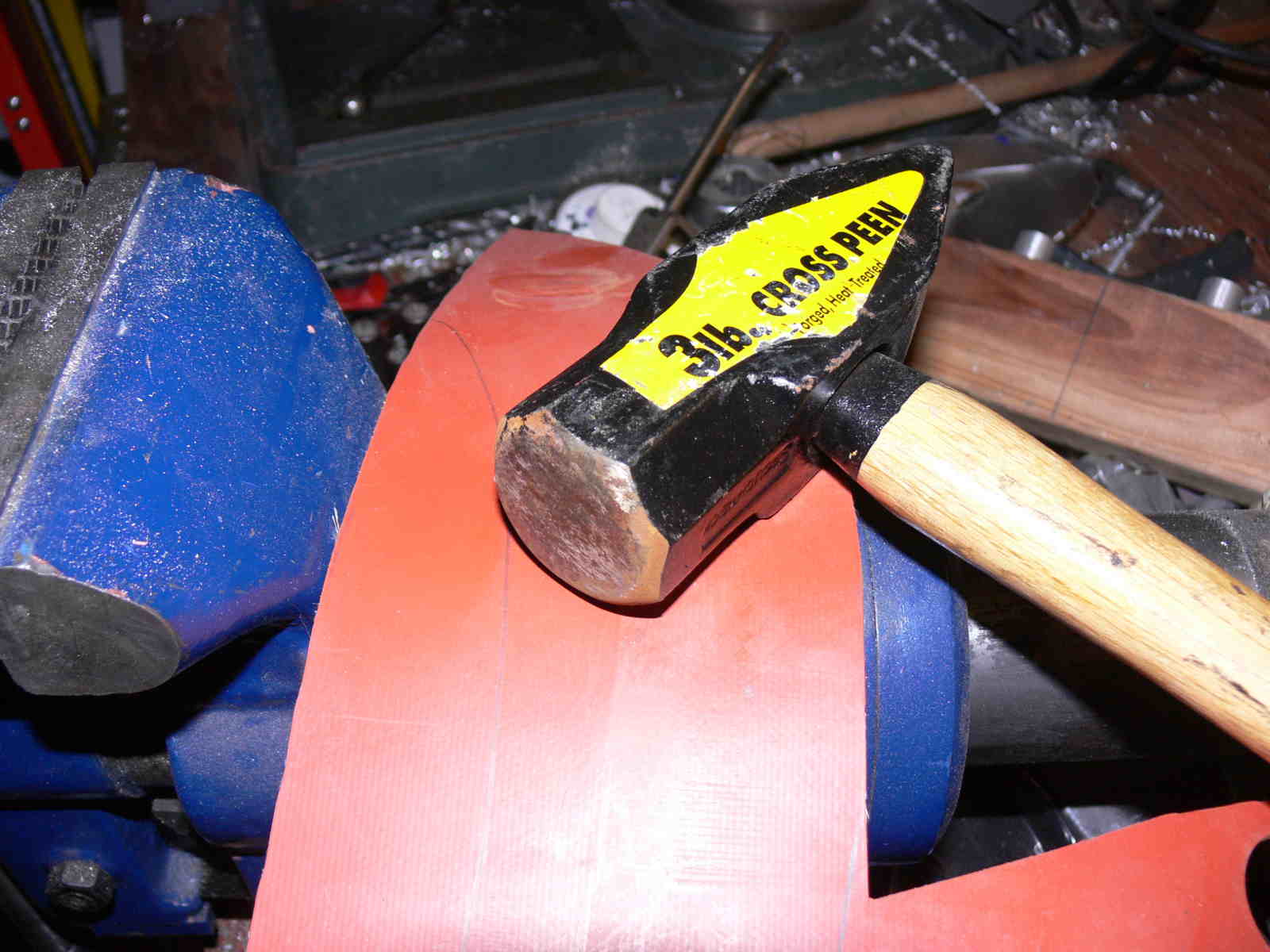
Here is another test Mark.
Get a 3 pound sledge and see if you can beat that silicone rubber into submission.
Paul Lamar
--
The Rotary Engine News Letter. Powered by Linux.
ACRE NL web site.
http://www.rotaryeng.net.
You Tube
http://tinyurl.com/beqqxas.
Copyright 1998-2013 All world wide rights reserved.