Paul,
What do you know about these?
What is Rotron Pressurised Cooling (RPC) system?
http://www.rotronuav.com/engines/rt-350rpc
This "patent" seems to be a variant or builds on the work of the
Norton-Garside cooler bur makes it a closed loop if you will.
http://www.enterprise-europe-network.ec.europa.eu/src/matching/templates/completerec.cfm?BBS_ID=176296&org=0&back=true&is_external=0&valid=0
( Details below the break-line)
These are on top of the other efforts ( Diamond ? ) etc are engaged in...
My best,
Anthony
The cooling fan requires HP reducing the net HP out.
Therefor the BSFC is around .52 rather than .47 in the oil cooled rotor
Mazda.
Notice they don't mention the HP required by the cooling fan in the
propaganda :)
From my book How to Cool Your Wankel
"However, for low-density fluids, such as gases, it is very easy to
expend as much mechanical energy in overcoming friction power as is
transferred as heat."
[What is being said here is HP is consumed by cooling drag. Since
cooling drag can be as high as 30% of over all drag the HP could be as
much as 30% of 200 HP or 60 HP. As you can see cooling drag becomes a
very important issue.]
"And it should be remembered that in most thermal power systems
mechanical energy is worth 4 to 10 times as much as its equivalent in heat."
[Here they are referring to the heat balance of most internal combustion
engines that only derive about 25% to 10% of the heat energy in a gallon
of fuel as mechanical HP.]
Paul Lamar
==================================================================
Description:
A UK SME has developed a “new generation” of Wankel type rotary engines
using a patented Self-Pressurised-Air Rotor Cooling System (SPARCS). It
has a wide range of applications including Unmanned Aerial Vehicles
(UAV’s), Automotive Range Extenders and portable generators.
Existing rotary engines available on the market typically utilise either
closed loop oil or forced air rotor cooling systems. Both of these
existing systems have advantages and disadvantages.
Closed loop Oil Cooling
Advantages:
• Lower oil consumption
• Cleaner engine operation
Disadvantages:
• High complexity of engine due to oil sealing requirements
• Lower efficiency due to increased friction losses
• Increased engine weight
Forced air cooling
Advantages:
• Simple engine design / low complexity
• Higher power
• Lower engine weight
Disadvantages:
• Higher oil consumption
• Wet oil lost, dirty engine operation
This novel rotary engine utilises the SPRACS rotor cooling system and is
designed to combine the advantages of both the forced air cooling and
closed loop oil cooling systems while reducing or completely eliminating
the disadvantages of both systems.
SPARCS:
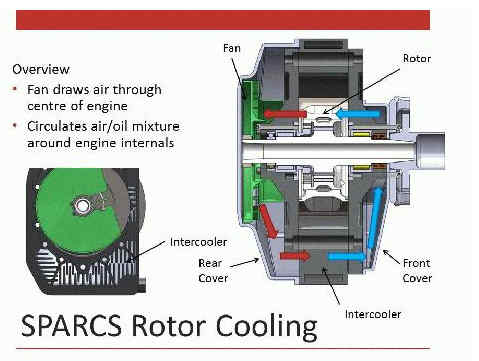
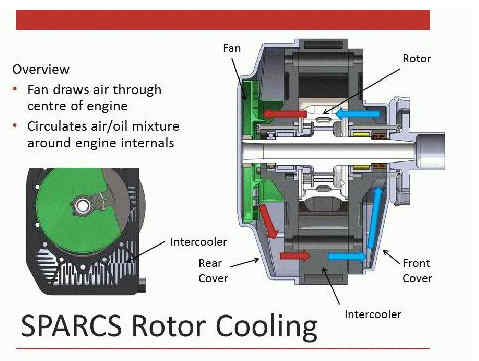
The SPARCS system utilises self pressurising blow by air and gases from
the combustion process which have escaped into the interior of the rotor
working chambers via the rotors side seals. This pressurised air gas
mixture is re-circulated in a completely closed circuit by means of a
main shaft driven internal fan impellor. As it recirculates the air gas
mixture passes through the engines rotor where it picks up heat before
then being ducted through an integrated heat exchanger within the
engines rotor housing. This intercooler rejects the heat into the
engines rotor housing and ultimately the engines main liquid cooling system.
The key to the system is that the higher density of the pressurised air
gas mixture enables higher levels heat removal from the engines rotor,
this system is far more effective than any previous ambient air cooled
systems even though the pressurised gases are at a much higher
temperature than those in an unpressurised ambient air.
Having the intercooler integrated within the rotor housing also has the
positive effect of heating the previously cold sections of the engine
(induction port area) thereby raising the temperature of the incoming
air and fuel mixture improving vaporisation and also helping balance the
temperature in the full 360 degree circumference of the rotor housing.
This improved temperature balance allows a more even axial thermal
expansion of the engine to take place which in turn improves gas sealing
at the axial ends of the apex seals, thus improving engine operational
efficiency and reducing the work load of the seals improving their
overall expected operational life.
As the SPARCS system is also totally sealed, oil loss to atmosphere is
completely eliminated and oil supplied to the engine core is constantly
recirculated lubricating all moving surfaces until eventually migrating
past the apex seals, lubricating them before being finally burnt in the
combustion process.
Because the oil in the engine core is re-circulated many times before
finally being burnt, overall oil consumption is lower than most oil
cooled rotary engine on the market and significantly better than any air
cooled rotary engine currently in production. There is also no
requirement for oil filters or an oil sump again reducing engine weight
and required maintenance.
The combination of better thermal control, improved gas sealing, clean
operation and reduced oil consumption in a simplified overall package
that is also lighter than any oil cooled rotary engines really does give
the SPARCS system the combined advantages of existing oil and air cooled
rotary engines, while greatly reducing or eliminating the disadvantages
found with both.
Innovations and advantages of the offer
SPARCS cooling system into their rotary engines has enabled a series of
engine designs that will offer:
- High performance
- Efficiency
- Clean to operate (no wet oil loss)
- Thermally stable
- Long-life
- Low maintenance
Current and Potential Domain of Application
Applications include automotive range extenders, portable power
generators, UAV propulsion units and aerospace APU’s
The Rotary Engine News Letter. Powered by Linux.
ACRE NL web site.
http://www.rotaryeng.net.
You Tube
http://tinyurl.com/beqqxas.
Copyright 1998-2013 All world wide rights reserved.