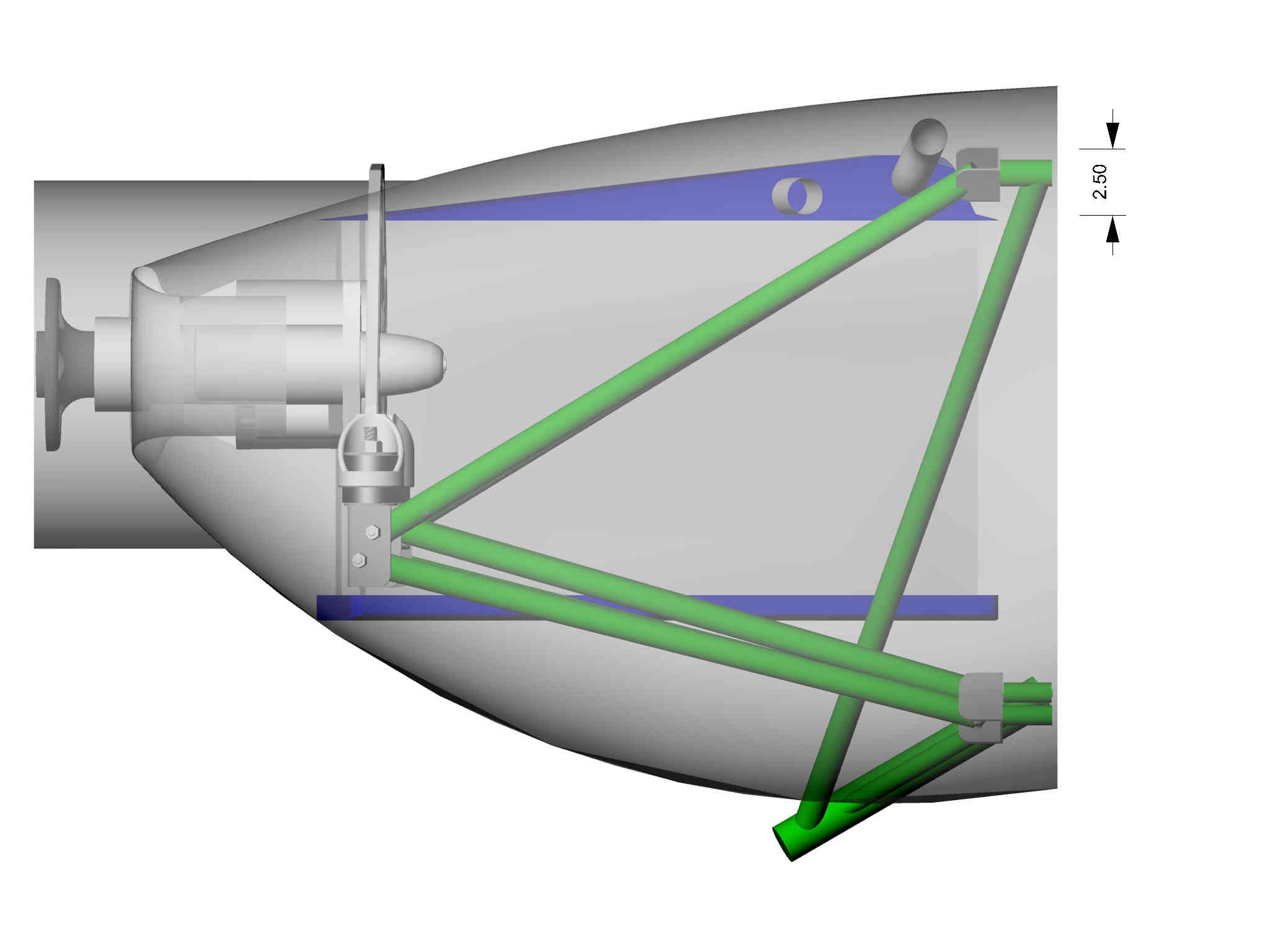
If we don't move the right side FW hard points inboard on Bruce's
AC the CCF rad will still fit. We might need a blister or two on the cowl
here and there.
It is hard to model the cowl accurately without a bunch
of cross section slices. If Tango Company has and old cowl lying
around they are willing to slice up and send me dwgs of
I will do a 3D dwg for them. That will give themn a starting
point.That way they can check the fit on different engine
installations. This cowl shape shown is just a guess.
I got two cross counter flow rads in the works.
It looks like no problem Tig welding them up. I have
done a bit of test welding already. Aluminum welds are
always configuration problematic.
For the people that don't have my book a cross counter flow rad is
a more effective heat exchanger configuration in therms of installation
volume consumed.
In plain English it is smaller for a given cooling :)
Paul Lamar
--
Paul it looks great!
I will check with tango for an old cowl to slice and model up.
As an option, for the top RH firewall mount vs fitting in the CCF rad, i
spoke with tango about welding a tube across between the 2 top mounts if
necessary at a later stage, and adding an extra firewall spacer about 2
inches inboard of the top RH one along that tube. If we attach the RH
top adjustable mount arm there it gives us space to model our diffuser
and the rad fits with space to spare. When I originally mocked up the
neon rad size with plywood it just fit under the cowl. Not sure how
thick the CCF rad will turn out.
If the cowl moves back 1" with 1" firewall spacers instead of 2" then a
blister is the easist way to go as you suggested. I have to put a
blister anyway for my intake plenum,
Alex
OK Alex that sounds like a plan. Across the tanks top and bottom will be
5 inches.
Across just the cores it is 3 inches.
It would be nice if Tango did not drill the hard points and the core of
the firewall was
3/8 to 1/2 inch thick ply. That would allow hard point almost anywhere.
-------------------------------------
For example if we moved the upper right (pilot"s view) hard point over
2.0 inches and down 2.5 inches it would make my life easier on the CCF
rad :)
One can always bond on a 1/4 inch thick plywood and cover it with
carbon fiber to thickened up the firewall.
One could even thicken up just the upper right corner of the firewall
alone. A steel tube from hard point to hard point really does nothing
for you. The forces go into the firewall and then into the fuse skin.
That is called the "load path" in mech eng speak :) Thats what we need
to keep in mind.
I am still fooling around with different ideas on the water necks
but there are limited options.
-----------------------------------------------------------
This appears to be the best water neck configuration.
I might be able to get the width (thickness) of the CCF rad down to 4.5
inches.
We might wind up with a small blister on the upper right outside of the
cowl.
Paul Lamar