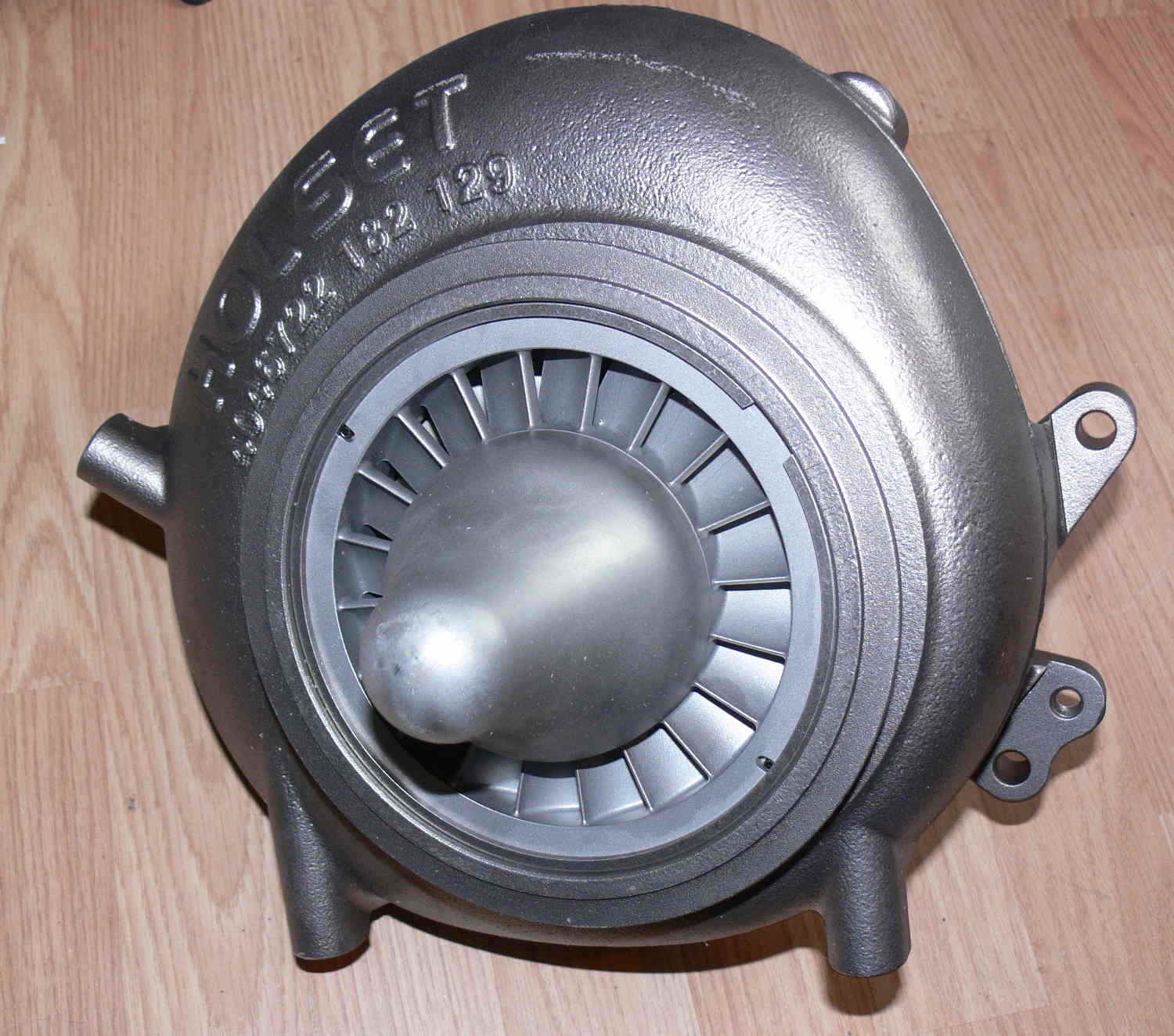
Hopefully I won't need a monster muffler.
Paul Lamar
What will be the affect on efficiency of the long pipe between the
engine and the turbine?
Cooler exhaust=denser gas, but cooler exhaust=lower velocity.
My gut-feeling is that closer is better ... ??????
If my guess is correct, I guess one could turn the turbine around and
come up with a more complex drive-train. But I suppose max-efficiency is
really beyond the goals of your experiment at this stage, huh?
RBerglund
Here is the effect of the gas temperature on the TC HP recovered.
From a SAE paper on TC published in 1945 by C.F. Bachle
"Turbo Compounding the Piston Engine".
On the other hand cooler temps are easier on the turbine blades.
Paul Lamar
OK ... If I read the graph correctly... and if I remember my physics
correctly ... Work is calculated as the integral of P x dv ( ie the
area beneath the curve on the pressure vs volume graph) so obviously
there is more area beneath the high-temp curve than beneath the low-temp
curve. But the curves for various operating temps are fairly close
together, and even with one-thousand degrees of cooling there is a
surprising amount of energy remaining in the exhaust gas.
Take all you can get! :)
RBerglund
The trouble is turbine strength is a steep slope :). Just like exhaust
valves.
Where temperature and centrifugal force converge failure occurs.
I think the limit in commercial jet engines is 1300 F long term.
Maybe military jets use unobtanium :)
Paul Lamar
Looking at that bellows section just before the turbine, it seems like
you're picking up some cooling as the exhaust expands into the larger
diameter turbine inlet. Given that the bellows is probably inducing a
little bit of drag anyway, I wonder whether it would buy you anything to
eliminate the bellows and turn that section into a short expansion
chamber (with the decrease in turbulence compensating for some of the
cooling loss), depending on what the exhaust temperature is at that
point. I can't tell whether you have a means of picking up the turbine
inlet temperature. Of course, if it's cool enough, it's not an issue.
You're probably eating, sleeping and breathing this thing right now, so
maybe you've considered all of this stuff already.
Dave Klingler
It has a smooth, smaller diameter liner that is only attached at the
input end. I am sure DD considered the heat transfer carefully.
That DD part cost over $100.
Paul Lamar