http://www.youtube.com/watch?v=m3pCLjHZmhM&feature=em-subs_digest-vrecs
Don’t think I buy this story, but was somewhat interesting
Jim M
Yeah I saw that Jim. Easy to check the slot . The problem with the
slot theory is there is no pressure difference across the lower spark
plug hole so in theory there will be no gas flow.
Wind blows from high pressure to low pressure in the atmosphere. No
pressure difference no wind.
The off set in the combustion chamber has been tried with little
apparent improvement.
http://www.rotaryeng.net/side-exhaust-port.pdf
BTW Mark's EFIS failed so he can't test the 3 rotor coupling until he
gets that fixed. I am thinking of welding up another one and sending
it to you. I have your spline plate.
Paul Lamar
More info on the rotor recess position.
From 1981 Yamamoto book.
Paul Lamar
Thank you for the interesting conversation. Regarding the
'Rotary Engine Breakthrough' video, as I wrote in YouTube, if
it's true that this arrangement decreases exhaust gas
temperatures by 60%, this would mean a higher effective
Compression Ratio, the very low CR ICEs of the first days were
those having the highest Exhaust Gas Temperatures, damaging
poppet valves, and also changing valves into 'glow plugs',
inducing severe detonation.
The article by Reiner Nikulski in 'Wankel News', with the title
''Glückendes Rohr' -Glowing tube- points that at full throttle,
high rpm, the Sachs Wankel KC-27 engine has lower exhaust gas
temperatures than at middle speed, part-load, meaning a higher
MEP or higher Effective Compression Ratio at higher rpm, and so,
the rationale of the inventor of the slot-like plug hole looks
sound.
I attach the R. Nikulski article in its Spanish translation, I
haven't had the time to put it in English yet, but as it's in MS
Word, probably any web translator would change it into something
more easy to read for many Americans, I send the article before,
I guess, but if redundant, it's easy to delete.
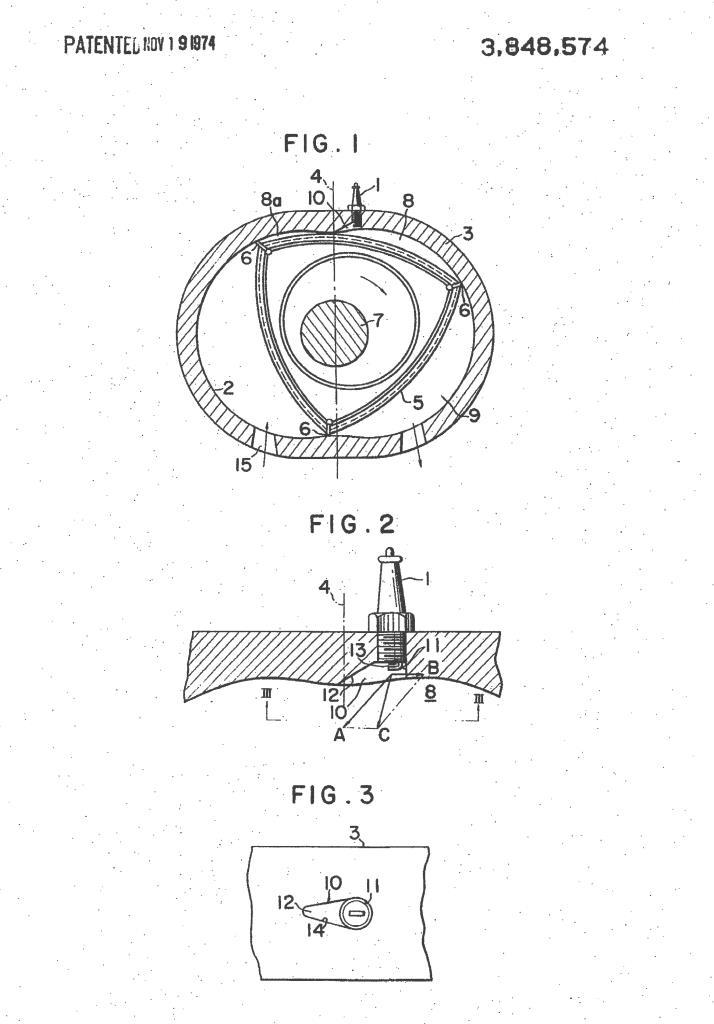
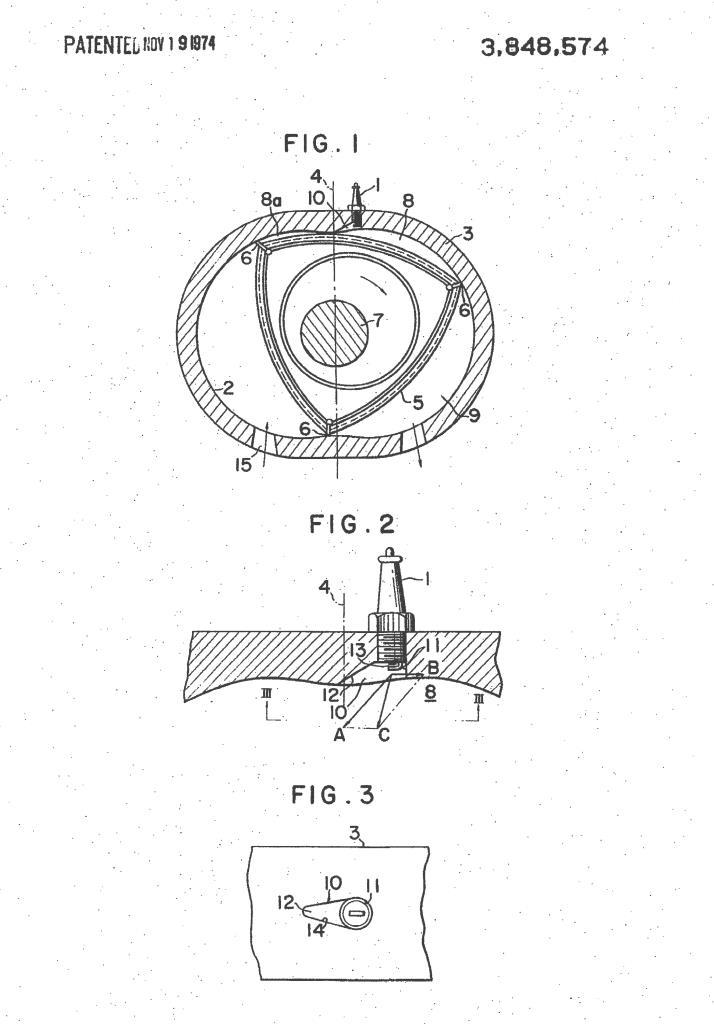
The idea came into my mind of changing this slot hole from a
band shape to an inverted 'T' shape, the vertical part of the
'T' pointing towards the trailing side of combustion chamber, as
in the Kawasaki patent of which I attach an image.
Does anybody know somebody willing to consider and issue a
budget for making this change in the spark plug hole of two used
13B NA, 1987 housings, with the surface in poor condition that
may deserve a new plating, changing the hole from a round shape
to the inverted 'T', and also taking care of the housing's
internal surface, if possible?
I was told by Kevin Landers, a very kind RCE repair man,
(Rotaryresurrection.com) that if you round the intersections of
ports and plug holes with the trochoid surface, from an angle to
something softer, you reduce impacts of seals in the hole
borders, thus increasing the overall life of both seals and
housings; once you've opened the engine, streamlining ports and
plug holes / trochoid intersections and ducts may be just a
little time of grinding, or grounding, I'm never sure about
which is the right word.
Thanks, Salut †
Jose Gros-Aymerich
E-28033 Madrid, Spain
The Rotary Engine News Letter. Powered by Linux.
ACRE NL web site.
http://www.rotaryeng.net
You Tube
http://tinyurl.com/beqqxas
Copyright 1998-2013 All world wide rights reserved.