I have not heard any bad things about RX8 tension bolts so far
but it might be a good idea if you have an RX8 engine to remove
the bolts one at a time and coat them with silicone rubber.
Then replace them after you accomplish that for each one.
Do this one at a time so you don't affect the stock sealing between
end housings and rotor housings.
13b engine tension bolts would vibrate and fatigue if you ran
the engine at high power at a fixed RPM.
One step up from this was to replace all the stock 10 mm (.394") bolts
with half inch bolts. It take a special drill jig to drill out the
end housings. Mazdatrix has such a drill jig.
The latest trick, with custom aluminum end housing, is use a long
steel rod threaded on both ends and use nuts on both ends.
This removes the bending loads due to vibration on the threaded portion
of the tension bolts screwed into the front end housing.
If you want your engine to last more than 15 years install Iannetti
ceramic
apex seals. Projected life for the ceramic apex seals is then 20,000
hours.
Not 2,000 hours.....20,000 hours!
However I have no idea how long the side seals would last.
My suggestion is use Mobil 1 fully synthetic oil in the sump.
I have years of experience with this oil in my street cars and
the engines last over 300,000 miles while a lot of
the stuff on the engine failed and had to be replaced.
Of course mix 2 cycle oil with the fuel to lube the seals.
Paul Lamar
Paul,
I do agree with the silicone trick, this was done on Norton's to very
good effect, a good blob of medium to low modulus silicone near the
centre area of the engine raised the failure events to 20,000 miles of
high speed work, we did have a resonance at around 7000 rpm and if the
bike was worked in a zone close to this a engine stud would let go
within around 200 miles, failures tended to be on the overrun or just
commencing of.
Bob
That is interesting. I did not the Norton suffered from the same
problem.
When we go up to a half inch several good things happen. The resonant
frequency goes way up and the bolts are a slip fit in rotor housings
absolutely
stopping them from vibrating. They also act as 17 locating dowels.
Late 280 HP turbo 3rd gen 13B's cracked the rear housings around the
upper dowel pins until Mazda beefed that area up.
The torque from the front rotor was twisting the entire engine.
They are also stiffer in tension helping the housing to housing sealing
in theory.
Paul Lamar
A heavier bolt, thicker bolt ? Would not the resonant frequency
go DOWN ? Virg
Maybe I was wrong about that. Low notes on string instruments
are thicker are they not? I am no musician.
Paul Lamar
Yes. GM had a problem with the generator brackets breaking. the
fix was a thicker bracket. NO FIX. The problem was the frequency
was lowered and the bracket broke sooner. A thinner bracket raised
the resonant frequency out of the engine range. No more breaking.
Heard this from Gene Abbey, GM Engineer,
Virg
Was it a round bar?
The devil is in the details. Just making it heavier is not enough.
One needs to know the design. Do you have a dwg?
The extra weight must be used to increase the stiffness.
As I recall low note strings on musical instruments are wound with
smaller wire that adds weight but not bending stiffness.
The bending stiffness of a rod goes up with the fourth power of
the radius while the weight only goes up with the square.
Paul Lamar
No, It was the bracket that adjusted the belt tension for the Generator.
By the way, Gene worked in the Pontiac Division,
Virg
Without DWGs no telling what happened.
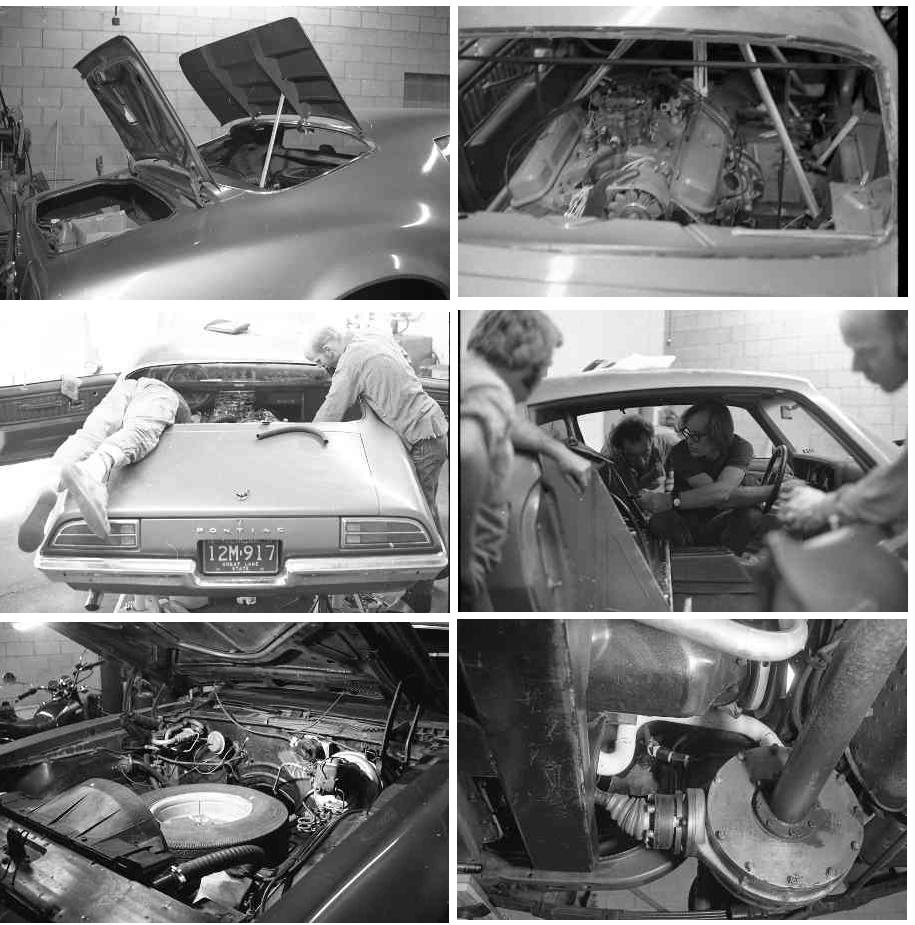
Did Gene see my mid engine Firebird I built for Pontiac back in the
early 70's? :)
http://www.rotaryeng.net/Mid-engine-Firebird.pdf
Paul Lamar
The Rotary Engine News Letter. Powered by Linux.
ACRE NL web site.
http://www.rotaryeng.net
You Tube
http://tinyurl.com/beqqxas
Copyright 1998-2013 All world wide rights reserved.