Paul,
If memory serves me, and sometimes it doesn't, I remember seeing someone
took a Cessna and replaced the engine with a Mazda rotary. They then
registered it as experimental.
Do you, or anyone have info on this?
Regards,
Norm Parmley
The FAA frowns on that big time. Only if you plan on getting an STC
and first you have to certify the engine. That means you make all the
parts and you have a paper trail from the iron mine to the air.
NASA did it but that was NASA.
You can make a fiberglass mold of a Cessna fuse and use Cessna wings and
tail.
That is OK. It is then a experimental aircraft.
Paul Lamar
I'll have to disagree with you Paul. The FAA will not certify an
airplane assembled from spare parts as an experimental armature built.
Time was when that would work, but no more. Even if the wing is toast
and you totally rebuild it they still will not buy it.
Mark LaPierre
Not spare parts from the same airplane. Parts from different
airplanes. If that
were not true you would not be able to use some of the parts found
on some certified
airplanes.
Lets take a Bellanca Viking for example. Lets assume the wood wing
is shot. If you make a new wing out of carbon fiber then it becomes
an experimental airplane. Arguably you have built 50% of the new
experimental airplane.
Lots of people have built experimental airplanes using wings from
certified airplanes. Quite common in the cub world.
Only 50% of the airplane needs to be built by you.
Paul Lamar
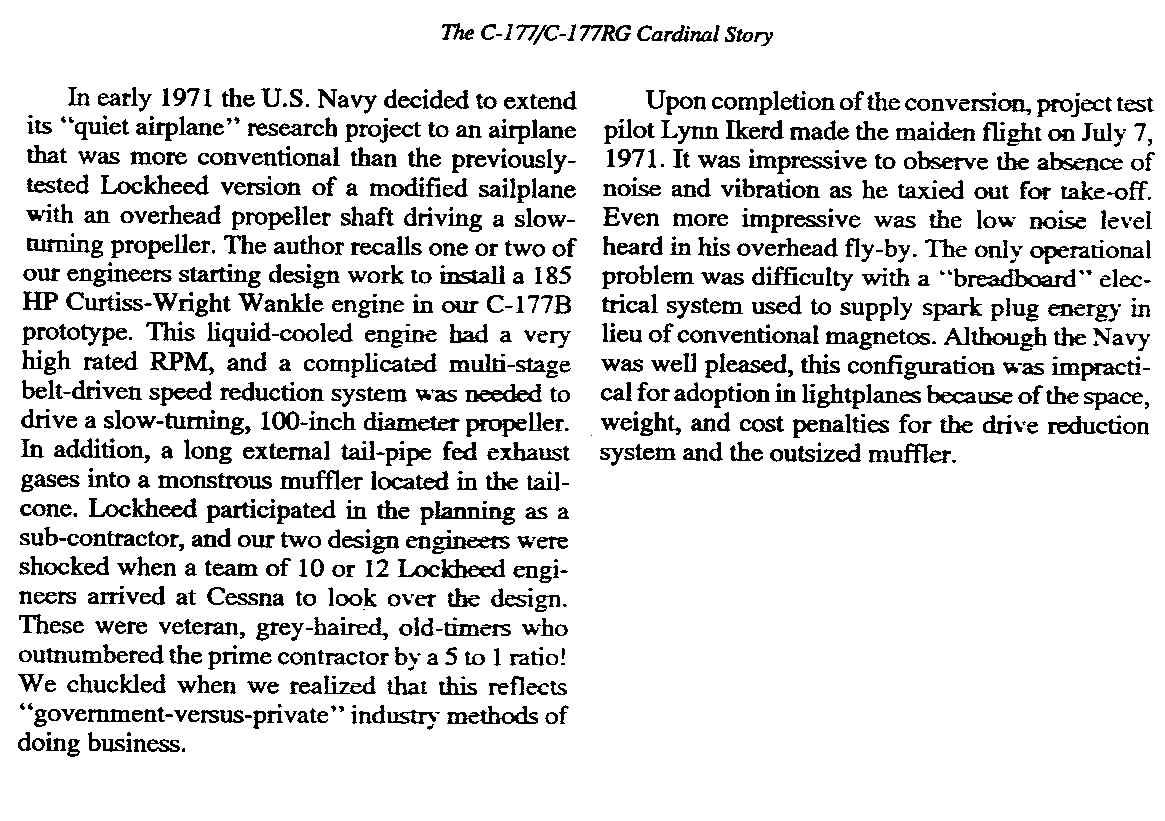
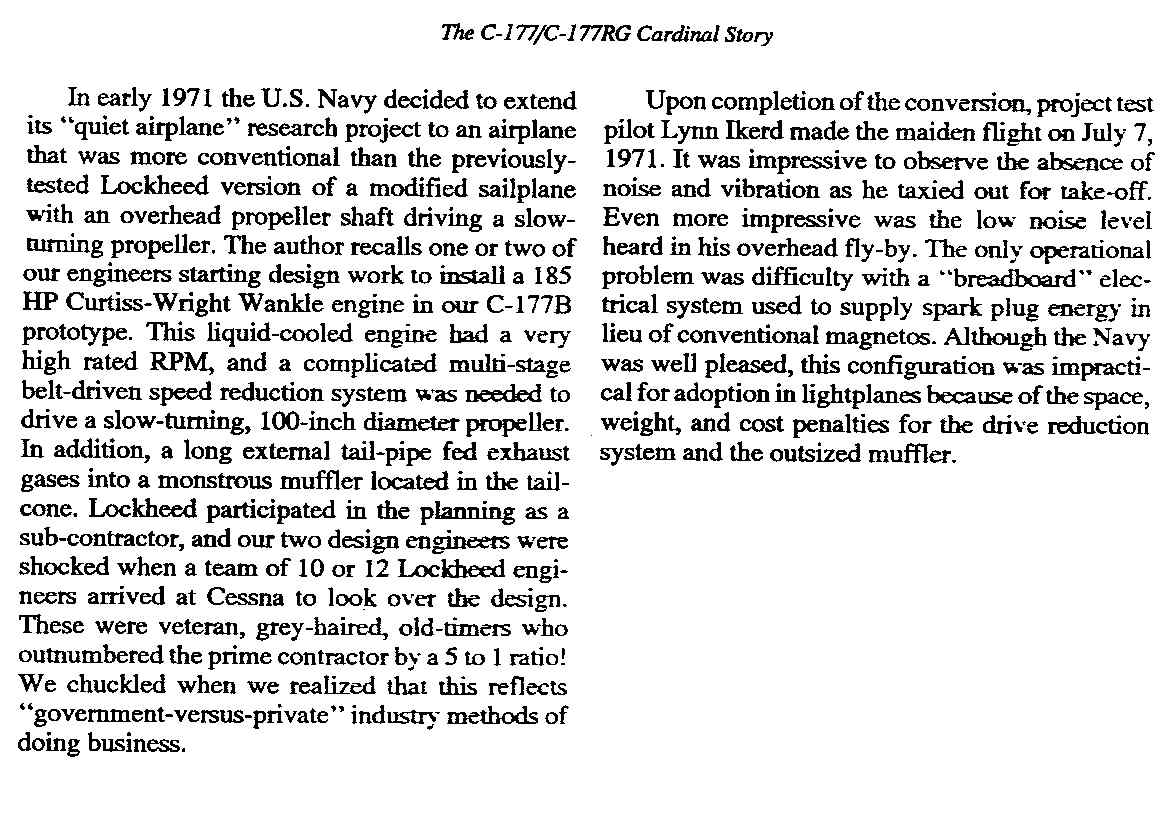
Cessna put a rotary engine on a Cardinal decades ago. I have
pictures of it.
They also put forward swept wings on a Cardinal.......but that was
Cessna, not any individuals.
Marc
Well send me the damn pictures :)
Yes aviation corporations can get away with stuff like that.
Paul Lamar
Paul,
Seems I have lost my old digital pics of them, but do have printed
copies of some stuff.
I paraphrase from "Wings of Cessna, Model 120 to the Citation III, by
Edward H. Phillips", page 63. The book is copyrighted 1991.
The engine (or a picture of it) was at one time under the stairs at the
Udvar-Hazy Dulles Smithsonian display? I think you have that pic
already? The Wankel engine display indicates that a Wankel RC2-60 was
first flown in a 1970 Cardinal (not sure this is accurate, or just a
picture of a Cardinal for illustration purposes!). Along with the engine
and description there was a picture of an RG, tail number N7600V. It
does not appear that the N7600V information is accurate from research.
The original Cardinal Wankel test bed was [N3766C (sn661)]?] reported to
be in the C-177B prototype (not an RG). The 185 hp (?) Curtiss-Wright
engine was installed under a Navy contract for `quiet airplane` research
(??? Secret or noise quiet-funny about that?) and had an extensive
muffler system. A multi-V belt reduction system drove a slow turning 3
blade 100 inch diameter propeller. Lockheed was a subcontractor. (N3766C
is now a Beach aircraft....)
"I was at Cessna as a Design Engineer 210 B, 205, 206 (1960-1963) and
Flight Test Engineer 300 and 400 series Twins (1966-1968). Cessna
typically flew 500 hour accelerated service tests on new models,
generally using the Certification prototypes for single engine and 1st
production models for twins. I was able to log a total of over 80 hours
of service test time on 6 different Cessna models, including 17 hours on
Cardinal N3766C. First flight of N3766C with the CW Wankel was on 7-7-71
with Len Ikerd as test pilot." Quote from Edward H. Phillips. It was
reported to have very little vibration and a low noise level on fly-bys. (!)
"Cessna`s normal practice for liability reasons was to scrap test
aircraft after they had served their useful purpose, so I think that I
can safely say that N3766C is long gone."
Other `quiet aircraft` efforts back in that era led to the production
Y03 powered sailplane that was used in Vietnam.
http://en.wikipedia.org/wiki/Lockheed_YO-3
The highly modified wing for the Cardinal was done by the aerodynamics
research dept at University of Kansas.
" At one time the Department of Aerospace Engineering proposed to build
a light aircraft wing that was about a third smaller than the original,
equip it with double-slotted flaps with a lot of `Fowler` or extension
and leading edge devices. They lobbied to obtain a 210 but could only
get the `68 177 prototype from Cessna. The University of Kansas, fearful
that someone would crash the thing, had it recycled years ago. In the
meantime it sat out in various states of disassembly at KLWC (Lawrence,
Kansas)."
I can send you that article if you are interested as well.
I will try to find the 'quiet' Wankel Cardinal pictures somewhere.
Marc W.
Did you get this picture of the Wankel powered Cardinal I sent out
previously? Note those exhaust pipes.....too bad they didn't use a
planetary redrive.
Marc
The Rotary Engine News Letter. Powered by Linux.
ACRE NL web site.
http://www.rotaryeng.net
You Tube
http://tinyurl.com/beqqxas
Copyright 1998-2013 All world wide rights reserved.