There are several CD ignition options for a 2 rotor.. In order of
redundancy and cost.
1.One power supply, two CD modules, two waist spark coils. Lowest
cost. 2.Two power supplies, two CD modules, two waist spark coils.
3.Two power supplies, four CD modules, four simple spark coils.
4.Four power supplies, four CD modules, four simple spark coils.
Highest cost.
Paul Lamar
I noticed that the specs for the demo circuit say that 1 sec is
required
to charge at 8V. Even the 400 ms at 40V seems a little long. How
do you
deal with that?
Gary Knutson
Very astute question. Good thinking Gary.
That is an on board 400 uF capacitor so it takes awhile to charge.
However once it is charged it can dump into the 1 uF CD cap rather more
quickly
I expect. One of the things I want to test.
Paul Lamar
I was hoping there was a solution. I will be watching for your
continuing
tests.
I have been closely following the "CD" thread as I think your efforts
could produce a big advance in aircraft engine ignitions. I may have a
requirement for a system for another engine (non-rotary).
Gary Knutson
CD ignition module PC board tested.
The movie show the plugs sparking with the waist spark coil.
There is a 2.5K resister in series with the 500 Volt supply so it
takes about 5 ms to charge the 1 uF cap. A smaller resister would
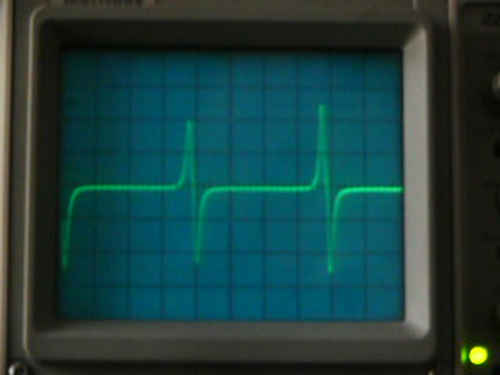
charge the cap faster. The scope wave form period is about 10
or 12 ms so this is 5000 to 6000 RPM. A slightly smaller resister
would be needed for 7500 RPM.
There is room on the PC board and the required circuitry is there for a
second 1 uF cap which in theory would double the spark energy.
This was tested with the 110 volt wall powered HV supply.
I will test it again shortly as soon as the 12 Volt HV supply arrives.
Paul Lamar
The ignition is looking better by the day. My (maybe) application would
require a max rpm of around 5600, so that certainly looks feasable. It
will be interesting to see how the 12 Vto 300 V supply works out.
Gary Knutson
That's a nice looking piece! I realize this isn't your only project but
/home/paul/Desktop/2people-9-24-2013/AA-Mike-Wills-RV4/best-engine-shots/DSCN0089
(Small).JPG.jpg
I'm looking forward to the next test. I would guess it won't really
change anything.
Sometime I would like to get your thoughts on a eight cylinder, twin plug
system as to what should be duplicated for redundancy. Cost won't be the
biggest factor.
Is the TC engine getting close to running?
Gary Knutson
I'll know in a few hours. I am getting ready to test it. The biggest
part is the 400 uF high voltage cap.
I just bought 5 quarts of Mobil 1 for the TC engine. I am thinking I
need to put some
auto transmission fluid in it to free up the apex seals. It probably
hasn't run in 20
years but it has some compression. I'll run it soon. The oil pressure gage
was a hang up. I don't want to run it with out some assurance it
actually has oil pressure :)
You only need twin plugs if the piston engine bore is greater than 5
inches.
Short stroke big bore is all the rage now a days. You can run it faster
and it breathes better for a given displacement. Formula 1 engines are
like
that. The current wheel driven land speed record engines is like that.
--------------------------------------------------------------
I got the 12 volt input 300 volt output supply working and I am about
to receive the PCBs. Been working real hard for the last couple of weeks
on this.
The multi-strike dual MOSFET version of the ignition module is working
on the bench.
but It needs a bit more development. I estimate the PCB design will be
done in a
day or two.
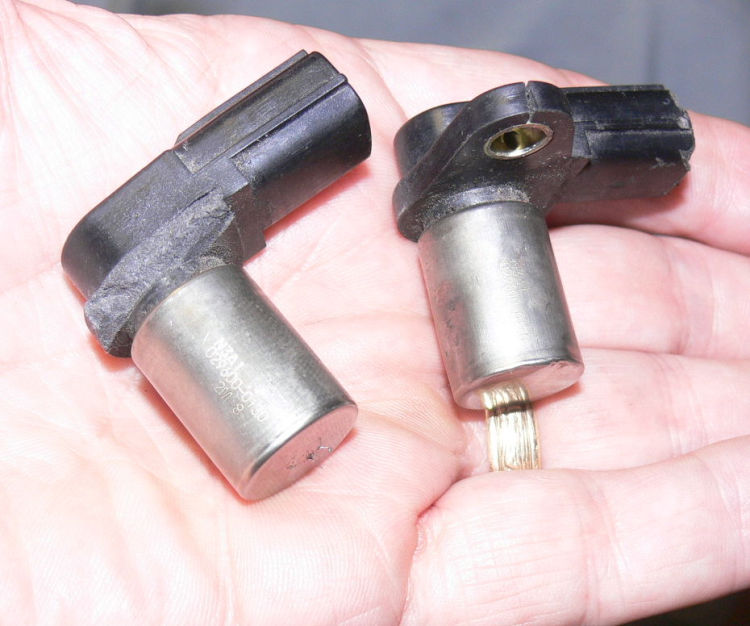
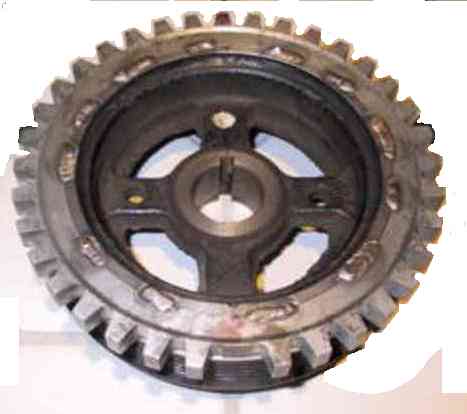
For a two rotor it will require two $16 ABS sensors and this trigger
wheel made from
a $22 chain sprocket. It fires 2 sparks close together 8 times over a
180 degree rotation
of the e-shaft. About every 22.5 degrees. 16 sparks total.
This will work to 7500 RPM unlike the MSD that stops multi strike at
4500 RPM.
This same spark spacing happens through out the RPM range.
Hopefully this will burn the raw hydrocarbons lurking on the back side
of the
flame front and improve the power and BSFC.
Paul Lamar
Paul,
Those ABS sensors look just like the ones used in the rear diff of ABS
equipped Mazda MPV's! I was literally thinking that they might be a good
idea for this CD ignition you've been working, LOL! Bingo!
-Dan
--
They work the same and are just as good as the Mazda crank Angle sensors
that sell for $100.
Paul Lamar
The Rotary Engine News Letter. Powered by Linux.
ACRE NL web site.
http://www.rotaryeng.net
You Tube
http://tinyurl.com/beqqxas
Copyright 1998-2013 All world wide rights reserved.