Paul
My friend Fred who building the twin with me forgot to lower his
landing gear on his Velocity XLRG during a precotional landing
practice in Pahookee Fl 3 months ago ,and try to overshoot but he was
to close of the runway and the prop hit the runway surface and the
lower part of the firewall and still flying to the grass on the left
side and hit so hard the fuselage was a complete scrap.
Fred as been to the hospital with his instructor for over a month and
he had spine injury, he is walking now with a body scan and he does
lot of therapy every day .
Fred is recuperating very well
I check for wings and their seems fixable if the spar is not broken
which I have the feeling it still in good shape, the strake fuel cell
still good and canard is fixable and I will need less surface.
I changed my design and we will reuse as much as we can from the
Velocity for the twin construction plus the wing will be extended 24"
each side and adding flaps and slats.
I did a schematic wiring diagram as we will add to the gear system to
prevent the same mistake.
I am at the stage of extending my garage of 25ft plus an outside
concrete slab 12'by 35' and should be completed in a few months.
I will start the twin construction after then.
I am following all your developments on the rotary every day.
JEAN PRUDHOMME
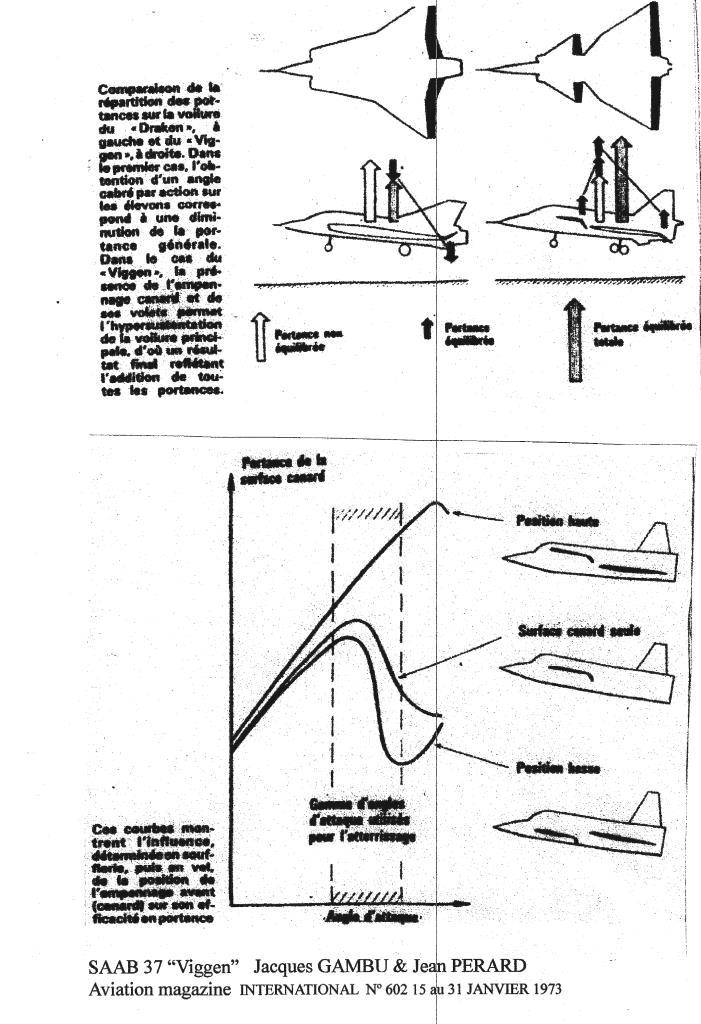
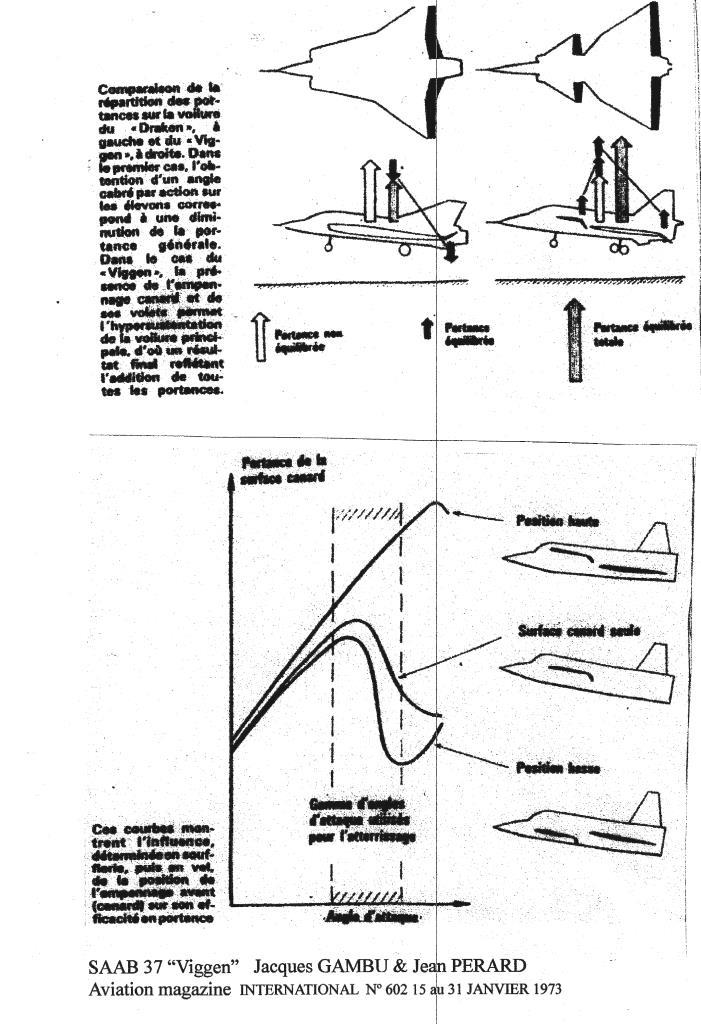
Bonjour: The Swedish put the canard foreplane in their Viggen
above the level of main wing, the same applies
for the French Rafale and the Eurofighter, and to the new Saab
Grippen, I have no idea about how many
airplanes with a canard surface have the foreplane in the same level
or below the level of the main wing;
according to the attached images from the French 'Aviation
Magazine', better results are obtained if the
Canard plane is above the main wing plane.
I guess also that an arrangement as in the Curtiss P-55 Ascender,
with the foreplane
angle of attack having the possibility of changing from 0º to +/-
90º, and the foreplane including also elevons,
may help theoretically avoiding the accident of a 'Velocity' canard
airplane described in 'Flying', Oct 2012,
page 36, when a blade of the pusher propeller broke, and the pilot
pulled the stick instead of what he should
have done, pushing it to have the plane diving and gaining airspeed.
As discussed, there's a quite detailed article about basic
calculations in canards: 'Canards, design with care',
by Robert Burns, in the magazine 'Flight', around February 1981
or 1982, back issues are of free download
in the 'Flight' website.
If the foreplane has a sufficient negative dihedral, as in the
Rafale, Grippen and Eurofigher cited, the induced
rolling would be in the right direction when the 'A' shaped canard
acts as rudder.
Hope you like this. Have a good week. Best regards. Salut †
Jose Gros-Aymerich
Madrid, Spain
The Rotary Engine News Letter. Powered by Linux.
ACRE NL web site.
http://www.rotaryeng.net.
You Tube
http://tinyurl.com/beqqxas.
Copyright 1998-2013 All world wide rights reserved.