Hi Phill,
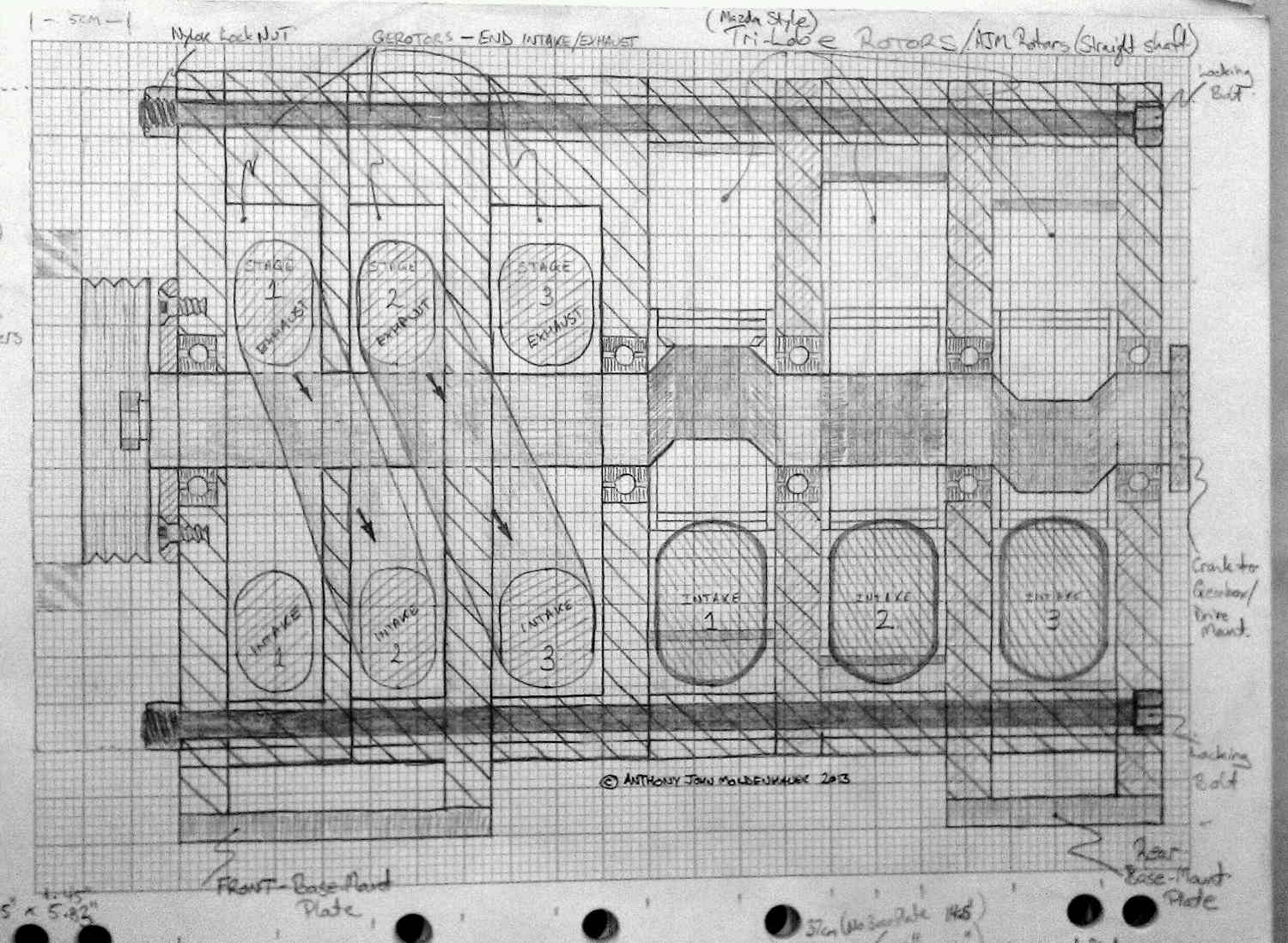
The first part of my drawings is as follows:
Looking from left to right:
Main accessories pulley to drive power steering pump(car or plane) and
alternator, or other accessories..
Multiple Gerotors for accepting the engine exhaust (air) and
compressing it through 2 or more stages ( at a ratio of around 5 or 6:1
) for return to the main supply tank(s) - here the Gerotors, like a
typical oil pump, are used to compress the exhaust air, as this system
uses no other fuel than air, both from the tanks ( Type IV wrapped such
as CNG ) as well as the air that is drawn in through the first of two
turbos/supercharges
Next, the three rotors on the right hand side of the drawing are your
typical Mazda style Rotary engine, and can be single or multiple rotors
dependent on the application
What is not shown are the natural oil ways, and the engines normal oil
pump. Also not shown in this drawing are the high speed air valves that
replace the typical single or dual spark plug ports on Rotary engines.
Using a fully customisable ECU such as a Haltech or Motec, the valves
are timed to allow a certain amount of compressed air (approximately 3
times the typical cylinder compression) into the cylinder at the same
time when combustion from the spark ignition would happen, typically
forcing the rotor to continue on to the exhaust cycle and generating its
power.
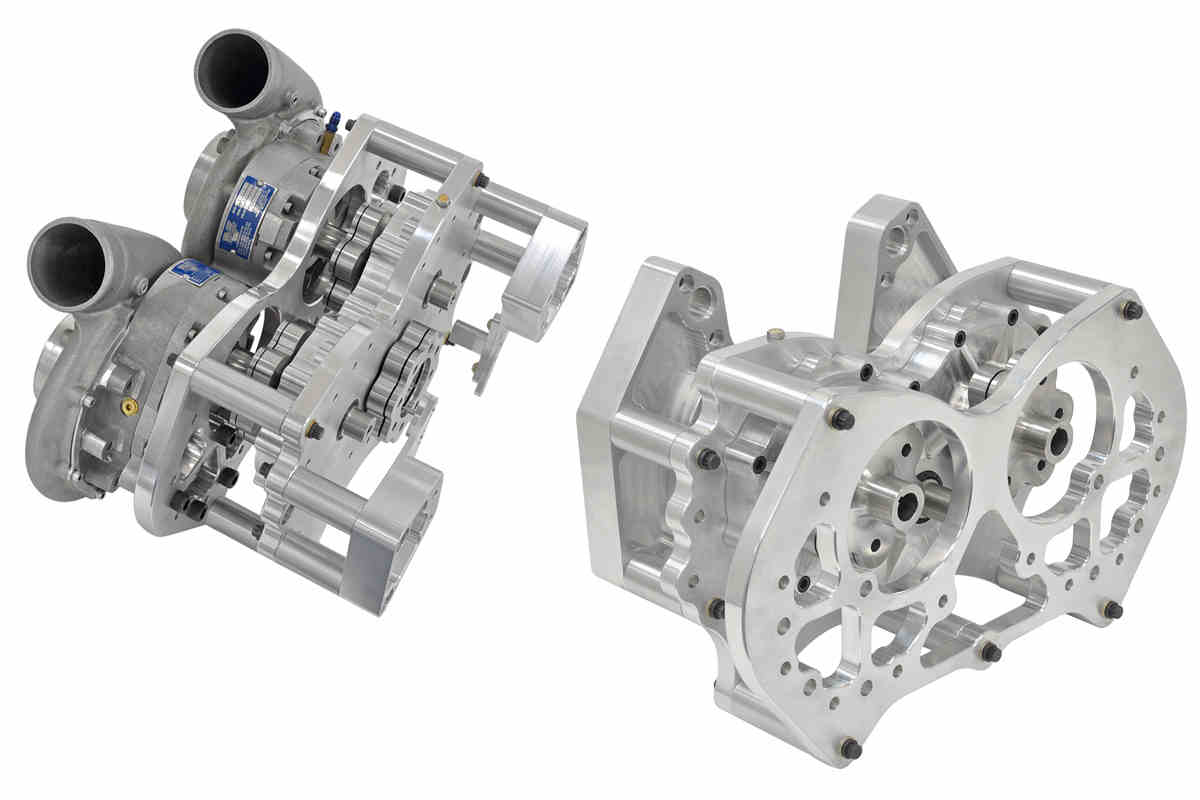
Dependent upon the power output of the engine, one of two forced
induction methods would be used, either 2 centrifugal superchargers such
as Vortech, Rotrex or Paxton or two IHI, Garrett or Blouch turbocharges
will be arranged in a compound setup to maximise the amount of boost,
anywhere up to and over 100psi, purely dependent on what the engine is
able to handle.
One aspect of this design is the cool running of the engine which,
utilising compresed air, eliminates any form of detonation/pre-ignition
which can be found in internal combustion engines.
The use of compressed air, when initially released holds its maximum
potential for work, and as such, the initial take-off/driving off from
idle, should have far less lag than a fuel-based engine.
Just my thoughts so far, and certainly all feedback is appreciated.
Kind Regards,
Anthony Moldenhauer
The Rotary Engine News Letter. Powered by Linux.
ACRE NL web site.
http://www.rotaryeng.net.
You Tube
http://tinyurl.com/beqqxas.
Copyright 1998-2013 All world wide rights reserved.