One of the pieces of info you need for an EFI is the RPM
of the engine. The required fuel flow is a function of the RPM,
the manifold pressure and the intake air temperature.
The usual way is to use a timer in the computer chip to
determine the time between a CAS signal and the next CAS signal.
CAS stands for Crank Angle Sensor. You have to invert that to get
the RPM. Another way is feed the CAS pulse into a counter in the
computer and
read and reset the counter in a known time period. That usually
requires
a real time clock hardware interrupt.
That is tricky to write the software to do that.
It is easier to convert the tach signal to a voltage and feed
that into an analog to digital channel. This takes way less computer
time and number of instructions. A simple read of the analog channel
and you have the RPM.
You also need to detect the magnetic CAS sensor signal with a zero
crossing
circuit. Fortunately there is a low cost chip to do both.
It is called the LM1518. It puts out a nice 100 usec wide
pulse controlled by a resister capacitor combination on pin 14.
Two jobs with one part.
Here is the simple schematic. The amount of charge (voltage) on
the capacitor is proportional to RPM as it is being fed a fixed
width pulse. The capacitor value controls the build up rate
of the voltage. I'll let you know what that is after I run
some test. Maximum analog voltage for the ARM BASIC chip is 3.3Volts.
Use a zener across the cap to make sure it never exceeds this value.
Paul Lamar
For a trigger wheel, you should be able to use a bicycle sprocket.
Lots of junk ones around.
Just look for the tooth count you want. One advantage is they are
light compared to some
automotive parts.
Dale Davies
I checked them out already. They are too thin to form a good
electrical signal and they cost more.
Paul Lamar
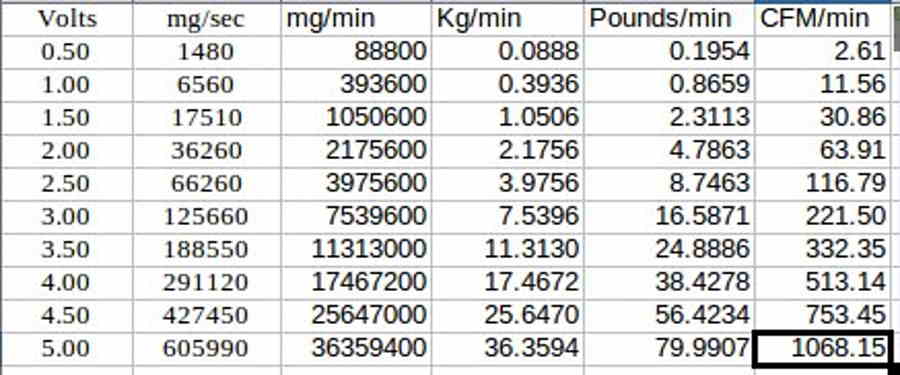
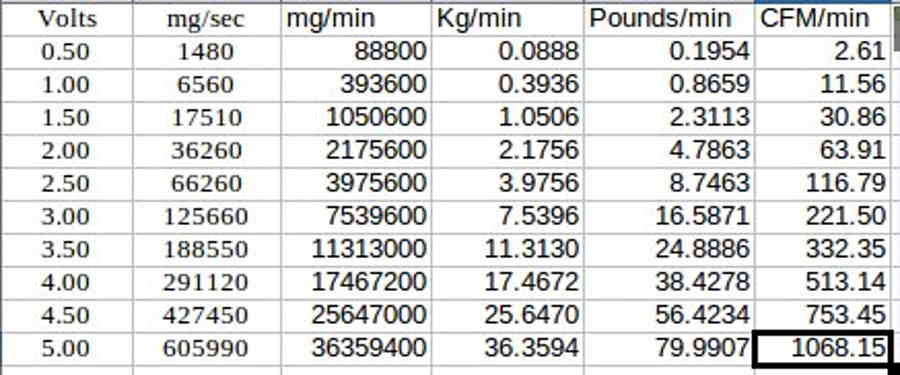
A couple of MAF response curves.
When you use these things you will need a look up table
to linearize the MAF data as the voltage out looks like
the square of the airflow.
HP is directly proportional to air flow. However BSFC (pounds of fuel
burned per HP)
varies so the look up table needs to reflect that as well.
Fortunately an aircraft engine with fixed pitch prop will be easier
to tune than a car engine. The torque load is known at all RPM's.
When we get going on this I will get people to send me their look up tables
so new guys can try them out to get a head start on tuning their engines.
Paul Lamar
The Rotary Engine News Letter. Powered by Linux.
ACRE NL web site.
http://www.rotaryeng.net
You Tube
http://tinyurl.com/beqqxas
Copyright 1998-2013 All world wide rights reserved.