Mercedes won, Redbull was second And McLaren was third.
Many cars dropped out with engine trouble as the new turbo V6's
are very complicated indeed. They don't call it turbo compound
but "energy recovery". That is because a large percentage of time
a road racing car is under braking and one want's to recover
that energy as well as waste exhaust energy.
That braking energy recovery does not help at all on the freeway or
autobahn.
It just adds a lot of unnecessary weight.
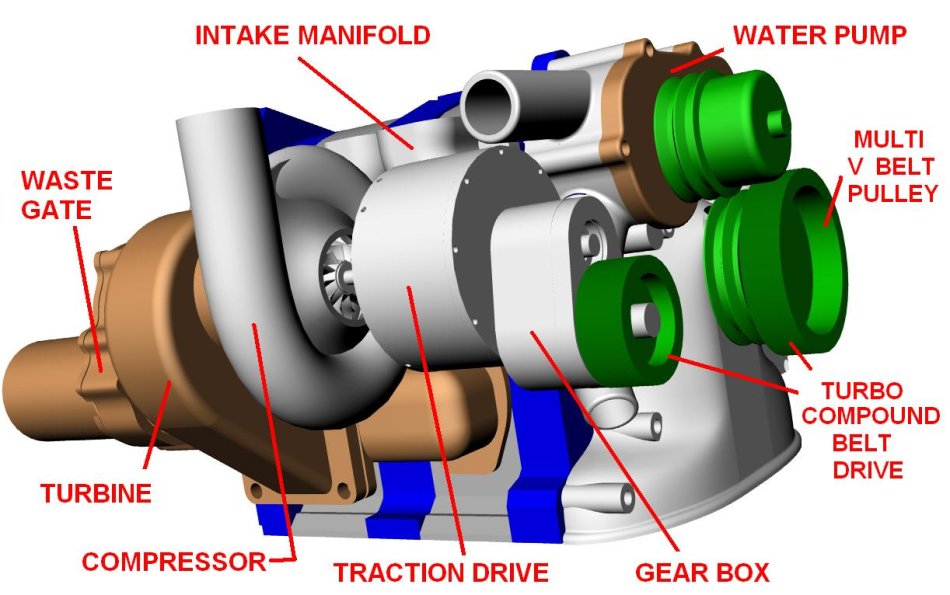
The exhaust energy is recovered by a shaft coming out the turbo charger
compressor driving a generator. This charges a battery. Similar
to the attached 3D.
This is not an efficient way of doing it in a passenger car.
Say the generator is 90% efficient and the motor is 90%
efficient over all energy recovery is then only 81%.
Again the battery is just more dead weight. Typically the electronc
controller could also be 90% efficient so over all recovery efficiency could
drop to 73%. All this waste heat heats up the engine compartment.
There is no beating a gear box between the exhaust turbine
and the crankshaft. That would be 95% efficient or higher.
The battery is also charged from the retarding force on the rear wheels
under
braking in a road racing car. These generators also serve as motors that
provide
extra torque under acceleration and in the case the turbo charger
generator it is
also used in electric motor mode to accelerate the compressor. This reduces
the notorious turbo charger throttle lag.
One can imagine this is a programmers worse nightmare.
Not only is the competition among the drivers and engineers but
now programmers are competing to see who can write the
best control program. I wonder what chip they are using?
I would not be a bit surprised if it was an ARM variation of some sort.
That is like using your cell phone to control 800 HP :)
The generator connected to the compressor shaft is interesting
as it must be geared down as the turbo is turning at 125,000 RPM.
An electric motor would probably blow up due to centrifugal loads
on the copper windings if it were to run at 125,000 RPM.
http://www.rotaryeng.net/Oxford-640-4802.wmv
Paul Lamar