Mercedes won, Redbull was second And McLaren was third.
Many cars dropped out with engine trouble as the new turbo V6's
are very complicated indeed. They don't call it turbo compound
but "energy recovery". That is because a large percentage of time
a road racing car is under braking and one want's to recover
that energy as well as waste exhaust energy.
That braking energy recovery does not help at all on the freeway or
autobahn.
It just adds a lot of unnecessary weight.
The exhaust energy is recovered by a shaft coming out the turbo charger
compressor driving a generator. This charges a battery. Similar
to the attached 3D.
This is not an efficient way of doing it in a passenger car.
Say the generator is 90% efficient and the motor is 90%
efficient over all energy recovery is then only 81%.
Again the battery is just more dead weight. Typically the electronc
controller could also be 90% efficient so over all recovery efficiency could
drop to 73%. All this waste heat heats up the engine compartment.
There is no beating a gear box between the exhaust turbine
and the crankshaft. That would be 95% efficient or higher.
The battery is also charged from the retarding force on the rear wheels
under
braking in a road racing car. These generators also serve as motors that
provide
extra torque under acceleration and in the case the turbo charger
generator it is
also used in electric motor mode to accelerate the compressor. This reduces
the notorious turbo charger throttle lag.
One can imagine this is a programmers worse nightmare.
Not only is the competition among the drivers and engineers but
now programmers are competing to see who can write the
best control program. I wonder what chip they are using?
I would not be a bit surprised if it was an ARM variation of some sort.
That is like using your cell phone to control 800 HP :)
The generator connected to the compressor shaft is interesting
as it must be geared down as the turbo is turning at 125,000 RPM.
An electric motor would probably blow up due to centrifugal loads
on the copper windings if it were to run at 125,000 RPM.
http://www.rotaryeng.net/Oxford-640-4802.wmv
Paul Lamar
Hi Paul,
The way I read it the MCU or "power unit" controller is "controlled" and
supplied by McLaren Applied Technologies (MAT) of Woking, UK for all teams.
"The identical electronic control units in F1 cars are made under FIA
rules by McLaren Applied Technologies (MAT) of Woking, UK – a company
kept strictly separate from the firm's McLaren F1 racing team, for the
sake of fairness. The control units choreograph everything from throttle
control down to changing the gears. Their software has been completely
rewritten for the new energy-recovering turbos, says MAT vice-president
Peter van Manen."
http://www.newscientist.com/article/mg22129604.400-7-tricks-to-keep-f1-cars-fast-and-fuelefficient.html#.UyVwEPmSx8E
<http://www.newscientist.com/article/mg22129604.400-7-tricks-to-keep-f1-cars-fast-and-fuelefficient.html#.UyVwEPmSx8E>
I suspect that Vettle may have had a dodgy one of these as he had
"software" problems thru qualifying too.
Phill Hinds
George Town TAS
Where is the fun in that? :)
That cuts my interest. Without software competition no possible advances in
the technology. That destroys innovation.
That is the main problem with Indy, Nascar and Rolex. They are all boring.
Did you take the vomit comet over to the race? :)
As I recall there was a hovercraft as well. I think Robin
and I rode it 10 or so years ago. Maybe that was in England Southsea to
Isle of Wight. It is all a blur :) I also took the really BIG Hovercraft
across the channel
way back in the early 80's.
Paul Lamar
The motor/generator between the compressor and turbine is a switched
reluctance design. These motors can spin up to very high rpm since they
have low rotational inertia; [no windings on the rotor] no gearbox
necessary. All motor control is electronic. The SRM design and modern
electronics make this concept feasible for energy recovery
applications. There is a hit on system efficiency going through several
layers of power conversion but there are advantages:
1-flexible location within engine compartment
2-elimination of variable vane within turbo
3-elimination of alternator
4-no compromise between spool up speed and turbine efficiency regarding
blade design
The turbo energy recovery system would make a great drop in replacement
for my Ford diesel turbo. All I would have to do is add a battery bank
and connect an electric motor to my front differential, I could the use
the 35% wasted energy going out the exhaust to help propel me down the
road...
Dan Tyler
Turbo energy recovery fan
"The switched reluctance motor (SRM) is a type of reluctance motor, an
electric motor that runs by reluctance torque. Unlike common DC motor
types, power is delivered to windings in the stator (case) rather than
the rotor. This greatly simplifies mechanical design as power does not
have to be delivered to a moving part, but it complicates the electrical
design as some sort of switching system needs to be used to deliver
power to the different windings. With modern electronic devices this is
not a problem, and the SRM is a popular design for modern motors. Its
main drawback is torque ripple."
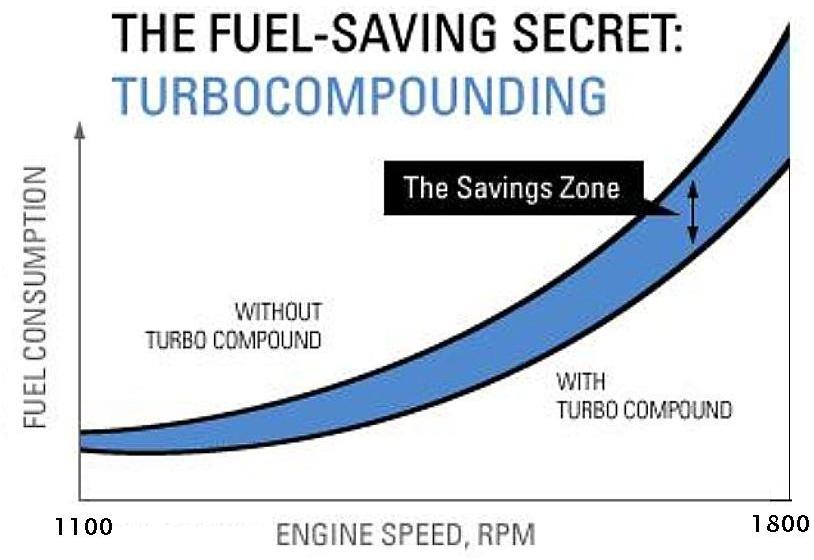
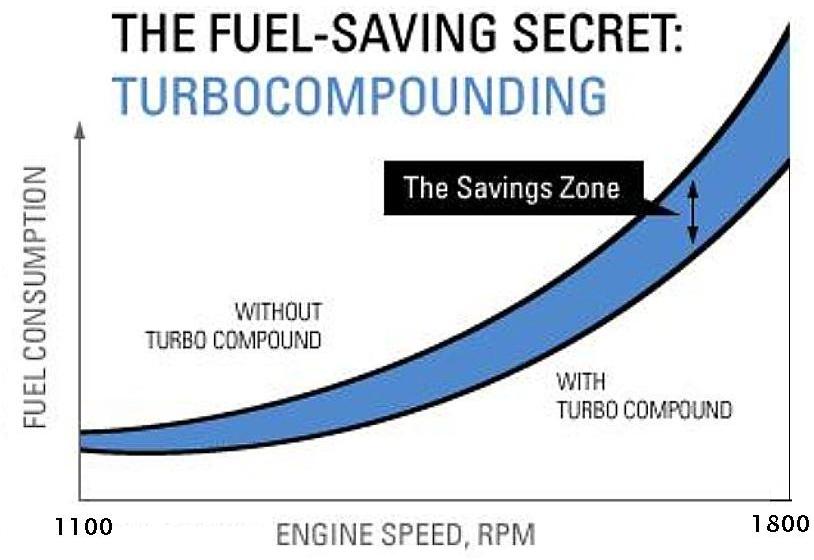
I suspect since the DD15 mechanical turbo compound is only 5% more
efficient you might
gain only 2 to 3%. However your diesel might accelerate better.
Caterpillar tried it
but did not implement production.
Diesels don't benefit as much from turbo compound as gas engines do.
The turbo compound rotary would be extraordinary as there are no exhaust
valves to get in the way.
Paul Lamar
The Rotary Engine News Letter. Powered by Linux.
ACRE NL web site.
http://www.rotaryeng.net
You Tube
http://tinyurl.com/beqqxas
Copyright 1998-2014 All world wide rights reserved.