Paul,
What is the ball park figure for radial and thrust dynamic load rating
for 240 hp in a 3.17 box. Milo
I need the distance between the bearings.
In simple theory the radial load is zero in a planetary gear box but
what happens
the load starts happening when you yaw the airplane. Worst case scenario
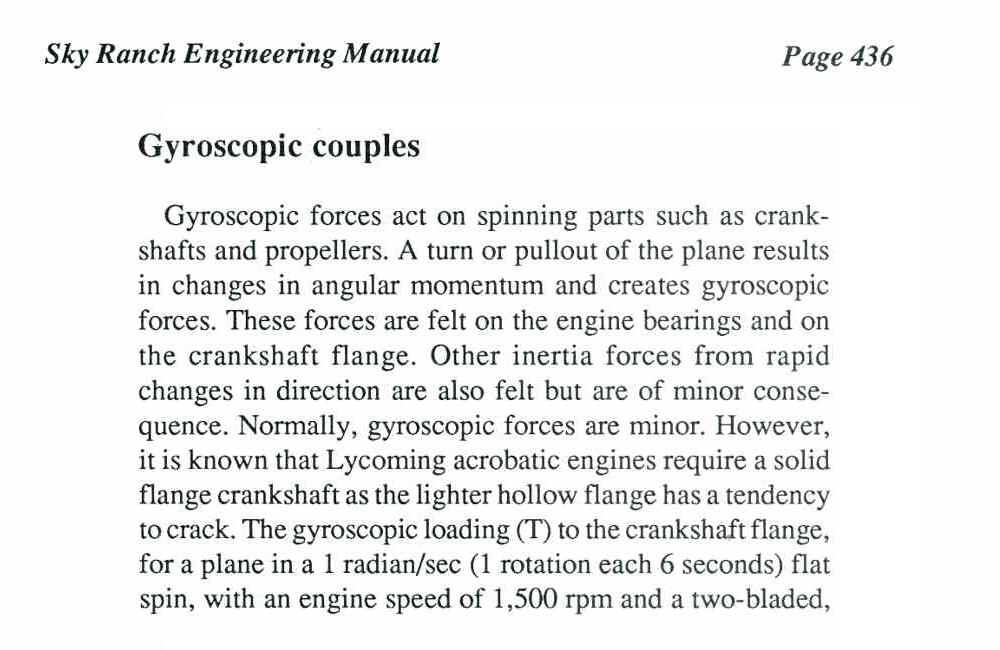
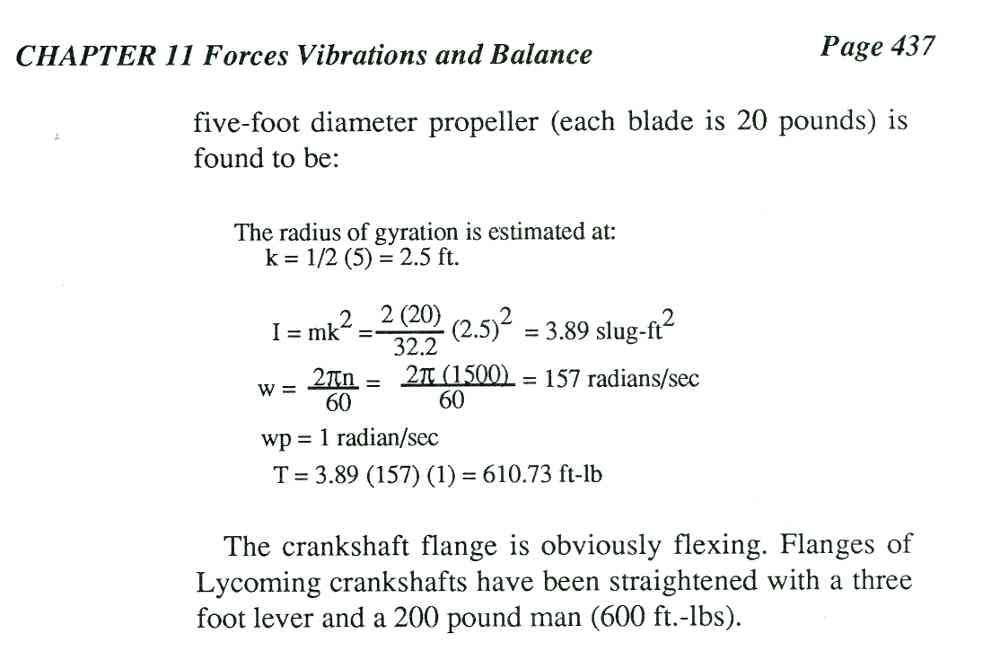
you spin. A stall is pretty bad too. Based on a 50 pound prop the bending
load is about 650 foot pounds. If the bearings are one foot apart one
bearing sees and up or side load of 325 pounds and the other sees
the same load in the opposite direction.
The thrust load is related to HP and is a max roughly when climbing out.
Lets say you are climbing out at a forward speed of 100 feet per second
and you
are generating 250 net HP at the prop to make it simple.
HP is a thrust times a velocity. Velocity in this case 100 feet per second.
HP is 250 so thrust HP is 250 pounds times 200 FPS or 50,000 pound feet
per second.
So the thrust is simply found by dividing that by 100 feet per second
or wonders
of wonders 250 pounds of thrust. In this one case only the same as the
HP number.
I like to use 1000 pounds because in simple theory the thrust is infinte at
zero speed. The prop efficiency enters into the equation and props don't
start to
bite until about 60 MPH or so which is 88 FPS.
So the thrust on the bearing is a max at lower speeds and tapers off as
you go faster and faster. For a 2 inch ID needle thrust bearing this is
a piece of cake.
Price about a dollar :)
Paul Lamar
I will pay gladly.
We managed to get the forward needle thrust bearing in the IO 470 nose
case and are now working on the aft thrust bearing, but are only now
getting worried about the connection between the 470 crankshaft and the
star gear. The 10 fasteners called out in your drawings may need some
considerable thought!
My daughter says to say hello to your puppy.
The distance between bearings is 5 inches if we use needle load bearings
and of course if we use the existing Babbitt bearing distance will not
be a factor.
Milo
The radial load is still rather low at 5 inches but a spin or stall is a
rare occurrence
unless your doing aerobatics.
Aerobatics will bend the prop flange on a stock lycoming so they have
a special aerobatics engine.
Paul Lamar
The Rotary Engine News Letter. Powered by Linux.
ACRE NL web site.
http://www.rotaryeng.net.
You Tube
http://tinyurl.com/beqqxas.
Copyright 1998-2014 All world wide rights reserved.