If you firing a rotary engine six times every 10 degrees at 10,000
RPM you need a fast crank angle sensor.
This has a rise and fall times of about 20 nano seconds. A nanosec
is one one thousandth of a micro second. Of course everybody knows a
micro second is one one millionth of a second.
Consequently a nano second is a short period of time to say the
least.
Naturally I am very pleased with this device. It is molded plastic
and strong as brick. I'll be sending it off on Monday to Poul
Woelflein Germany so he can mount it on the e-shaft of an AIXRO kart
rotary for testing our new patent pending high speed CD ignition in
a week or two.
It has the promise of reducing the fuel consumption, increasing the
power, reducing hydro carbon emissions and curing an occasional
mis-fire at idle due to port overlap. It is six times more likely to
fire a bad mixture.
The pulse width shown is about one millisecond and the pulse
amplitude is zero to 12 volts. A very solid and unambiguous signal.
Paul Lamar
Hi Paul, The ignition looks very good. Could you mention my name to
Poul. I am gathering info for a magazine article and may need some
information from him. Any news on Austro Engines new 80 hp rotary.
There was a bit of info at the beginning of the year but now,
nothing. Murry
I think they may have ran into problems. I suspect they
underestimated the torque pulse from a one rotor that large. I don't
really know. Seemed like a good idea at the time. I think they would
be better off with a turbo as their main customer is Alexander
Schleicher sail planes, the worlds largest user of rotary engines in
aircraft not counting UAV's.
Ignition of gasoline depends on the spark being immersed in a mixture
in the air fuel range of 10:1 to 20:1. The mixture ratio varies
widely in the combustion chamber and it is very turbulent meaning
that any given moment the mixture may or may not not be ignitable.
Due to port overlap some exhaust gases (less oxygen) could be
included making the mixture non ignitable at a given moment in time.
That is what happens in the old Mazda 13B and causes a distinctive
and noticeable miss at idle. The RX8 eliminated the port overlap for
that reason.
This ignition is six times more likely to find an ignitable mixture
ratio because it waits for a good mixture to come along :) Notice the
Wankel combustion stroke lasts almost 300 degrees while the piston
combustion stroke is only about 120 degrees. During this long time
period some un-combusted combustible mixture may be passing the spark
plug. We know this is the case because of the high hydro carbon
content in the Wankel exhaust. Our goal is to ignite that mixture
thereby gaining a lower BSFC and more power.
It is well known that a hotter spark can ignite a lean mixture
better. The best MPG in an aircraft engine is obtained with a lean
mixture in the vicinity of 18:1 and with a spark advance of 50
degrees or so at low manifold pressures (high altitude).
I am counting on that happening with this ignition.
Klaus tells me a good ignition can set paper on fire. Mine has no
trouble doing that :)
Paul Lamar
If it were not for airplane use, I'd add a Reed-Valve close to the
rectangular
intake port opening in the working housing surface, as per the patents
US3844256 Nissan, 1974, US1412931 and US4020800 Nissan, 1974;
US3514235, Yamauchi, Yanmar Diesel, 1970, or CA1032477, 1978,
and CA1045553, 1979, both by Ford; and if somebody has a housing
in its last days of useful life, I'd suggest testing the results of
the patent
US3848574 by Kawasaki, 1974. Dreamin' is free!
Thanks for your attention. Best regards. Salut †
Jose Gros-Aymerich; Madrid, Spain
Jose, forget reed valves. They are a HP penalty.
What does the same thing is mounting the slide throttle close to
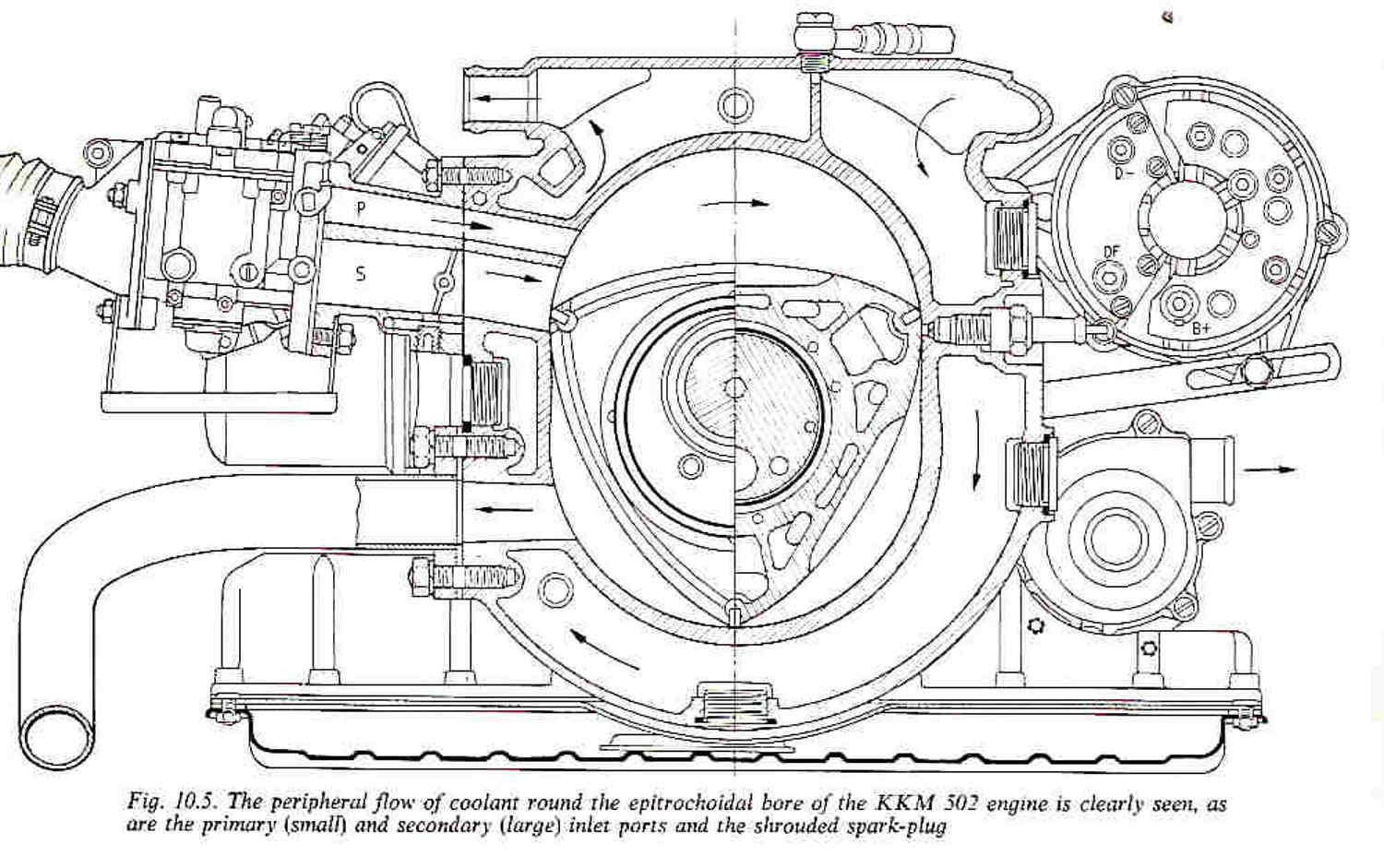
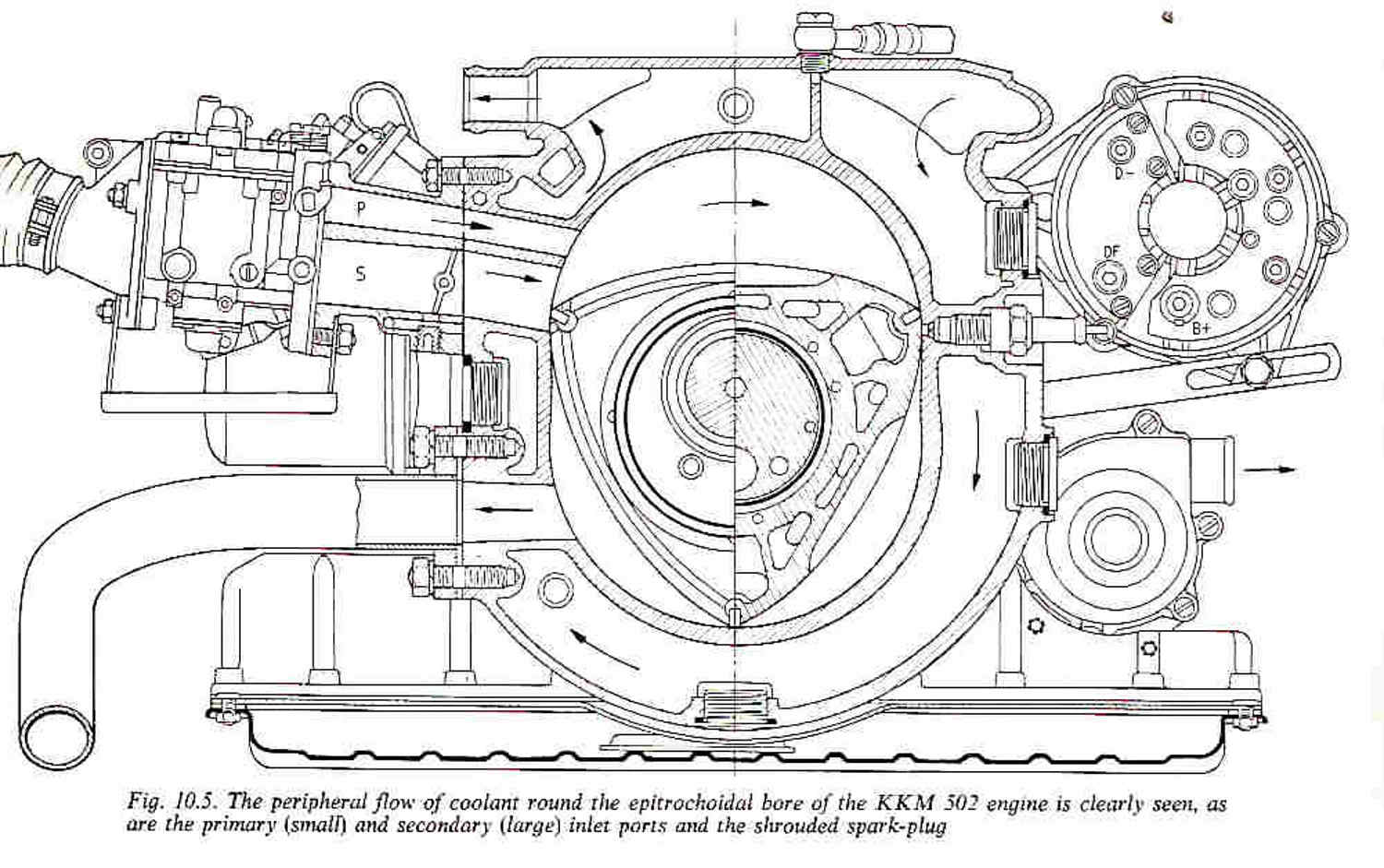
the p-port. NSU knew this way back in the 60's.
Paul Lamar
The Rotary Engine News Letter. Powered by Linux. ACRE NL web site.
http://www.rotaryeng.net You Tube
http://tinyurl.com/beqqxas
Copyright 1998-2014 All world wide rights reserved.