Paul,
I have been experimenting with signal condition for the 2nd gen CAS
sensor.
Do you know how much voltage it produces?
It seems to be producing a AC signal at .05 volts at 500 rpm CAS
shaft speed.
I am trying to increase the voltage with the LM1815 chip but can’t
get it to work.
Does the voltage go up when you turn it faster?
Does the CAS turn 2 X Eshaft speed?
Thanks for any help.
Joe Berki
Yes it does. That LM1815 handles that very well.
You must however use a 5 volt regulator LM78L05 to power the LM1814
chip. It is designed to output a 5 volt 100 usec wide pulse to a
computer.
The second gen CAS turns at half E-shaft speed. That is why there are
two tits on the top part of the rotor shaft. That way you get one
signal pulse per revolution of the e-shaft at 22 degrees BTDC rotor
1.
You will need two LM1815's. One for the upper level and one for the
lower level if you need that.
If you are using it for something other than a computer and you need
a higher voltage a good chip to take in 5 volts and put out 12 is a
ULN2003. It will work up to 30 volts. It is easy to use and will
tolerate a lot of abuse. You get six Open Collector outputs.
Paul Lamar
Paul,
I have a Zeal Dauughter board whack is marketed by DIYAutoTune but I
can’t get it to work. It has 2 LM1815 chips on board.
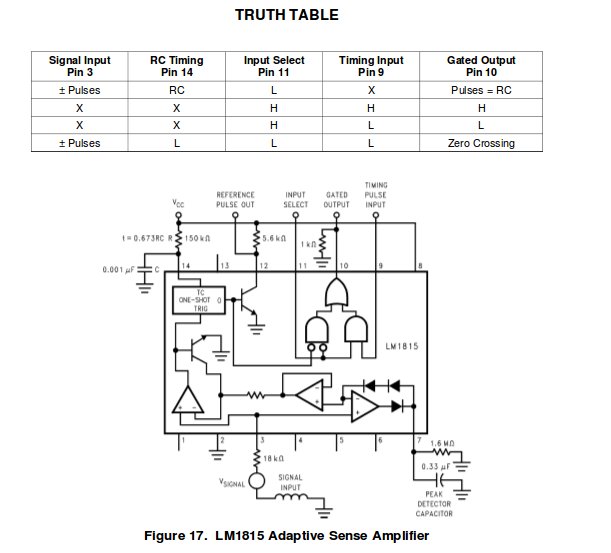
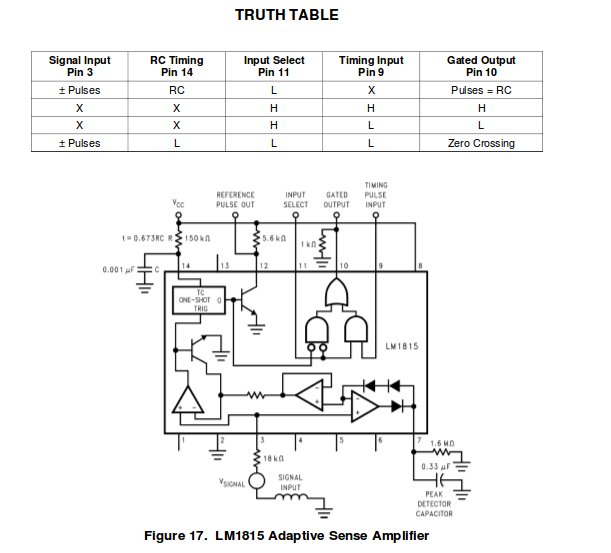
Do you have a schematic of a LM1815 circuit that works? Maybe I have to
change some values, The board does not have a schematic and I had to
reverse engineer a schematic from the assembly instructions.
Joie Berki
I just uploaded one. It is also in the LM1815 pdf. Your not on a cell
phone or tablet are you :) They have their limitations when it comes to
email :)
Paul Lamar
The Rotary Engine News Letter. Powered by Linux. ACRE NL web site.
http://www.rotaryeng.net You Tube
http://tinyurl.com/beqqxas
Copyright 1998-2014 All world wide rights reserved.