You know the Pacer was designed around the RCE that GM never
produced, 2-Rotor, 266 ci, not too far from the 258 of the big
6-in-line AMC engine, just the Wankel was more powerful, at 150 HP,
for 95 HP at 4'300 rpm in the 6-L Pacer; with the 304 ci V8: 125 HP
at 3'600 rpm, so they say.
If the 1987 NA RX-7 13B provides 145 HP at 6'000-6'500 rpm; just with
an axle keeping the engine a bit at higher rpm would be enough,
100-200 lb of difference in engine weight, the Mazda being lighter,
are not that much, and the RCEs taxation is for a single chamber
displacement multiplied by the number of rotors, in this case, 80
ci, 1304 cc, instead of 180 ci, 2608 cc, versus 258 ci for the 6-L
AMC engine. I guess that everything is kept within reasonable limits,
so: what are you so afraid about? Thanks for your attention and help.
Best regards. Salud †
Jose Gros-Aymerich Madrid, Spain
The Mazda Wankel is not 266 ci. It is only 160 ci.
A worth while project is to install a Mazda Wankel in this car.
Probably the lowest drag car on the road. Not necessarily the lowest
drag factor. Certainly the lowest frontal area.
Paul Lamar.
Yes you're right, the GM RCE gave 150 HP from 266 ci, and Mazda
RX-7 provides
145 HP from 160 ci, NA, 1987. The frontal area of AMC is much
wider than that
of RX-7, and also the AMC drag coefficient worse, even being among
the best of its days and class, but with the weight reduction
from the
Mazda versus the AMC engine, both the RX-7 and the AMC Pacer are
roughly equivalent in overall weight.
I'll let you know, if the project comes to an end, it's not
clear now.
Thanks, best regards. Salud †
Jose Gros-Aymerich
Madrid, Spain
Jose.
I think Paul means that the 13B is like a 160 cu in reciprocal engine.
But it is only 80 cubic inches. All manufactures agree by their
designation proceedure.
Don't let the Spanish government tax you at twice the vehicle engine
size rate!
I do combustion pressure testing. When tuned ideally the rotary sees
1200 psi peak pressures. Part of the program's formulas for horsepower
and torque requires actual displacement reference for each degree of
rotation. I use 0-45 cu in for one rotor (with 9:1 compression we
include the 5 cu in rotor pocket). It works out to 500 hp @ 15 psi boost.
If we doubled this displacement as Paul (and the SCCA, FIA, and others)
would have us do it would show 1000 hp @ 15 psi boost....... If HP
increases could be so easy!
Barry Bordes
No! 2.6 liters!
The rotary is not a two stroke. It is a four stroke.
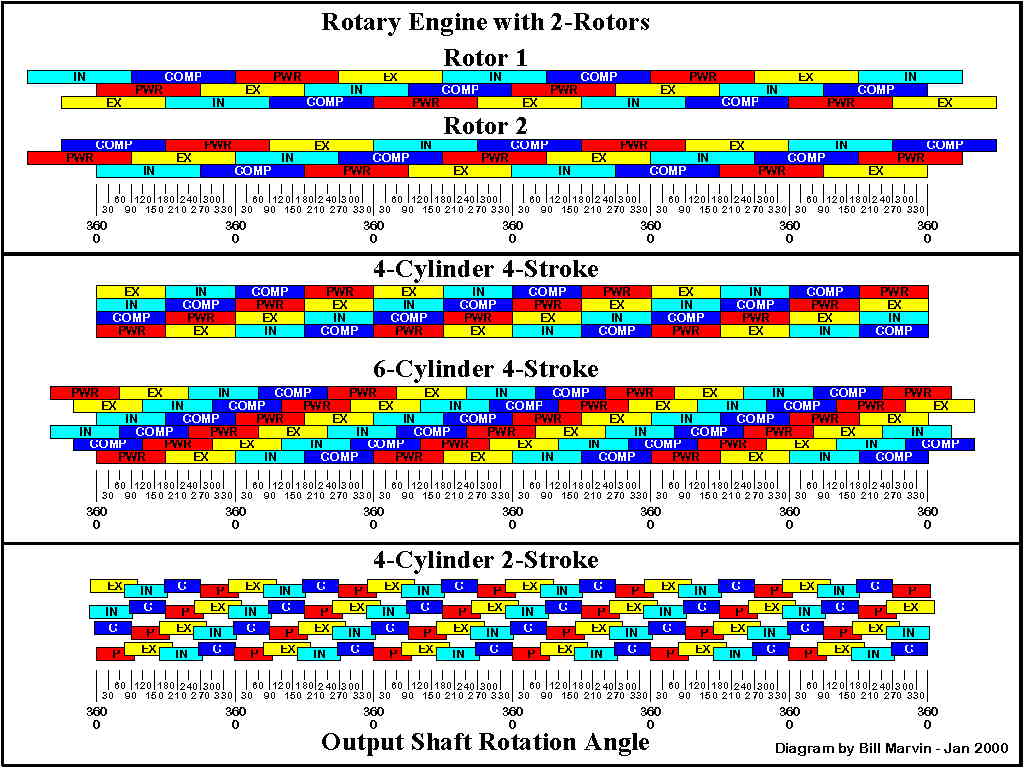
Lets turn it around. How much air would a 2.6 liter two cylinder
TWO STROKE engine pump and process in one revolution?
The definition of displacement, as far as engines are concerned,
is only valid in context with the type of stroke.
As far as HP is concerned the ONLY thing that matters is how much
air a four stroke engine pumps and processes in ONE REVOLUTION at 100% VE.
Not the physical displacement of x number of chambers.
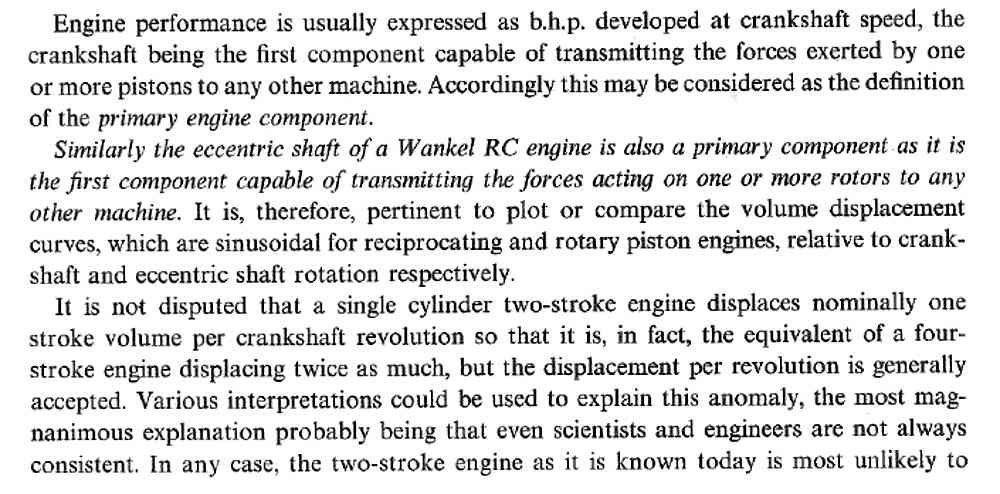
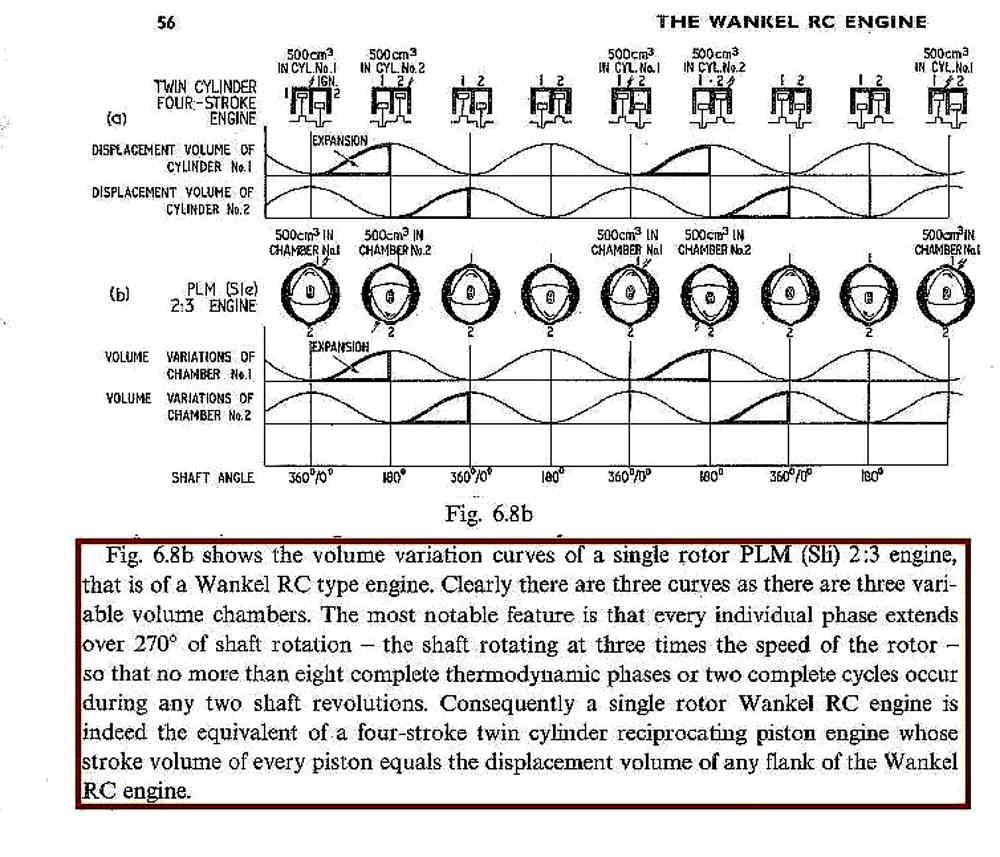
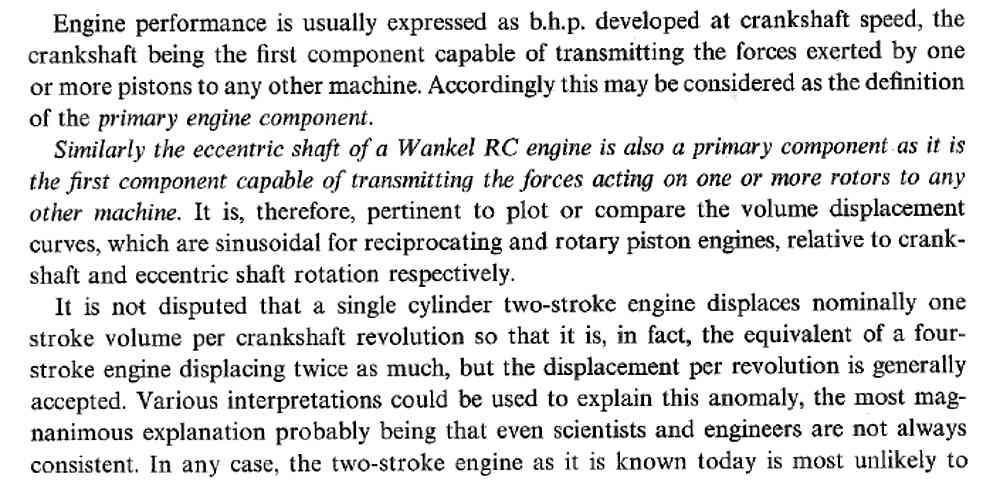
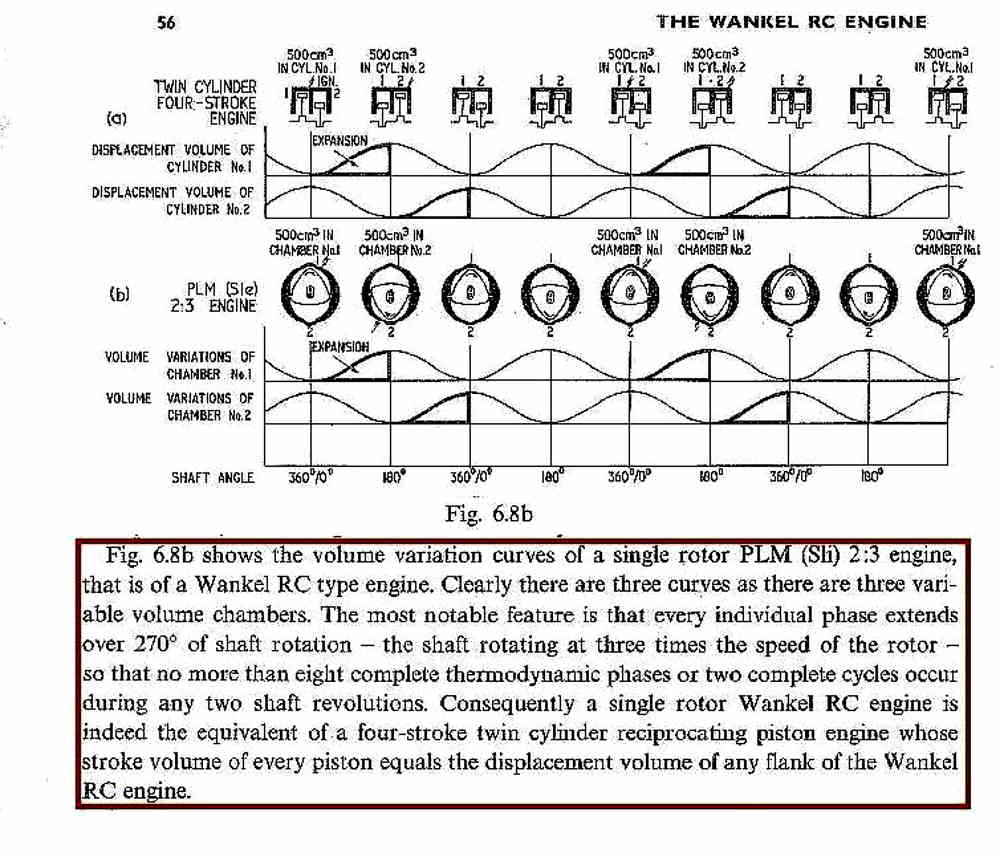
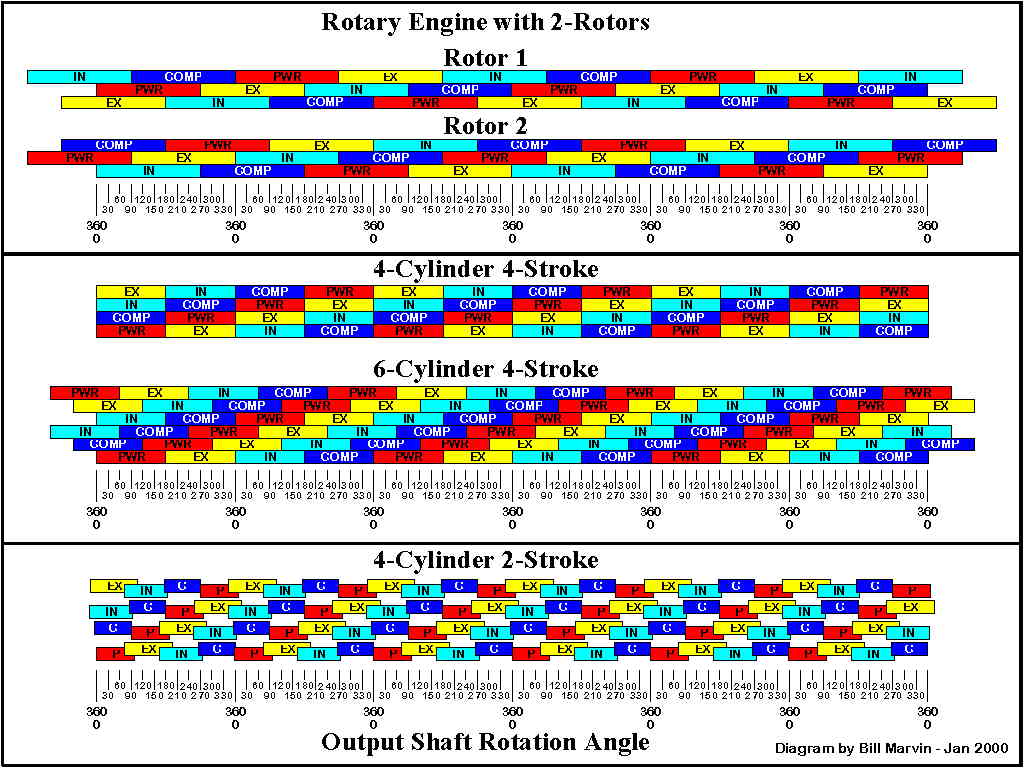
Here is what Ansdale has to say about that. See the attached jpgs.
It is agreed world wide that Ansdale is the authority on this subject.
13B rotaries are raced in the 2.6 liter class world wide
for a very good reason. The only reason they generate more power
than a 2.6 liter four cylinder 4 stroke engine is they turn faster
and breath better. Lately that is less true as the piston
engine RPM has been raised by detail development and the
use of high strength to weight ratio materials like titanium.
Also four valves per cylinder has improved the breathing.
It is very rare for any 2 valve cylinder to have a VE over one.
The RX8 engine is just over one and P-ports are typically
1.2.
Formula One (2.5 liter as I recall) V8 engines are now
turning 19,000 RPM. At least four valves per cylinder with
a very short stroke so larger valves can be used for a given
physical cylinder displacement. You will not find the details
of a competitive Formula One engine anywhere. Its a well
kept secret. However I would not be surprised if the VE's were
well over one.
Applying the RPM difference to a 2.6L p-port Mazda rotary
making 340 HP at 10,000 RPM would make the Formula One engine
about 19,000/10,000 times 300 HP or 655 HP which is about
right for a Formula One engine.
Paul Lamar
The Rotary Engine News Letter. Powered by Linux.
ACRE NL web site.
http://www.rotaryeng.net
You Tube
http://tinyurl.com/beqqxas
Copyright 1998-2014 All world wide rights reserved.