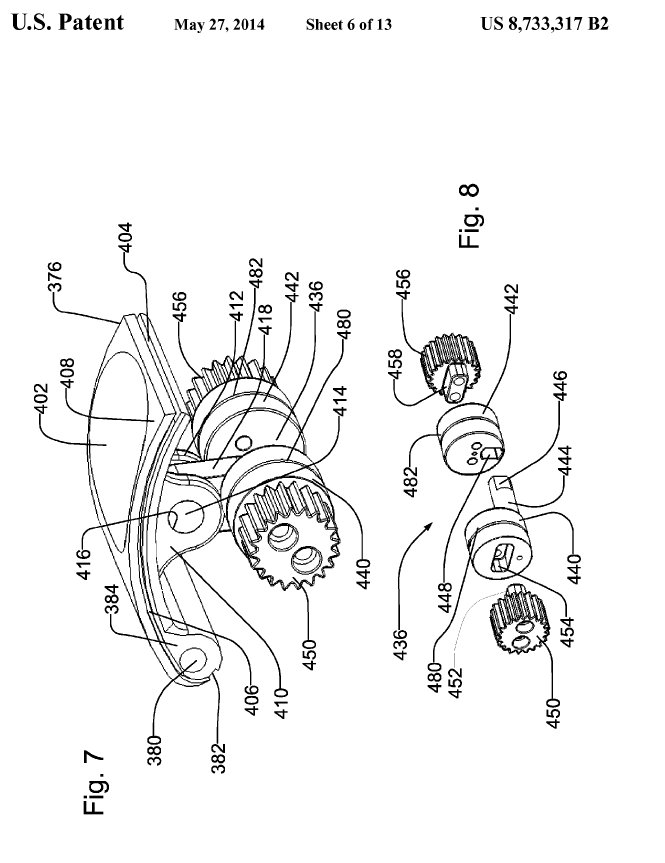
The Gotek engine is not a true rotary engine. It is a four flapper
reciprocating engine. The flappers called "pivoting rockers" that
move up and down inside the housing as they rotate. There are four
small crankshafts and four small connecting rods. See the attach
page of th patent.
As such there is nothing about it to make it more efficient.
Furthermore it violates several of the following requirements.
By Kenichi Yamamoto from his book "Rotary Engine" 1981
1.3 REQUIREMENTS FOR A PRACTICAL ROTARY ENGINE Although various
types of rotary engines have been developed to date, there are few
that do not qualify as internal combustion engines or do not qualify
as a practical engine even if they satisfy the qualifications of an
internal combustion engine. The requirements for a rotary engine to
be qualified as a practical internal combustion engine can be summed
up in the following five items. The practicality of various ideas on
rotary engines can be judged by evaluating them by these criteria:
(1) Every moving part, including the timing mechanism, should make a
rotating motion. A mechanism having a reciprocating inertia will
increase mechanical noise and vibration, and will work against high
speed and high revolution. [In addition mechanisms that reciprocate
generate reversing loads. Reversing loads lead to reversing
stresses. Reversing stresses lead to metal fatigue and limited life.
The Wankel rotary engine has no reversing stresses therefor the life
of the major parts such as the eccentric shaft and rotor are
unlimited unlike, crankshafts, connecting rods, pistons and poppet
valves. Paul Lamar] Accordingly, structures that require intake and
exhaust valves and mechanisms using the rotors oscillatory motion are
not desirable.
(2) Gas seals or the working chamber should be three
dimension-ally reliable. The gas seal mechanism of a rotary engine
should be constituted by connecting the individual seals three
dimension-ally. Among the many ideas we come across are those that
don't show such three dimensional thoughts.
(3) Appropriate gas exchange of intake and exhaust should take
place. Together with having a mechanism that can correctly open and
close the ports, sufficient time for intake and exhaust should be
provided especially for high speed and high revolution. Among the
ideas on rotary engines, there are some that ignore this point.
(4) Every component part should have the strength to endure high
speed and high pressure. As the component parts are exposed to high
pressure, high sliding velocity and high heat load, every part
should have sufficient allowance in size and in shape.
(5) Sufficient cooling and lubrication should be provided. In
order to qualify as an internal combustion engine, although this is
related to above (4), durability against high heat load, high
sliding velocity, etc. are required. Therefore, the structure should
be simple, and the ideas on rotor cooling, lubrication of seal
parts, and oil seal structure should be those that are given
adequate thought. Also, it is desirable for a practical rotary engine
to have a simple and compact structure. When we evaluate the various
type's of rotary engines devised to date in view of the above
mentioned requirements, the NSU Wankel type rotary engine is the
engine that best satisfies the above mentioned requirements.
So far there has been no provision for cooling in the Gotek
drawings.
BTW I have owned or (now own an RX8) seven Mazda rotary powered
cars, some with over 300,000 miles, since 1973 and have had no
problems of any kind with the seals or the wear on the seals.
Paul Lamar
Thank you.
Henry Dubroff
What for Henry ? :)
Here is an improvement. Easier to seal the pistons and the combustion
chamber is a much better shape. The original square chamber is not good.
Four one cylinder engines rotating around a stationary center gear.
Only one shown. The cylinder block also rotates needless to say.
Sort of a Mickey Mouse contraption compared to the elegance of
the Wankel.
Sealing everything is going to be a night mare due to radical temperature
changes around the engine.
The Achilles heal is the crank pin and the gears. More so on the square
chamber version.
This is sort of like a WW I rotary radial.
Paul Lamar
The Rotary Engine News Letter. Powered by Linux. ACRE NL web site.
http://www.rotaryeng.net You Tube
http://tinyurl.com/beqqxas
Copyright 1998-2014 All world wide rights reserved.