To: AA-1-Me <rotaryeng@earthlink.net>,
Scott Farrenkopf <sfarrenkopf@gotekenergy.com>,
Henry Dubroff <hdubroff@pacbiztimes.com>, dajustesen@vcstar.com,
Gotek-info <info@gotekenergy.com>
Blown 2 cycle version of the GoTek
Paul Lamar
=========================================
Here is a double HP version. Two power pulses per rev.
Paul Lamar
=====================================
It may not be a true rotary but with a few changes it could be a
pretty good engine. The fundamental idea is not that bad. Breathing
is excellent.
Here is an improvement. See the attached 3D's. Easier to seal the
conventional pistons with off the shelf piston rings and the
combustion chamber is a much much better shape. The original square
chamber is not good.
In effect it is four- one cylinder engines - rotating around a
stationary center gear. Only one engine shown in the 3D. The
cylinder block also rotates needless to say.
Sort of a Mickey Mouse contraption compared to the elegance of the
Wankel :)
Sealing everything is going to be a night mare due to radical
temperature changes around the engine.
The Achilles heal is the unbalanced crank pin and the gears. More so
on the square chamber version.
I have a hanger at Santa Paula with a Mazda Wankel powered airplane.
Paul Lamar
========================================
On 09/01/2014 09:46 PM, Henry Dubroff wrote: Thank you. Henry
Sent from my iPhone
======================================== On Sep 1, 2014, at 9:08 PM,
rotaryeng <rotaryeng@earthlink.net wrote:
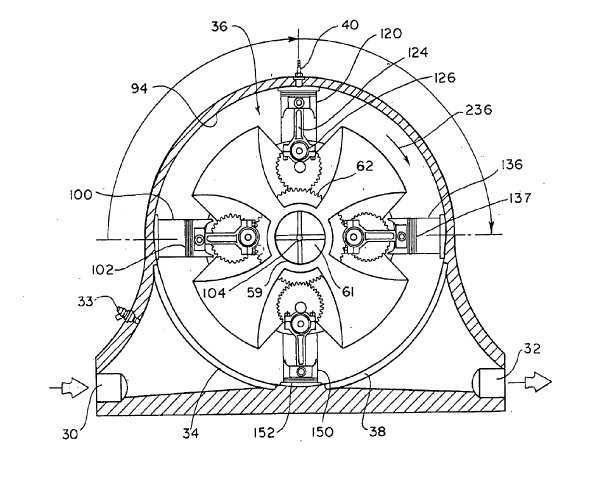
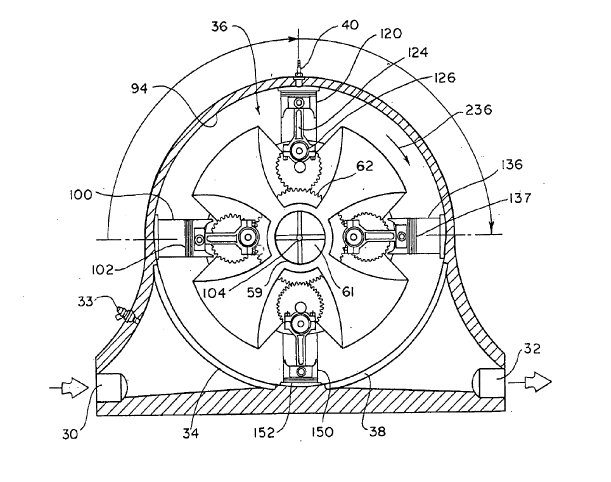
The Gotek engine is not a true rotary engine. It is a four flapper
reciprocating engine. The flappers called "pivoting rockers" that
move up and down inside the housing as they rotate. There are four
small crankshafts and four small connecting rods. See the attach
page of th patent.
As such there is nothing about it to make it more efficient.
BTW I have owned or (now own an RX8) seven Mazda rotary powered
cars, some with over 300,000 miles, since 1973 and have had no
problems of any kind with the seals or the wear on the seals.
Paul Lamar
=====================================
Hi, if they can solve the cooling, sealing, lubrication problems
they might have a running engine. If it is superior in performance to
conventional engines and Wankels and can be made at lower cost they might
have a business. A patent or computer engine design is so far from a
successful engine program that they are near fiction.
Murry I. Rozansky
I agree.
I suspect my changes would make their patent invalid.
Their patent attorney did not recognize the real unique idea in
the engine so he patented only one implementation.
That leaves my idea of using pistons instead of flappers open to another
patent.
Especially the two power pulse per revolution variation.
Paul Lamar
Paul & Murray
We like to answer every email we receive from casually interested
supporters to Automotive PhDs at Ford GM BMW Volvo and all the rest.
Please see your rotary piston engine design that is patent granted in
2007 by a man named Nicholson.
We attached it for your viewing pleasure. You might want to write him to
see how he is doing with your design.
GoTek Energy Inc. has developed a unique rotary engine compressor and
pump architecture that we
call 'DynakineticTM// (DK) Technology.
TECHNOLOGICAL ELEGANCE
We have a profound respect for Felix Wankel and all his innovation. He
has moved the engine industry into a new realm of understanding that
//the piston engine is not the only way to make an internal combustion
engine//. He has opened the door and paved the way for many others such
as Eco Motors Pinnacle Engines Achates Power Duke Engines and many more.
Most of these companies are well funded and are banking on the idea that
the engine market has room enough for them to compete in their own
sphere of technology with some inherent advantages over their
competitors. The Wankel rotary engine has proven that the world wants a
better engine. Felix Wankel developed a very elegant engine design and
stuck to his primary goal of creating an internal combustion engine that
had only one moving part.
Unfortunately in doing s sacrifices were made:
. Poor torque:
The fact that Wankels have only 1 moving part per housing sets them
apart from more complex piston engines. However this same benefit has
also become its nemesis when it came to having the needed leverage to
create impressive torque. The centerline of the rotor compared to the
centerline of the main crankshaft is a little over 0.5 inches compared
to piston engines of similar volumetric size whose leverages are
typically 1.5 inches (main journal to rod journal centerlines). This is
why a Mazda only launched well after a high RPM was achieved.
. Poor fuel economy:
The long thin center-pinched combustion chamber at top dead center did
not allow for optimal charge ignition or flame front propagation. The
large rotor divot used to connect the two //sub-chambers/' is necessary
to overcome the pinch-off or the flame could not propagate. Additionally
two staggered spark plugs are used to ignite the spread out mixture.
Even with all these efforts the ignition firing occurs around 20 degrees
before top dead center and no significant leverage occurs until about 20
degrees after top dead center resulting in 40+ degrees of inefficient
unused //chemical energy-to-kinetic rotational energy' transfer. This
chemical energy is instead converted to heat energy. Basic physics
explains that the inability of power conversion creates excessive
exhaust gas temperatures. Wankel's run 400+ degrees Fahrenheit hotter
than their common piston engine counterparts!
. Poor combustion sealing durability:
Mazda did have a sealing problem early in their product lifecycle but
made great strides to improve them. The rolling of the rotor tip's apex
seals as they passed the figure 8 oval housing's pinch-point, created
excessive flex and vibration, which commonly show as chatter marks in
the housing surface.
Harder apex seal materials were developed to reduce this problem to some
extent. Rich mixture conditions, especially with turbo charging, still
allowed soot to jam the seals and under extreme conditions to create
fracture and engine failure if retraction did not occur at the pinch
point due to that soot. The Wankel apex seals never really achieved the
same level of durability as piston engine rings which simply expanded
and seated in.
DYNAKINETICTM ENGINE IS NOT A ROTARY ENGINE
We feel the definition of a rotary engine is when all chambers
rotationally pass by a common intake port, common fuel injection, common
spark ignition, and/or common exhaust port interfaces and the main power
rotor "rotates" in a circular motion. Wankel rotors do not rotate in a
true circular motion.
It appears that you are mistaken that a DK engine is not a rotary
engine. If anything, DK engines are more of a true "rotary" engine than
a Wankel engine.
Additionally, our whole housing or "block" does not rotate like some
designs (ref. Adams Farwell). The power module with all moving parts
enclosed, is the only rotating unit and it does rotate in a true
circular rotation.
DYNAKINETICTM ENGINE "PISTON" SHAPE IS NON-OPTIMAL
While we agree, the DynaKineticTM curved rectangular pivot pistons
cannot use conventional piston rings what we can do is pack more
displacement volume into our engine volume. Stacked boxes always utilize
available space much better than stacked cylinders.
Our pivot piston and chamber shape also supports a rolling in and
tumbling of the air fuel mixture.
While a true perpendicular air entry port could have some potential
shear issues at high RPM, our ports are designed to merge the air flow
into the expanding chambers with the pivot pistons moving away from the
flow and creating a void for the air to rush in.
DYNAKINETICTM ENGINE BREATHING
You are correct that breathing of our engine is superb from associated
pumping loss minimization created by the elimination of valve train
opening/closing and air column flow starting/stopping.
DYNAKINETICTM ENGINE SEALING IS A NIGHTMARE
Every rotary engine requires a great deal of engineering of the
combustion seals. This is one of the reasons we leveraged Total Seal who
has a substantial market share in NHRA NASCAR and Formula 1 piston rings.
Geometry took a great deal of development time but materials finishes
edge profiles coatings etc. are aligned with piston seal technology. Our
seals unlike Wankels do not extend and retract substantial distances
multiple times per main crank revolution nor do they flex. They simply
seat in and stay put not unlike a piston ring.
Concern was mentioned over how temperature variation around the engine
might impact sealing. Every engine whether a Wankel or a piston engine
has a circumferential area or cylinder in the power stroke during
combustion where the temperature varies from adjacent chambers. All of
these temperature variations have the potential to create localized
expansions and warps or ovality if structure wall thicknesses and FEA
thermal modeling are not done correctly.
Any ring locally heated across a small arc of its overall circumference
simply grows to a slightly larger diameter. The DynaKineticTM housing is
a ring. However a pinched oval when heated across a small arc of its
perimeter does not symmetrically grow. The Wankle housing is a pinched
oval.
Paul mentioned that he had Mazda Wankel cars with one which had over
300000 miles on it and no seal problems ever occurred. We have never
heard of a Mazda RX Wankel accumulating this many miles with
conventional seals and no rebuild. We (and most likely Mazda also) would
be very interested to confirm if no rebuilds occurred whether
aftermarket ceramic seals were used and if any special lubricants were
used. If you have successfully achieved this you should definitely
contact Mazda for some prize money.
DYNAKINETICTM ENGINE MINI-CRANK AND PLANET GEARS ARE ITS ACHILLES HEEL
The DynakineticTM mini-cranks are a key stress area to be watched in
shear and bending modes no different than a piston engine crankshaft.
What is different however is the offset which exists between the
journal/gear centers and the shaft center supporting the one piece rods.
This offset very quickly allows for the transfer of combustion pressures
to be converted into rotational leverage 4° ATDC. The Wankel is 20° at
best (only considering the ATDC side).
Due to the hinging of the pivot piston at one end the full weight of the
piston and its increasing effective mass as RPM increases is not born by
the mini-crank shaft like that of a piston engines crankshaft rod
journal. The symmetry of the pivot pins guides and adheres structural
alignment of the pivot pistons at all times.
THERE IS NOTHING ABOUT THE DYNAKINETICTM ENGINE TO MAKE IT MORE EFFICIENT
There first question is "more efficient" than what other engine.
Wankel engines have never had a reputation for being efficient. They do
have a great HP density to weight ratio and that has put them into the
mainstream of the engine world. But their MPG is worse than an old Chevy
Monte Carlo with a 350 CID V8.
DYNAKINETICTM ENGINE PERFORMANCE NOT SUPERIOR TO WANKELS
We have two investor/advisors that are Pro Race Teams who have
successfully raced Mazda Wankel engines for many years and are known as
experts in the rotary engine field. One of those two has also
successfully raced piston engines and was sponsored by Mazda and
subsequently by Nissan. Neither would have invested in our company if
theYI with their many years of expertisel did not see the potential
ofthe DynaKineticTM design to be far superior.
DYNAKINETICTM ENGINE PATENT AND CAD DESIGN FAR FROM A SUCCESSFUL ENGINE
PROGRAM
GoTek EnergYI Inc. fully agrees that a granted engine patent alone does
not guarantee a successfully operating engine. Likewise we agree that
CAD designs do not guarantee that either. We also know that simulations
do not guarantee that either.
Any successful engine program requires a great deal of the above coupled
with performancel emissionsl and durability testing at an engine level
followed by those same type of tests in the field at an application level.
GoTek EnergYI Inc. is far beyond patents and CAD only models of an
engine. Hardware exists. We are currently going through our in-house
test procedures to be followed by certifications and third party testing.
Just for your own knowledge you might want to look up Felix Wankel/s
history and see how his progress developed. His tenacity is amazing and
he ran into obstacles and hurdles most people are unaware of.
His timeline and the marked milestones are legendary.
GOTEK ENERGy/S PATENT ATTORNEYS ONLY PATENTED ONE IMPLEMENTATION
Without question you have not done any due diligence in this area.
Attached please see what you feel is your unique and novel idea patented
by Nicholson many years ago. His patent is one of our references that we
used to discern our technology.
SUMMARY
We wish you all the fun and enjoyment you can find with your Wankel
engines. They are truly a work of art a passion for betterment and have
the inbred tenacity of true innovation. Our hats have always been off
with respect to Felix Wankel and his marvelous achievements.
Enjoy
GoTek Energy Inc.
Scott Farrenkopf
In regard to the Nicholson patent I am disappointed. I though thought
you guys invented the
planetary geared piston engine :) I stand corrected.
Having worked for Chaparral as an engineer and sold wings to many racers,
in my 50 years, very few are engineers. Good mechanics they may be but
not engineers.
You are quite wrong about the Mazda apex seals. If you wish to read the
history here it
is. http://www.rotaryeng.net/history.html All the seal problems you
mention went away
in 1969. Your sealing problems are a nightmare with square pistons in
comparison
to the round piston engine as is the shape of the combustion chamber :)
Let me get this straight. After 16 years of editing the Rotary Engine
Newsletter
you want ME, Paul Lamar, to look up Felix Wankel/s history. Surely you
jest :) We have 500 gig of emails and jpg's on the subject over the past
16 years.
My RX8 gets 25 MPG on the freeway. Far better than an old Chevy Monte Carlo
with a 350 CID V8. Come on over and I will give you a test ride and we can
measure the fuel burn with OBD II.
Your engine is not a rotary engine due to the reciprocating CG of the
square pistons.
Good luck with your flapper piston engine.
If you want an new CD ignition system that fires a Wankel rotary engine
six times
5 degrees apart at 10,000 RPM let me know.
BTW I also invented a clutch throwout annular cylinder in 1972 that is
now on just about
every car manual transmission and some paddle shifters in the world
including Ferrari's .