On Wed, Sep 17, 2014 at 8:22 AM, rotaryeng <
rotaryeng@earthlink.net
<mailto:rotaryeng@earthlink.net>> wrote:
One would have naturally thought that a "3rd Generation" PSRU would
be the "cat's meow"; but that evidently isn't the case, and it almost
cost a pilot and pax in an RV-9A their lives! The below report (see
link) also states that there have been quite a few failures of this
PSRU, and one came after only 160 hrs of usage! Amazing the "snake oil"
that is out there and ready to hurt people...
http://www.ntsb.gov/aviationquery/brief2.aspx?ev_id=20140224X15602&ntsbno=ERA14LA130&akey=1
<http://www.ntsb.gov/aviationquery/brief2.aspx?ev_id=20140224X15602&ntsbno=ERA14LA130&akey=1>
Marc Wiese
AIRPLANE INFORMATION
According to Federal Aviation Administration (FAA) records, the
RV-9A, a two-seat, all-metal, low-wing airplane with tricycle configured
landing gear was issued an airworthiness certificate, in the
experimental category, on July 18, 2011. It was built from a series of
kits provided by Vans Aircraft and Eggenfellner Aircraft, Inc. The
airplane was equipped with an Eggenfellner Subaru H4 modified automobile
engine which included a Gen 3 V4 propeller speed reduction unit (PSRU)
gearbox that was used to drive the propeller at a speed slower than the
engine speed. The engine was equipped with an IVO propeller assembly
that consisted of three electrically-controlled wooden propeller blades.
The engine kit was based on an EJ-25, 2.5L Subaru water cooled
4-cylinder engine and was rated at 160 HP at 5400 rpm.
The pilot/builder stated that he purchased the kit for the airplane
in 2001 and began construction shortly after. He purchased the engine,
which at the time, was equipped with a Gen 1 PSRU and solid flywheel,
direct from Eggenfellner Aircraft, Inc. in 2002 and installed the engine
about January 2008. In 2011, prior to receiving the airworthiness
certificate, the pilot employed Eggenfellner Aircraft, Inc. to remove
the original PSRU and replace it with a Gen 3 V4 PSRU.
During a telephone interview a representative of Eggenfellner
Aircraft, Inc., now defunct, stated that the Eggenfellner Subaru H4
engine transfers power to the PSRU through a spline shaft. One end of
the spline shaft is inserted into a splined drive disk adapter at the
engine. The splined drive disk is bolted to the engine crankshaft
through the flywheel. The other end is inserted into the PSRU input spline.
The spline shaft and PSRU input spline were taken from the transfer
cases of Nissan Pathfinders. The machining of the drive disk adapter
that affixes to the solid flywheel and crankshaft were outsourced to a
separate facility and made from non-heat treated 4140 steel.
The engine information system (EIS) installed in the cockpit showed
that the total time for the airframe and engine at the time of the
accident was 324.5 hours
The last recorded annual inspection took place on September 13,
2013, at which time 278 hours were reported. A review of the maintenance
records revealed no record that the PSRU had been removed or that the
spline components had been inspected or lubricated since installation.
In addition, the pilot/builder of the airplane stated that he had not
inspected or lubricated the PSRU, the spline shaft, or drive disk
adapter during the airplane's total time in service.
Removal of the PSRU revealed that the spline shaft rotated freely
within the drive disk adapter, which was attached to the engine solid
flywheel. The PSRU input spline contained approximately one teaspoon of
red dust (consistent with ferrous fretting-wear debris). The drive disk
adapter and spline shaft were then removed from the flywheel and
separated. The teeth of the spline shaft exhibited mechanical damage
consistent with the wear on the drive disk adapter teeth.
Further examination at the NTSB Material's Laboratory revealed that
the PSRU input spline, spline shaft, and drive disk adapter exhibited
severe wear and were void of lubrication. Examination of the spline
shaft and drive disk adapter using a 5X to 50X stereo zoom microscope
revealed the flanks of the spline shaft teeth that mate with the drive
disk adapter were worn by about 75%, with the tips of the teeth forming
sharp cusps that had been bent over consistent with rotation of the
spline shaft within the drive disk adapter. Wear surface features on the
spline shaft teeth were consistent with fretting wear that had
progressed to adhesive wear. [Additional information can be found in the
Materials Laboratory Factual report located in the public docket.]
I thought everyone long since knew to not use an Eggenfailure PSRU.
Strange that he would have used one without even doing any inspections
given their propensity to fail. (even the 3rd generations)
Does anyone know if this is the usual failure mode for these drives.
Tracys PSRU also includes a spline mated with the flywheel. I never
noticed any wear before, but its been a couple hundred hours since last
inspection. It does seem that Tracy's input shaft/spline is hardened.
I assume that could make all the difference in the world.
Dave Leonard
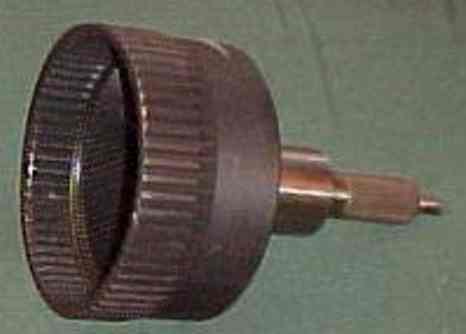
Tracy box's. The torque on that end is limited to 200 foot pounds and the
spline is right out of the C6 A4OD tranny. I think he cuts the drum off.
Paul Lamar
The Rotary Engine News Letter. Powered by Linux.
ACRE NL web site.
http://www.rotaryeng.net
You Tube
http://tinyurl.com/beqqxas
Copyright 1998-2014 All world wide rights reserved.