Hi,
Can you please explain the problem and solution of balancing when
using a
cut down e-shaft with single rotor 1/2 Mazda 13b engine.
Regards
Zahid
Balance is controlled by these equations. The Wankel is not
just statically balanced but dynamically balanced as well.
In a single rotor engine the counterbalance weights
must provide a STATIC balance for the e-shaft eccentric and
its rotor and must also account for the DYNAMIC wobble
caused because the static counter weights are not located
at the mechanical centres of the rotor and the eccentric.
It is impossible to do this.
They must be mathematically sized relative to their lateral
position from the rotor and eccentric centre line.
Paul Lamar
The Tracy ISO is physically attached to the flywheel.
Does that need to be brought in to balance equation as extra mass to mF
(front counter weight) or mR (mass Rear Counterweight)?
Regards
Zahid
The rear counter weight is hiding behind the ISO.
Paul Lamar
Here is how I solved some of the balancing issues.
There are a whole lot of issues interacting when building a new engine
configuration.
Weight control influences almost everything. A single rotor engine
certainly
requires a considerable flywheel, if one wants the idle speed somewhere
below 3000 RPM.
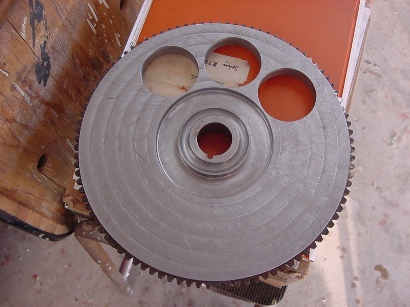
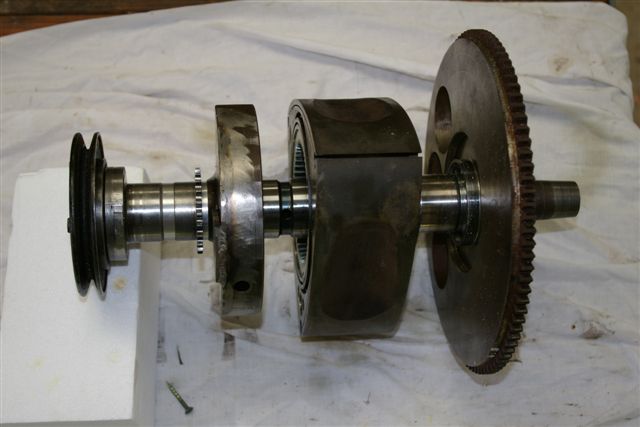
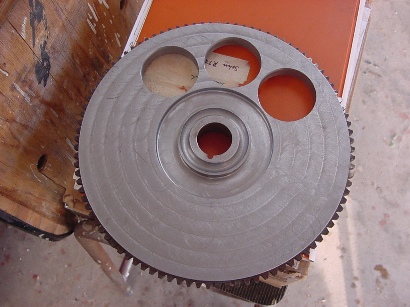
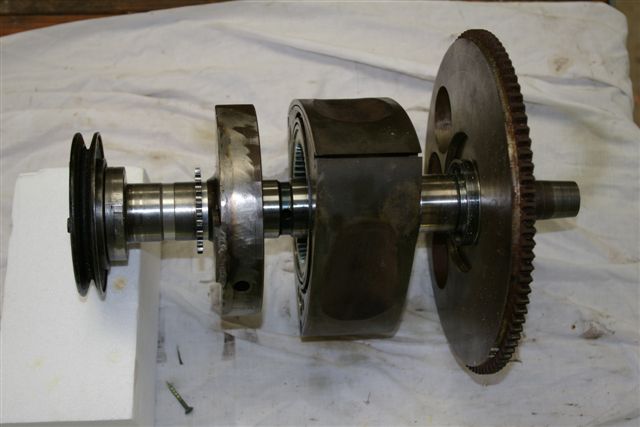
I integrated the rear balance weight in the flywheel (picture). The front
balance weight I modified with tungsten inserts before dynamic balancing. I
ended up with a clean rotating setup.
My engine is based on 12A rotor and housing, so I do not have any direct
comparison to 13B size parts.
FWIW.
Richard Sohn
N2071U
http://www.fairpoint.net/~res12/home.html
The Rotary Engine News Letter. Powered by Linux.
ACRE NL web site.
http://www.rotaryeng.net
You Tube
http://tinyurl.com/beqqxas
Copyright 1998-2015 All world wide rights reserved.