It amazes me what people will put up with to burn kerosene. .82
lb/(hp-hr) and they talk like its the greatest thing since sliced
bread. 19 gph! compared to 11.5 running lean with the IO-540. The
world really really needs a heavy-fuel-burning rotary! And this
article - is Amy smart enough to realize that if the CG difference
makes the plane feel so much different than her IO-540 RV-10, it
might mean there could be an aft CG issue with 4 people and bags?
Might that be something to discuss in a flight review article?
David Bonorden
I would never buy one. Diesel fumes stink and they are carcinogenic.
Packard figured that out in 1930"s. The power to weight ratio sucks.
Diesel should only be used in trucks and ships. The only reason it is
popular in European cars is the tax is a dollar a gallon less. If
they taxed it as high as gasoline ($7 or$ 8 gallon) it would
seriously affect the European economy.
----------------------------------------------------------------------------
C172 gasoline verses C172 diesel data from the Cessna web site.
Diesel fuel is a pound heavier than gasoline. Gas is six pounds per
gallon and diesel is 7 pounds per gallon.
44.6 gallons of diesel weighs 312 pounds of fuel.
Max useful load on a Diesel C172 is 742 pounds. Subtract the full
fuel weight and you get 430 pounds. Range is 588 nm. 85% power is 132
HP. Cruise speed at 85% power is 118 kts or 5 hours.
8.9 gallons an hour or 62.5 pounds per hour. BSFC is therefore .47.
Not a lot different than a fully leaned Mazda rotary. And typical for
a diesel engine running near full power.
How can this be? Everybody knows that diesel cars get much better
mileage than gasoline powered cars. The fact is diesel engines
running near full power are not much better than gasoline engines
based on a HP per pound of fuel burned. See the attached chart.
A leaned Mazda rotary at 132 HP would be about the same BSFC but the
gallons per hour would be higher at 62.5/6 or 10.4 gallons per hour.
A turbo compound rotary on the other hand would be down in the below
.4 range or about the same as a truck diesel running at 50% power.
------------------------------------------------------ The numbers
for a stock Lycoming powered C172 are:
56 gallons of gasoline weighs 336 pounds of fuel. Max useful load is
758 pounds. Subtract the full fuel weight and you get 422 pounds.
Range is 580 nm. 80% power is 128 HP. Cruise speed at 80% power is
122 Kts or 4.8 hours.
Four kts faster than the diesel.
11.8 gallons an hour or 69.6 pounds per hour. BSFC is therefore .54
which is a typical for a Lycoming rich of peak.
It would take a long time to pay for the extra $15,000 you will pay
for a diesel powered Cessna 172.
Not to mention you are required to throw the diesel away at 1200
hours if it does not pass detailed inspection. No overhaul allowed.
If it does pass 1200 hour detailed inspection you are required to
throw it away at 2400 hours. No exceptions.
At 100 hours a year that is 24 years. At that point the Mercedes A
class diesel engine will probably no longer be available so the air
plane, in theory, will be worthless. One would have to replace the
engine now certified in the Mercedes A class diesel powered Cessna
172 with some other engine and obtain an FAA one time STC.
I don't see it.
Do you want to tow or do you want to go?
Paul Lamar A hobbyist doubt: if the density of Diesel fuel, the
weight per volume, is higher: would this mean that in a liter of
Diesel fuel there are more Carbon and Hydrogen molecules to be burnt,
and thus, the power density of fuel is better, a liter of Diesel
yields more heat when burnt, this adding to explain the better SFC of
Diesels in terms of gr/kW/hr, besides the better thermal efficiency
from the much higher Compression Ratio, or this was taken into
account in Diesel vs Gasoline SFC figures?
I've learned from this e-mail about the meaning of 'Thermal load'
inside an Internal Combustion Engine, HP per surface of combustion
chamber, and MEP, I remembered having read about the worries of the
early Air-Cooled Wankel Engine designers about increasing CR and
Power, because of the dangers of thermal load (on bearings and
shafts?), and on the lubricating oil film, but the chart you added
indicates an extremely low thermal load for the only RCE on it, a
Mistral. Is this because of the poor MEP of Wankel, or for other
reasons?
The high surface to volume ratio of Wankel RCE combustion chamber was
blamed for the improvable fuel economy, but the surface/volume ratio
in the time of top compression may not be the same during the process
of expansion, where the working chamber volume increases, both in the
irregular shaped Wankel and in the classical cylinder. How does the
plot of surface/volume ratio changes from 'TDC' to 'BDC' compare in a
Wankel versus a reciprocating engine? Somebody to forward here a
chart about this? Is there a safe way, safe for the lubricating oil
film, the bearings, and the shaft, for increasing the housing and/or
Rotor working surface temperatures, a condition that was shown
improving fuel economy and cleanliness of exhaust gases? Some tested
an Iron housing, with improved results in SFC and exhaust gases over
Aluminum, but I've read nothing about differences in thermal
dilatation between housing and rotor when both are made of iron, and
if this makes possible having the engine seized when overheated.
Thanks have a nice season. Best regards. Salut † Jose Gros-Aymerich
Madrid, Spain
-------------------------------------------------------------------------------
PS: the Napier was a Single Sleeve-Valve. 2-Stroke, compression
ignition engine, Harry Ricardo solved the problems met during
development of top power S S-V engines by making the Sleeve Open,
something like an annular piston, 10% of the piston surface, that
contributed with 3% of the total engine output via the Sleeve-Valve
operating mechanism and the crankshaft, this also eliminated the
very complex 'Junk head', of former S S-V engines. The clean air acts
had an influence on the SFC of car engines, as a clean exhaust
required a bit of fuel consumption increase, but I was told about an
experience around 1975 with a Seat/Fiat 4 cylinder, OHV, camshaft in
the block side, 1438 cc car engine being measured an SFC of 178
gr/HP/hr, pretty good.
---------------------------------------------------------------------------------------------
Well, i just can not sit Idylle by here. I have flown both C172
Diesel and not ad nauseam. And i can say the 172 with the
diesel firewall forward Package which includes a constant speed
prop, single lever engine command, full fadec. And no such
nuisances as carb Heat, shock cooling, having to lean, leaded
fuel and so on is a whole different league.
The conventional172 does not even come close.
Not in performance neither in
handling. Add to that the reduced fire hazard of diesel fuel !
And yes the WEIGHT of diesel fuel is higher PER VOLUME but it
also has a higher energy content, you might want to comparison
apples with apples. By the way Switzerland does NOT "subsidize"
diesel and there too the diesel is the way into the future. It
is not the fault of the diesel engine that the American industry
never managed to build a decent one. And thus has to scorn
those who did.
Lutz Strobel
Talk about apples and oranges. Put the constant speed prop and turbo on
the 172
and fly the comparison again. It is self evident that the turbo CS prop
gasoline 172
would be head and shoulders above the econo shit box diesel engine
version :)
As bonus it would not stink and give you cancer :)
Unlike diesel trucks in California the econo shit box powered 172 is
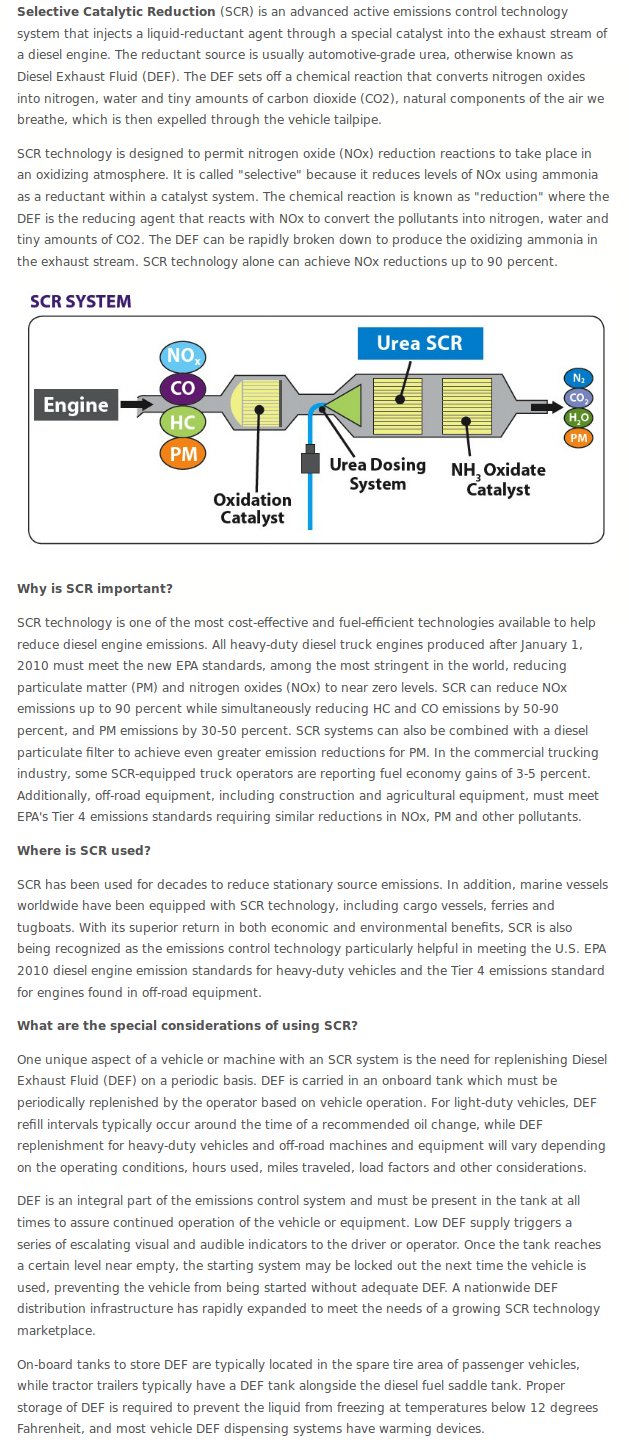
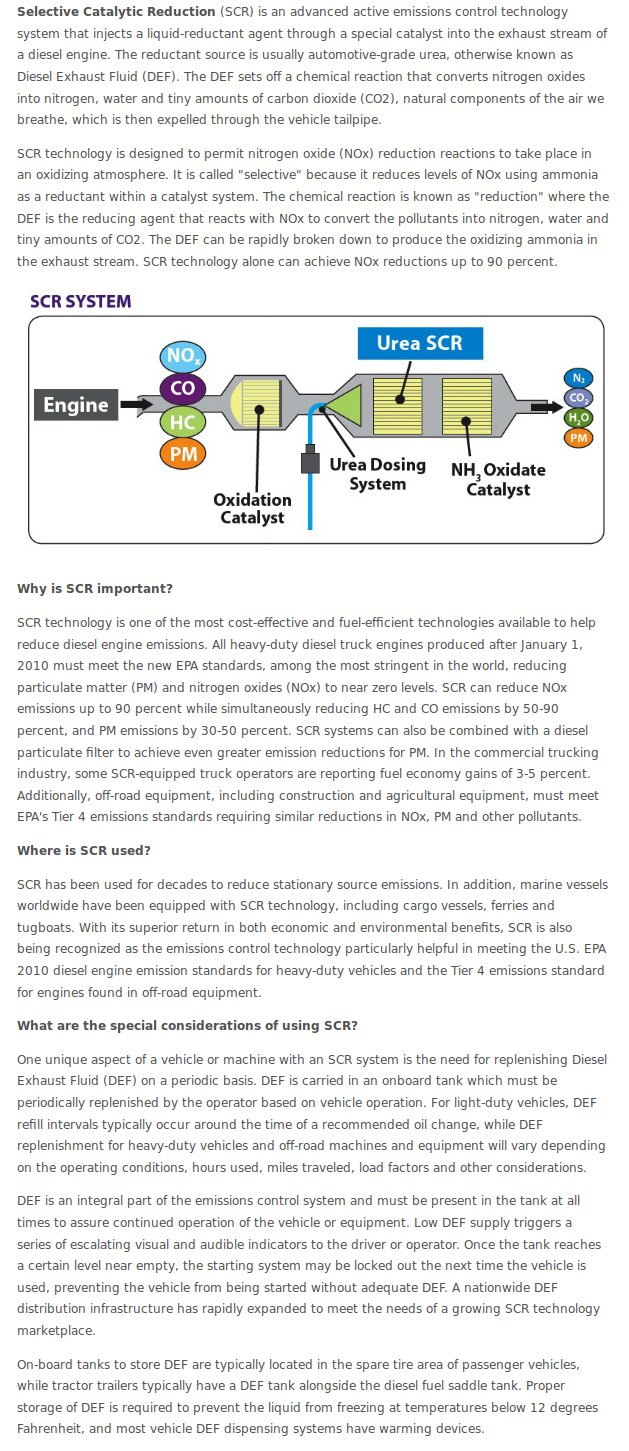
NOT burning pig piss (SCR).
"Every day, on and off-road diesel engines create air pollutants that
can adversely affect human health. ARB requires engine manufacturers to
meet strict pollution standards for newer engines. However, fleet
owners may need to install a verified diesel emission control strategy
to clean up emissions from older, dirtier diesel engines. A diesel
emission control strategy is a technology that, if maintained properly,
reduces harmful air pollution from diesel engine exhaust before it is
emitted into the air."
Paul Lamar
The Rotary Engine News Letter. Powered by Linux. ACRE NL web site.
http://www.rotaryeng.net You Tube
http://tinyurl.com/beqqxas
Copyright 1998-2015 All world wide rights reserved.