I know some of you are into sailing.
I have invented a new bi plane catamaran sail boat. The advantage is
for a given sail area the over turning moment with two main sails and
two main sails is less.
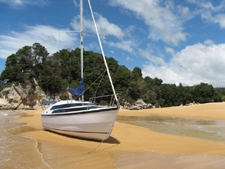
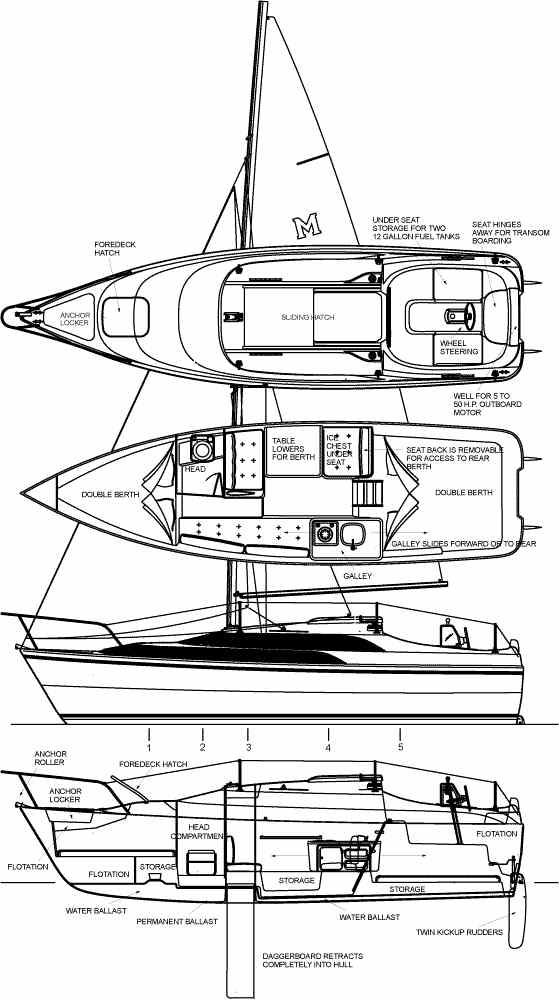
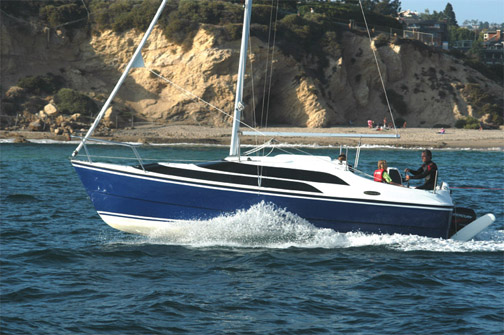
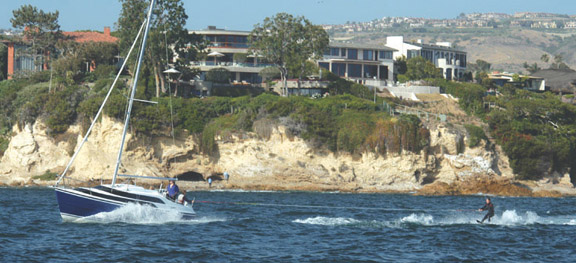
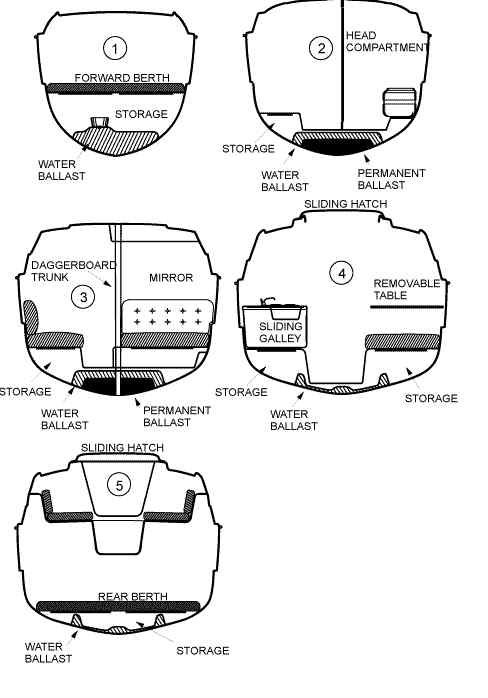
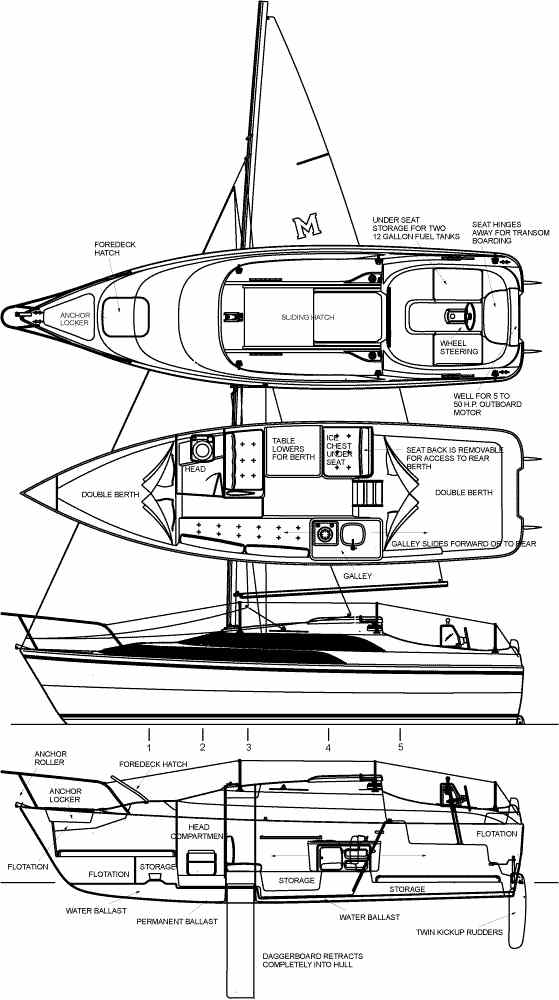
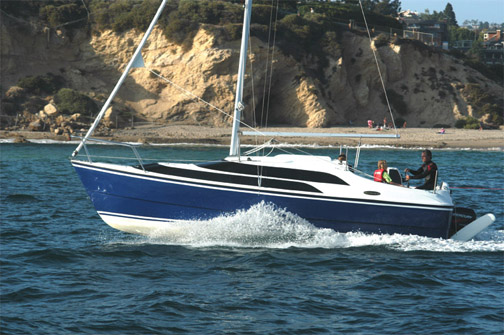
This version is a water ballast catamaran. It use two stock MacGregor
water ballast 26 foot sail boats that can do 23 Kts with out board
motor power.
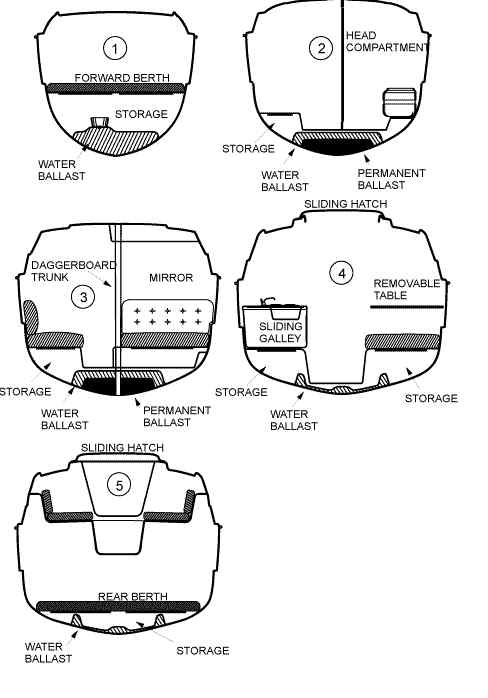
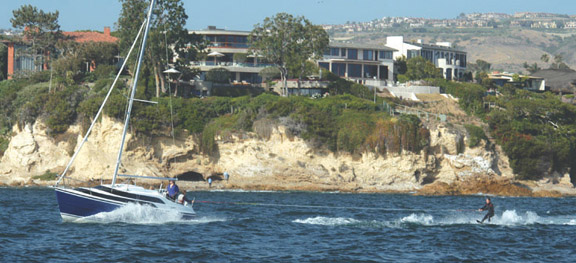
You empty the water ballast to reduce the weight and then they will
plane when powered by outboard motors.
When sailing on a reach or upwind you ballast the lee boat.
When sailing down wind you empty the water ballast in both boats for
mare speed. You hoist a square sail between the two mast for down
wind.
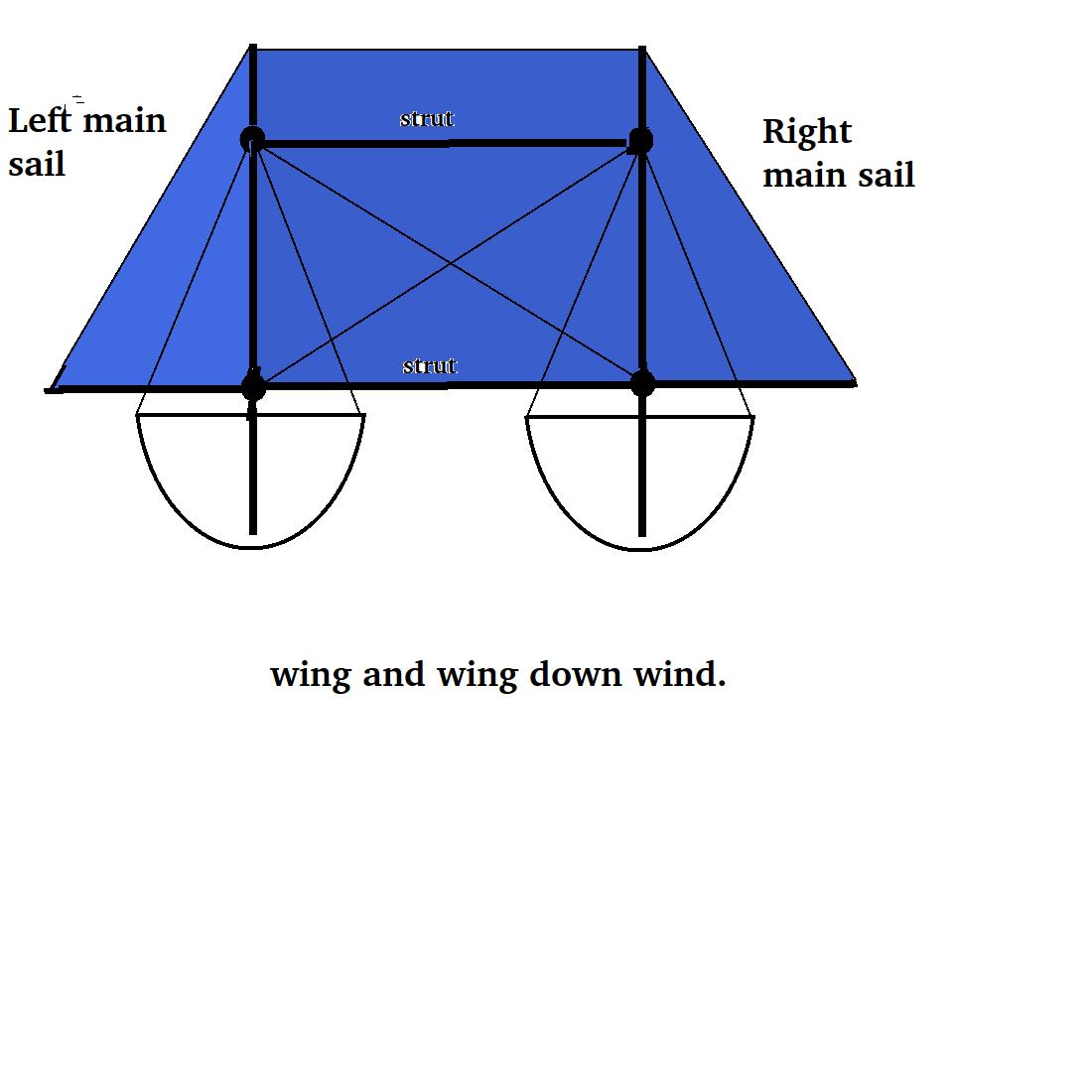
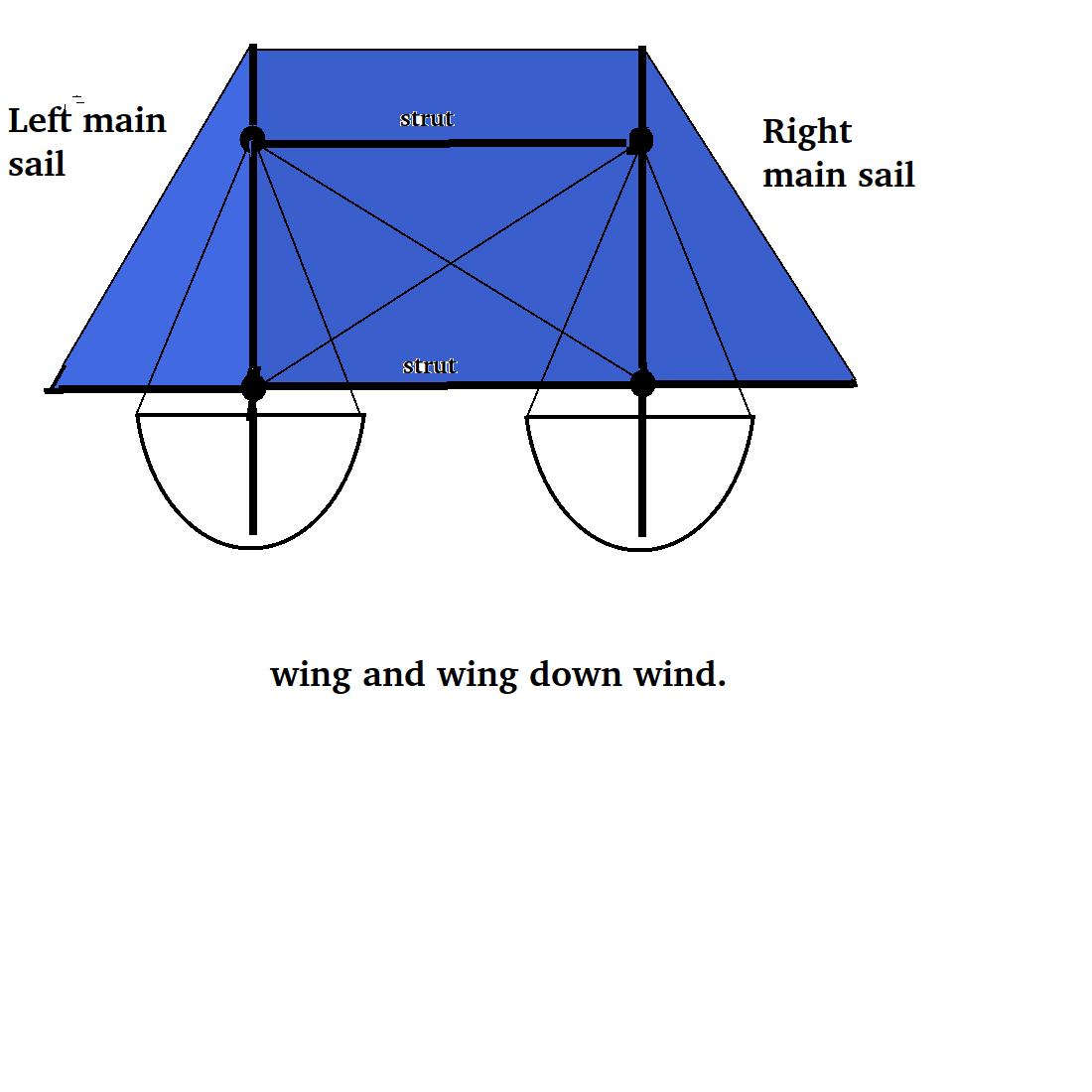
With two mast you don't need a heavy box cross beam. Two ball
jointed struts and an X cable is all you need.
Locking the boats together It is all done with X shrouds and ball
jointed struts. See the sketch.
Paul Lamar
http://www.macgregor26.com/
Hey Paul,
Build it and test fly it. Let us know how it turns out.
How were you planning on keeping the two hulls parallel so they are both
sailing in the same direction?
How were you planning on keeping the two hulls in alignment along their
centre lines such that one does not get ahead of the other?
I don't see anything in your diagram that indicates any con-straining
mechanism for those planes of rotation. I see only a con-straining
mechanism for the vertical transverse, "Z" plane but nothing for the two
horizontal, "X" and "Y", planes.
There's good reason why successful catamaran style hulls have a strong
bridge linking the two hulls together into one stable platform. It's
not pretty when the bridge is not strong enough to withstand the forces
placed on it when the sea starts working the two hulls.
Consider what happens when one hull is lifted at the bow while the other
is lifted at the stern. There is a tremendous force generated that
wants to rip the two hulls apart. Strapping the two masts together like
you plan will only result in one, or both, masts being ripped out by the
roots because they are not designed to handle forces of such magnitude.
Think about what happens when you jack up the right front tire and left
rear tire on a car. If the chassis is not strong enough the car will
twist and bend in weird places and eventually fail. It's not fun when
the chassis fails and parts start falling off. It's even less fun when
your boat tears itself apart.
I may be wrong about this. It wouldn't be the first time. You could
prove me wrong by buying two hulls and strapping them together as your
diagram indicates and taking it sailing. Please choose a calm day and a
small body of water for your first test flight.
Among my other talents and occupations I've been designing and building
ships for about 40 years. Don't waste your money and endanger your
life, and/or the lives of others, on this idea.
Mark LaPierre
There is another ball jointed strut from stern to stern and another
horizontal wire X. I'll do a 3D soon.
The hulls are allowed to pitch independently
as the larger the wave the more the distance between
crest. So locally large angle differences between hulls do not
occur in such a small boat.
I have extensive open ocean sailing experience like 3000 miles
in some of the roughest water in the world. Off the west coast of Baja.
The more the torsional flex in the
cross beam the lower the stress in this situation. The south sea
islanders lashed the catamaran hulls to together with
rope and small diameter wood logs. Low modules materials both.
The ideal cross beam in a conventional catamaran would
be a 3 foot diameter tube with one of more plain bearings
where the tube intersected the hulls. A thin sheet of teflon
could be used as a bearing materiel.
Two struts and a wire X is equivalent in this case. Think of it
as a thin sheet metal angle. Little or no torsional stiffness.
If you want a real world example peek at the rear suspension
of a VW Golf.
Paul Lamar
The Rotary Engine News Letter. Powered by Linux.
ACRE NL web site.
http://www.rotaryeng.net
You Tube
http://tinyurl.com/beqqxas
Copyright 1998-2015 All world wide rights reserved.