A few days ago we (Chris Wade and I) thought we have made a great
invention by putting spark plugs on the rotor, and thereby eliminate
the leak across the plug hole. We contemplate to file a patent. I
am a patent attorney so I take up the task of drafting. At that
point I found two US patents on the idea. Too bad. But those
patents would not work in our view as they did not deal with the
issue of insulation of the high voltage.
Gordon GAO
I got bad news for you Gordon. There is no leakage across the plug
holes. To get leakage you need a pressure difference.
Down load Kenichi Yamamoto books from here that deal with this and
many other rotary engine subjects..
http://www.rotaryeng.net/interesting.html
http://foxed.ca/rx7manual/manuals/REbyKenichiYamamoto-1971.pdf
http://foxed.ca/rx7manual/manuals/REbyKenichiYamamoto-1981.pdf
Paul Lamar
Just a small comment,
NSU started out with spark plugs in the Rotor, in their DKM machines.
It likely is anticipated. Of course improvement patents are always
possible but who would make it more complicated? You need 3 plugs and
a sliding contact somewhere. Changing plugs requires motor
disassembly.
Rolf Pfeiffer
Just another small comment,
I don't think that a sliding contact is needed, to implement spark
plugs in a wankel's rotor. Inductive coupling between stator and
rotor, located on the flat side wall, would do the job nicely.
However I read that some reasearch work has been conducted to
replace spark
plugs by laser pulses that illuminate all the chamber volume. That
seems to me to much more promising than a rotor spark plug
configuration
Has anyone heard of that and about some results of these studies ?
Philippe Dejean.
If you hear about it and a year passes with out appearance it did
not work :)
Paul Lamar
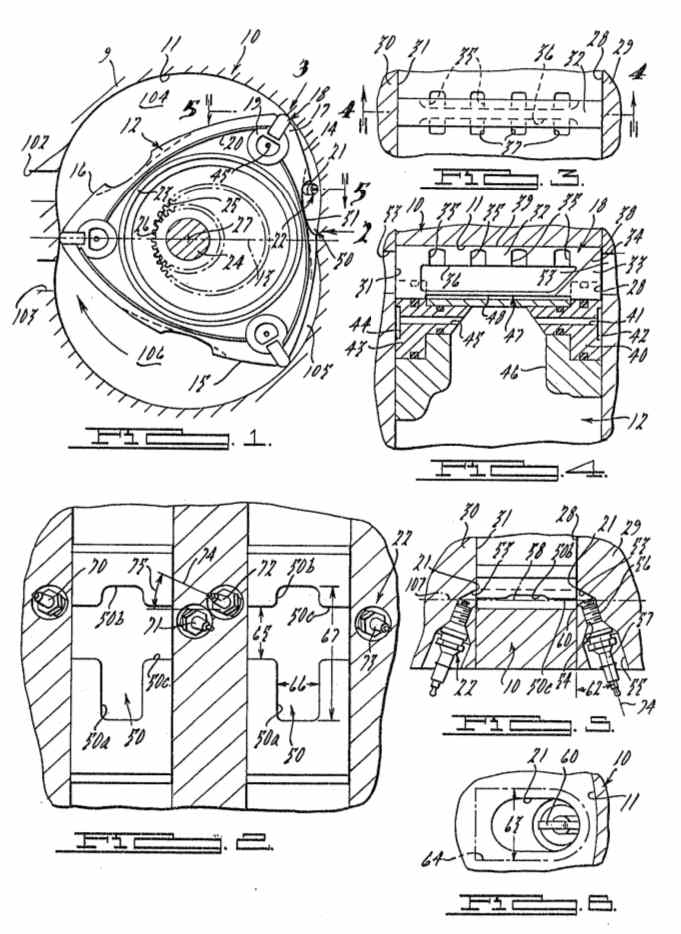
Some patents exist with plugs located in side plates, Ford
applied for one in
1978, but I guess their were not the only ones.
Have a good season, best regards, + salut
Jose Gros-Aymerich
Madrid, Spain
Here is some of the patent. Ford spent money building it and testing it.
Nice try.
Obviously it did not work as nobody sold a rotary with this arrangement.
Paul Lamar
------------------------------------------------------------------------------------------
Patent Quote
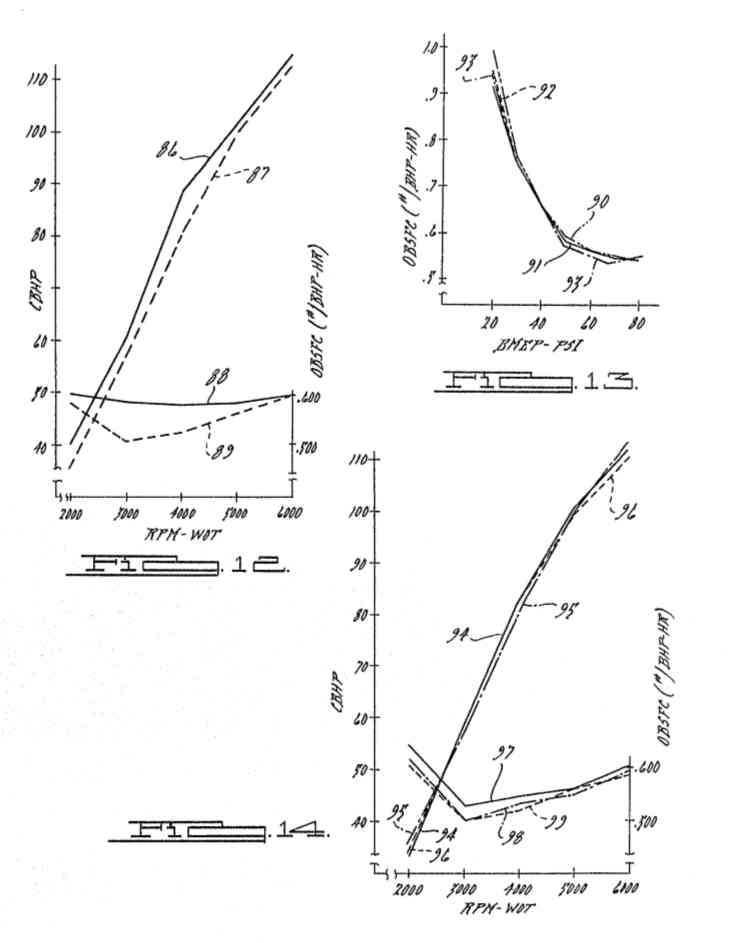
"Test results were collected using an engine rig making it possible to
fire 1, 2 or 4 spark plugs per rotor in the side housings (the 4 plug
arrangement has one pair at the leading position and one pair at the
trailing position of the compression pocket), and 2 plugs in the
peripheral trochoid wall per rotor. These results indicated that one or
two spark plugs located in the periphery of the rotor housing, in
conformity with prior art constructions. consist- ently gave lower brake
horsepower than the symmetrically arranged 2 side spark plug
construction and the 4 side spark plug construction (with the pairs
fired with '00 lag between them).
With reference to brake specific fuel consumption, the lowest was
obtained with the firing of two or four symmetrically arranged spark
plugs in a trailing position in the side housing; peripherally located
spark plugs gave low fuel consumption at high road load
speeds/horsepower ratios. The highest fuel consumption may result when
only unsymmetrical side spark plugs are fired, such as one plug only in
a side housing.The reason for improved fuel economy with this invention
is explained by a modified flame front.
In Figure 7, a typical flame front for leading ~d trailing spark access
openings in a peripheral spark port engine of the prior art is plotted.
A flame front is designated by a line centred about one of the openings
and has a lateral component extending along the width of combustion
chamber (abscissa in millimetres) and extends substantially forwardly in
the direction of rotation (see arrow) along the length of the chamber
(ordinate, in millimetres measured from the minor axis of the trochoid).
The different flame fronts represent the time lag from ignition to
ionization represented by degrees of rotation of the eccentric shaft.
Note that the flame front tends to proceed in the direction of rotation
and back-up in a direction counter to rotation is relatively small. This
is due to strong compression turbulence and quenching on the trailing
side which slows down the flame travel counter to, rotation.
As shown in Figure 7, the flame front emanating from the trailing spark
access opening 190 never adequately proceeds across the chamber and
leave pockets of uncombusted fuel. The trailing spark access opening'190
is smaller than the leading opening 191, for the reasons described
earlier. ,Thus. to fully combust the mixture, the leading position is
required which results in low efficiency since it is coming too late in
time to do the total job.
The symmetrical side spark openings 192 in the trailing position of
Figure 8 represent the preferred mode of this invention. Note the
thorough coverage of the chamber by the flame front early in ignition
event. The flame propagation proceeds from opposite points of the
compression pocket and has less distance to travel to provide uniform
combustion of the compressed mixture within the time limit available.
Maxtmum pressure from the flame front is 0 reached at about 15 of
eccentric shaft movement after top dead center; at this point, the
pressure rise can be as high as 60 psi per degree, although a maximum
rise of 40 psil degree is more desirable.
The flame front should be in the position shown for a flame front at 150
to obtain smooth operation of the engine. If the maximum pressure is
reached earlier or later, considerable roughness is encountered. To
obtain a maximum pressure at 15 ATDC for the trailing plug opening 190,
firing must be earlier which produces negative work causing a .Loss in
power of 11-15'. 'rhe symm- etrical arrangement of this invention
reduces negative work substantially. "
End patent quote.
The Rotary Engine News Letter. Powered by Linux. If you want off the
list PLEASE let me know and I will remove you. ACRE NL web site.
http://www.rotaryeng.net You Tube
http://tinyurl.com/beqqxas
Copyright 1998-2015 All world wide rights reserved.