For cars, trains, and even boats the problemn is rather simple as far as
only the "realistic look" is concerned.
For flying models, the problem is much more complicated because it is
not only scaling down a real airplane and adapting weight and power.
The tricky thing is the Reynolds number that influence the flow around
the aircraft body.
Theoretically reducing the scale while keeping the Reynolds number
constant would be possible to a certain extent, but that would mean that
the speed should increase in the inverse ratio of dimension.
The weight and the power should remain the same.
Scaling down a low subsonic light aircraft by a small amount (80% for
instance) while keeping exactly the same Reynolds is probably feasable.
In a way, this is not very different to that is done when a single or
two-seater is used at higher mass to test a new body shape for a future
four seater (like the Dyke Delta, for instance)
Very often, RC flying models just wouldnt' fly properly without some
small modifications.
As the Reynolds number is reduced by a large amount, the original wing
profile has to be changed for a better adapted to small Reynolds.
This is even more accute for the tail, and the tail surfaces have to be
slightly enhanced...
The nice thing about that is that if the model flies correctly (in
particular it recovers easely from spin) the real size aircraft with its
more efficient tail would recover even better.
SCALE
So if an RC model is created to test a future real scale aircraft, there
is no other way to make large enough (and hopefully fast enough) to
represent accurately enough the future large scale one.
12:1 is much to much !
Usually, the scale is also chosen to make the calculations as simple as
possible : 4:1 for instance. (32 ft wingspan is reduced to 8 ft, that is
still reasonnable both for handling and shape accuracy)
MASS
In order to keep time constants similar, the mass is often chosen in the
proportion of the power four of the scale.
This means that the wing loadind is in the proportion of the square of
the scale and thus, (neglecting the Reynolds effect) the stall speed is
in the proprtion of the scale (60 mph woudd be reduced to 15 mph)
Comparing the measured stall speed and the calculated one for the full
scale version is a very simple way to ensure that the Reynolds effect is
kept in reasonnable range.
For low wing loading aircraft, it is recommended to make a heavier model
(proportion of the cube of the scale).
POWER
For any model, and surprisingly for full scale light aircraft as well, a
rule of thumb give a power to mass ratio around 100 watt per kg (or 45,3
watt per lbs)
For a 2500 lbs MTOW light aicraft, that would mean 113.25 kW or 152 HP.
This rule of thumb is usefull to determine the minimum power of the RC
model.
An electric motor is generally prefered beacause it is much easier to
adjust the power to a known setting.
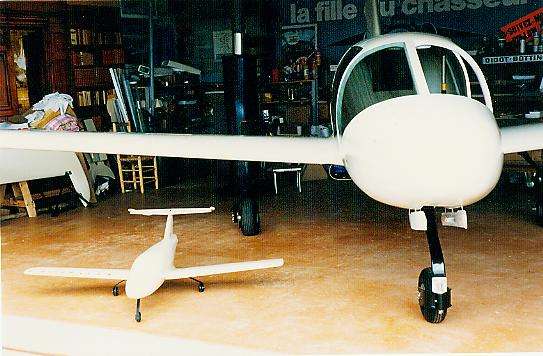
The picture is the one of the G801 "Orion" prototype and its 6:1
model./(See attached file: 215_3_avec_bebe.jpg)/
Philippe Dejean (from France)
Seeing as you know some about model aircraft; If you build one with
a 12:1 scale (1" = 1 foot), do you scale the intended real airplane
weight the same? Do you need to scale the engine power to lift the
weight at the same ratio? Thank you for your thoughts,
Dale Davies
We never thought about that at all. We just used the best materials
available at the time. Mostly Balsa and silk span.
I did have a large Skyvale FF model made out of aluminium with
points type ignition model air plane engine.
"Before 1950, all engines were either spark ignition or diesel. But
unlike modern large spark-ignition engines such as the Quadra, Zenoah
or other "appliance" engines (weed-eater, chain saw, etc.) that are
used to power giant scale and other large aircraft, the pre-1950
"sparkers" were not equipped with magnetos. They derived their spark
from a spark coil in virtually the same way as an automobile engine.
The airborne ignition system consisted of a small spark coil, a
condenser (capacitor), an ignition battery
(3 Volts), and a switch. The circuit was very simple:
The timing of the spark is controlled by the contact points, usually
on the front of the engine, operated from a cam or a flat on the
crankshaft. When the points close, DC current passes through the
primary of the spark coil. When the points open, the breakdown of the
magnetic field in the coil causes a very high voltage to be induced
in the secondary windings, which is passed to the spark plug via a
high-tension lead. The spark occurs just before the piston reaches
top dead center. The timing of the spark can be advanced or retarded
by manual adjustment of a timer arm which rotates the bracket or
housing containing the points. Normally the engine is started with
the spark retarded, then the timing is advanced (the engine speeds
up) and the needle valve is adjusted. In order to preserve the power
in the airborne ignition battery, a booster battery is usually
connected for start-up and adjustment of the engine, then
disconnected immediately prior to launch."
Merry Christmas to all and a Happy New Year.
Paul Lamar
This article explains true scale model weights with another at the
bottom of the page for scale speed. I think this is what Dale was
asking about.
http://www.alphalanding.com/rc-track/true-scale-weight-of-a-110-rc-car/
Jay Jacobs
Thank you Jay, that is exactly what I was on about. The idea to build an
airplane but to test with a scale model. I could not see how a 1/10 scale
plane could fly at 500 pounds being 1/10 what the planed plane would be.
I watched some videos of giant scale planes and they have 20kg and
40kg classes, some using turbine engines. Impressive watching a Sikorsky
helicopter fly with a turbine engine that may or may not fit in a Mazda 3
or CX5. Models of an A380 and B747-400 or a 6 foot long B -71.
Dale Davies
For cars, trains, and even boats the problemn is rather simple as far as
only the "realistic look" is concerned.
For flying models, the problem is much more complicated because it is
not only scaling down a real airplane and adapting weight and power.
The tricky thing is the Reynolds number that influence the flow around
the aircraft body.
Theoretically reducing the scale while keeping the Reynolds number
constant would be possible to a certain extent, but that would mean that
the speed should increase in the inverse ratio of dimension.
The weight and the power should remain the same.
Scaling down a low subsonic light aircraft by a small amount (80% for
instance) while keeping exactly the same Reynolds is probably feasable.
In a way, this is not very different to that is done when a single or
two-seater is used at higher mass to test a new body shape for a future
four seater (like the Dyke Delta, for instance)
Very often, RC flying models just wouldnt' fly properly without some
small modifications.
As the Reynolds number is reduced by a large amount, the original wing
profile has to be changed for a better adapted to small Reynolds.
This is even more accute for the tail, and the tail surfaces have to be
slightly enhanced...
The nice thing about that is that if the model flies correctly (in
particular it recovers easely from spin) the real size aircraft with its
more efficient tail would recover even better.
SCALE
So if an RC model is created to test a future real scale aircraft, there
is no other way to make large enough (and hopefully fast enough) to
represent accurately enough the future large scale one.
12:1 is much to much !
Usually, the scale is also chosen to make the calculations as simple as
possible : 4:1 for instance. (32 ft wingspan is reduced to 8 ft, that is
still reasonnable both for handling and shape accuracy)
MASS
In order to keep time constants similar, the mass is often chosen in the
proportion of the power four of the scale.
This means that the wing loadind is in the proportion of the square of
the scale and thus, (neglecting the Reynolds effect) the stall speed is
in the proprtion of the scale (60 mph woudd be reduced to 15 mph)
Comparing the measured stall speed and the calculated one for the full
scale version is a very simple way to ensure that the Reynolds effect is
kept in reasonnable range.
For low wing loading aircraft, it is recommended to make a heavier model
(proportion of the cube of the scale).
POWER
For any model, and surprisingly for full scale light aircraft as well, a
rule of thumb give a power to mass ratio around 100 watt per kg (or 45,3
watt per lbs)
For a 2500 lbs MTOW light aicraft, that would mean 113.25 kW or 152 HP.
This rule of thumb is usefull to determine the minimum power of the RC
model.
An electric motor is generally prefered beacause it is much easier to
adjust the power to a known setting.
The picture is the one of the G801 "Orion" prototype and its 6:1
model./(See attached file: 215_3_avec_bebe.jpg)/
Philippe Dejean (from France)
The Rotary Engine News Letter. Powered by Linux. If you want off the
list PLEASE let me know and I will remove you. ACRE NL web site.
http://www.rotaryeng.netYou Tube
http://tinyurl.com/beqqxas
Copyright 1998-2016 All world wide rights reserved.