Paul,
You seem to be on top of the cheap fuel injection world so I'm
seeking your advice. Don and I are a couple other buddies are racing
a Lemons car-a 1988 Honda Prelude with some 275,000. The car is
mechanically pretty sound, but its engine management system is
failing, though it's hard to diagnose because it only happens when
the engine is warm form running for considerable time.
One alternative to trying to trouble-shoot the stock system is to fit
a complete aftermarket engine management system. We don't need
anything terribly sophisticated or elaborate. Our priorities are low
cost and ease of calibration. The existing system controls both the
fuel injection and the ignition timing so we need a system that can
do both, though I guess we could replace the distributor with one
from a carbureted Prelude and go with a fuel injection only
computer.
I've seen the Megasquirt I (fuel injection only) for around $235 on
eBay for the solder-it-yourself version. The Megasquirt 2 can be had
for around $290. Do you think these are good choices, or do you have
a different favorite, cheap engine management system?
Any advice is appreciated.
Csaba
All of them have a steep learning curve. Megasquirt included.
It is better to learn how to do it yourself then you totally
understand how it works. It actually takes less time
to learn how to program it then it does to get some of them
working.
We have screwed around with the Motec for two months
and that supposedly is the best EFI system in the world.
How it is doing something is proprietary and that causes
problems when you are trying to trouble shoot something later.
If you don't mind learning a little Basic programming I would use a
Maximite and
write my own EFI.
http://geoffg.net/maximite.html
http://circuitgizmos.com/gizmo-store/#!/CGCOLORMAX2-Color-Maximite-Retro-Computer/p/53819402/category=14171440
gizmo@thebackshed.com
It appears this company is having trouble so you might have to contact Geof
in Perth for another source for the assembled color Maximite in the US
or Oz.
Geoff Graham
<geoff@mmbasic.com>
This is the easiest system to program for any hard ware control.
The Maximite Basic language is designed for hardware control.
To give you an idea of the power of a $60 maximite
it has 32Gig logging memory.
The $3000 Motec M800 only has 1 meg.
This is a digital record of what your efi did. It can save the
mixture value and manifold pressure every 100 RPM from idle to redline.
for hours every time the RPM changes buy 100 or even 10 if you wish.
You can save the date every tenth of a second if you wish.
There is plenty of storage space on the 32gig SD card.
You can then pull the SD card out of the MM and read it
in your computer.
To get that amount of logging with a Motec you have
to buy their expensive LCD instrument panel called the ADL 3.
This is all there is to logging data.
OPEN "log.dat" FOR OUTPUT AS #1.
You do this at the start of the program.
Then when the RPM changes
you do this. You can also do this every tenth of a second
if you wish.
PRINT #1 , rpm,
PRINT #1, manpress,
PRINT #1, intaktemp
Thats it. You have logged all your data.
When you exit the program you
CLOSE #1
all this helps when you are making changes to the mixture map
or table.
Here is a preliminary code. ' means it is info.
'SETPIN pin, cfg [,target]
'Will configure the external I/O pin according to cfg :
'The original Maximite has 20 I/O pins numbered 1 to 20, the Color
Maximite adds
'another 20 I/O pins on the Arduino connector. These are labeled D0 to
D13 and A0
'to A5.
'0 Not configured or inactive
'1 Analog input (pins 1 to 10, A0 to A5)
'2 Digital input (all pins and 5V tolerant on pins 11 to 20)
'3 Frequency input
'4 Period input
'(pins 11 to 14)
'(pins 11 to 14)
'5 Counting input
'(pins 11 to 14)
'6 Interrupt on low to high input change (pins 1 to 20, D0 to D8) for target
'7 Interrupt on high to low input change (pins 1 to 20, D0 to D8) for target
'8 Digital output
'(all pins)
'9 Open collector digital output to 5V (pins 11 to 20, D0 to D13) In
this mode the
'function PIN() will also return the output value.
'The starting line number of the interrupt routine is specified in the
third 'parameter
' target . This mode also configures the pin As a digital input so the
value of the 'pin
'can always be retrieved using the function PIN().
'See also IRETURN to return from the interrupt.
'See also:
'IRETURN PORT P
Mode 1
'Mode 4
For n = 11 To 20
SetPin n, 9 'set pins 11 to 20 as open col 5 v output
Next n
Open "data.txt" For output As #1 'data file
SetPin 8, 6, 10 'pin 8 low to high int gosub line 10
SetPin 10, 1 'manifold press on pin 10
SetTick 1000,20
BakGnd:
manpre = Pin(10) 'A to D on pin 10. may need to be scaled
manpre2 = manpre * 10
'Print manpre
manpre3 = Int(manpre)
PWM 20,manpre3,manpre3 'pulse width on primary injectors
'''''''''''''''''''''''and secondary 20 times a second
GoTo BakGnd
10 RPM:
RPM = RPM + 1
IReturn
20 RPMRoutine:
RPM=RPM*30
Cls
Locate 30,30
Print "RPM = ";RPM
RPM = 0
Locate 30,60 'col 30 line 40
Print "Manifold pressure = ";manpre 'EFIS function
IReturn
Read this. I may have some PC boards you
can have for the injection transistor with heat sinks.
http://www.rotaryeng.net/simple-cheap-555.html
I like to use cheap video coax to the injector
as that wire is a major source of electrical noise.
You will get lots of help from me on everything.
We want to put the code in the public domain.
Much much easier to program than C which is used by the others
including mega squirt.
Paul Lamar
Here is a nice circuit board from Hong Kong but there must be some
part kits or assembled boards out there some where.
Paul Lamar
Here we go. This looks like the best bet.
http://www.altronics.com.au/p/k9555-maximite-colour-computer-kit/
Paul Lamar
This seems like a lot of work. Wouldn't it be easier to fix the factory
EFI? Given the age of your Lemons racer, it's likely to be an issue with
the wiring harness, fuel pressure, sensor(s), fuel injectors, or ECU.
If you go the aftermarket route, you need to address those items anyway,
in addition to the learning curve issues. IIRC, Lemons is mostly about
reliability as it is a 24 hr format. If it were me, I think I'd prefer
to have a couple of spare Honda ECUs laying around on race day instead
of a custom installed aftermarket ECU that might have been soldered
together at 2am.
Also, while the factory system is pre-OBD II, it does have some
diagnostics should something go wrong. With the aftermarket EFI
approach, on-board diagnostics might prove to be insufficient.
Rob Weinstock
It is nearly impossible to change the mixture map on those
old EFI's. If you want max power that is what you will need to do.
Some of the newer ones can be re--flashed but it takes a lot
of info on how it works and what it is currently doing to do that.
That info is closely held by the car manufacturers or the
EPA would have known VW was cheating :-)
Paul Lamar
Lemons cars are likely not pushing the HP limits. As such repairing the
stock system may work fine. A lot of the older ECM'S in Japanese cars
were mounted under the passenger seat. I would contact Honda tuners for
advice re: what systems they have hacked for tuning and then get ALL the
parts off a wreck or two. Sensors are probably different so they need to
be installed on the Lemons car. Only do this if you gain an ECM that can
be hacked.
Remember that problems can be on the ECM circuit board. Most sensors use
three wires. They are 5V, ground and signal which will be between 0V and
5V. Fuel injectors are supplier 12V on a common wire and the ground is
opened and closed to turn them on and off. It is a safety thing for the
electronics. More volts in the sensor circuits means more fuel injected.
The O2 sensors generate a voltage between 0V and 1V. The system tries to
control that voltage at 0.5V. If you can read cross counts on a scan
tool, you want a high cross count number. If it is low the O2 sensor is
probably past it's prime.
Dale Davies
Sounds like if you can change the efi you can make other changes.
If you want to win you need more HP. The way to do that is move
the torque peak closer to the red line. The way to do that is use
tuned intake runners.
If it has a Helmholtz intake plenum it is real easy to reduce the volume.
Take a picture of the intake and send it to me..
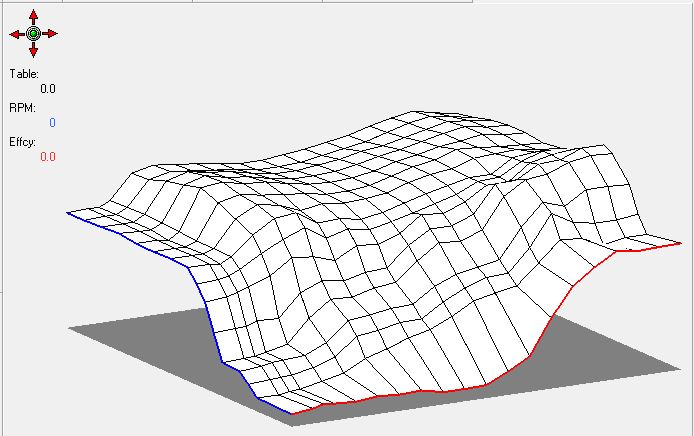
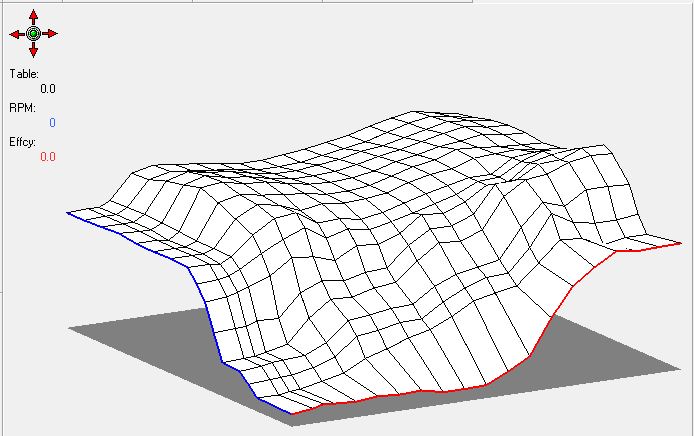
Here is the mixture map on the TTC engine.
You will have to change this on the Lemon
BTW Quiz question of the month.
Why does adding a heat shield on a front drive car between
the exhaust manifold and the radiator make the car faster down
the straight?
Paul Lamar
The Rotary Engine free News Letter. Powered by Linux.
If you want off the list PLEASE let me know and I will
remove you. ACRE NL web site.
http://www.rotaryeng.net
You Tube
http://tinyurl.com/beqqxas
Copyright 1998-2016 All world wide rights reserved.