On May 29, 2016 3:01 PM, "paul lamar" <
rotaryeng@earthlink.net
<
mailto:rotaryeng@earthlink.net wrote:
It occurred to me if you pump enough oil into the rotor roller
bearing it will cool it. Normally a roller bearing requires very
little oil and that is why they are used in charge cooled engines.
The trouble is there is not enough oil flow to cool it at high power
levels mixing small amounts of oil with the fuel.
The engine will also need a scavenge pump to get the hot oil out and
through a oil cooler and back into an oil tank.
On the OMC all that is needed is one small hole in the back side of
the eccentric lobe to feed high pressure cooling oil into the rotor
roller bearing. High pressure cooling oil is fed into the eccentric
shaft from one end or the other.
There will also be a hole in the case just beyond one or both of the
main bearings to suck the excess cooling oil back out. Some the of
the fuel mixture will be sucked out as well but the fuel will go to
the bottom of the oil tank and can be recovered.
If the intake plumbing is changed so no mixture goes into the main
bearings and through the rotor then no fuel will be sucked out with
the cooling oil. In other words just a simple p-port is all that is
required. In fact there will then be no mixture in the center of the
engine at all.
Here is a scavenge pump on ebay for $219. One section can be used as
the pressure pump.
This is A MAJOR DEVELOPMENT for charge cooled engine including the
AIXRO if it works.
Paul Lamar
Paul, and Group, Roller, needle, and ball bearings have a
requirement for light lubrication. Rollers especially. If over
lubricated the rollers can hydroplane, or skip. The problem is when
they touch back down. Think of a plane landing and how the tires
often chirp as they match speed. The same thing can happen to a
roller bearing with catastrophic results. The steel can weld
together or chip causing bearing failure
Bill Jepson.
How does load and clearance factor in?
The load on the rotor roller bearing is quite complex due to
centrifugal force on the rollers varying as they make their way
around the center of the e-shaft.
It's a wonder they work at all. I think it is still worth a try.
Paul Lamar
Roller bearings will handle heavy loads better than most rolling
element bearings when done right. Clearance is a factor. A more open
bearing can handle more volume of oil. A good example was the older
Kawasaki Z1. 900cc. It had a roller bearing crank, and a good one.
The thing was the oil pressure on that engine was very low. About 3
psi at idle and 15-20 max to prevent too much oil at the crank. Guys
would put a automotive oil pressure gauge on them and freak out and
call the shop. Most gauges for plain bearings START at about 20 psi.
That engine had a lot of side clearance on the rollers. In fact the
bearings were wide open on the sides.
Bill Jepson
I can see a scenario where the rollers could stop with no centrifugal
load on them. Such as a simple shaft situation. The rotor rollers
bearings are in an unusual and unique environment. They are constantly
subjected to centrifugal loads. Besides that they are subjecting to high
heat well beyond 500 F. Silicon Nitride rollers might work better.
I think more oil to cool them will work. It may not take much.
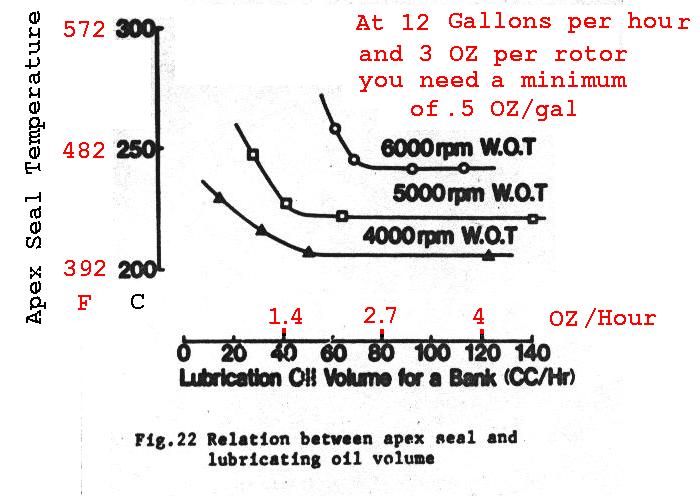
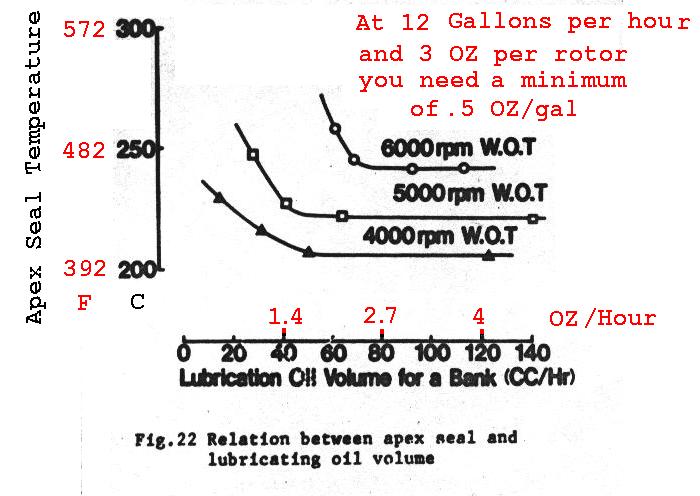
Here is a chart of apex cooling oil requirements. If the iron apex
seals get much over 500 F they too will fail.
Paul Lamar
The Rotary Engine free News Letter. Powered by Linux. If you want off
the list PLEASE let me know and I will remove you. ACRE NL web
site.
http://www.rotaryeng.net You Tube
http://tinyurl.com/beqqxas
Copyright 1998-2016 All world wide rights reserved.