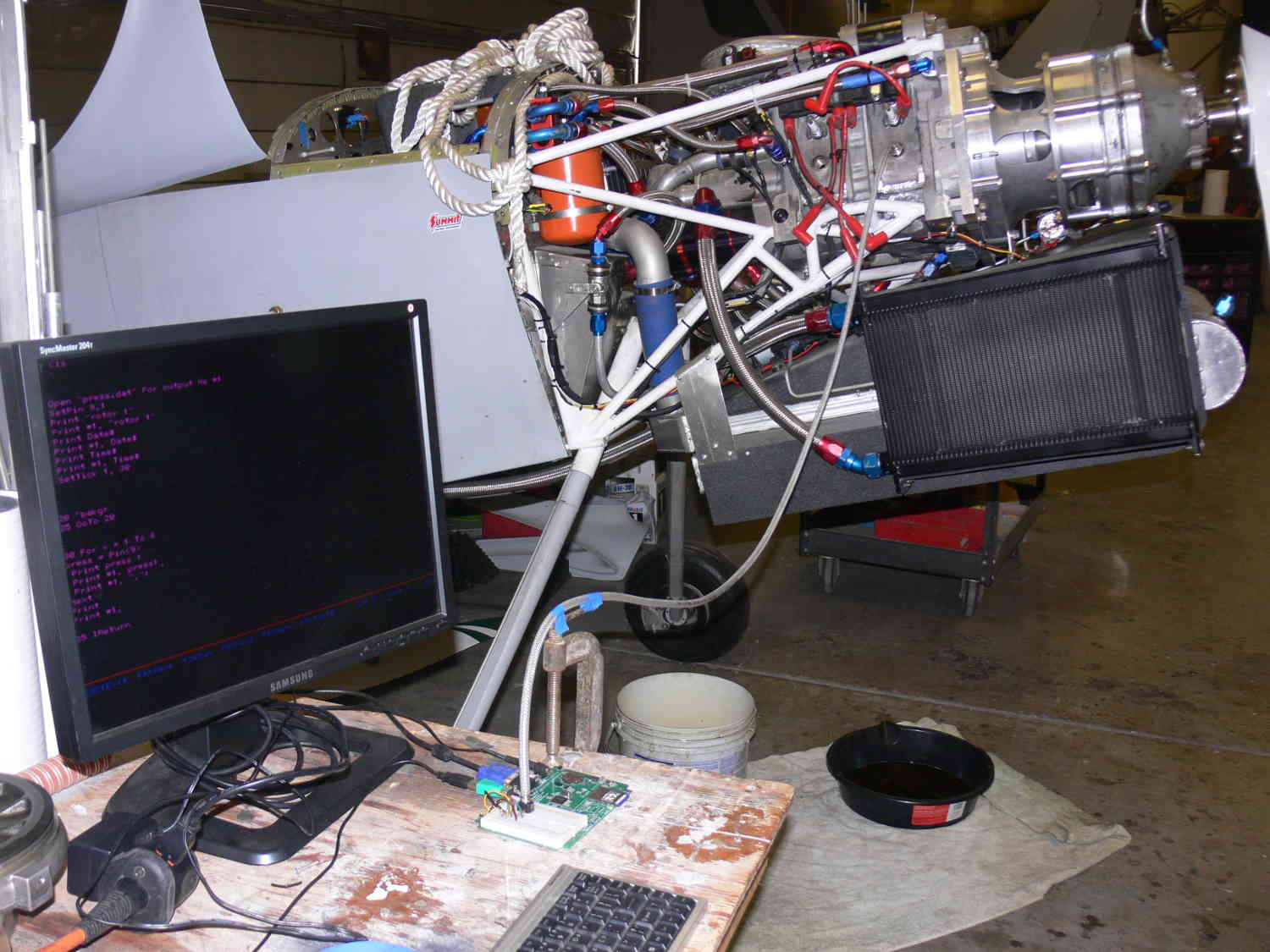
OK Steve, Subtract .37 from the data and 3.3 volts is 150 psi.
Here is the latest and greatest. 1 msec. 6.8 K bottom resistor and
1.2 K top resistor. The resister junction goes to the MM pin 9. The
top of the resistor divider goes to the out put of the .37 to 4 volt
pressure sensor.
Paul Lamar
Hi Paul
Chart is - Average Data - Subtract 0.375 Then Multiplied by 150/3.3
Of all the 3000 data samples, there was only 228 samples of actual
rotor pumping.
Odd! The sample period appears the same as the 10mSec run. MMBasic
Ver 4.5 claims a min tick of 1mSec
Also, the 8 samples are very consistent so taking them and averaging
appears superfluous.
Steve Izett
I have to run the MM program, run around the front of the airplane
to behind the left wing, over to the cockpit and turn on the master
switch and hit the red starter button on the far right of the
instrument panel for 30 seconds. Then run back around the front of
the airplane and stop the MM program :-)
The data file on the MM 32 Gig SD card was then about 229K. Before
I sent it to you I erased over 100K of samples taken at 1000 samples
per second :-)
When Pete is in the hangar he hits the starter button for me just
after the program starts running. That cuts down on the number of
useless samples.
The data looks great. One usually gets about 60 psi when rotating
the engine with the starter. The throttle was still closed. That
rotor is in perfect condition. That is quite understandable with
ceramic apex seals.
Paul Lamar
I’m thinking I’d like to buy a sensor and try this on our engine. So
is my math right here: If starter RPM was 400 (total guess) then that
is 1200 pulses/min. 20 pulses/sec. So the timing of a complete pulse
would be 50mSec from beginning to end.
I was thinking about the rise time required for the transducer. I can
buy 5v 150psi general purpose transducers for oil/water/air etc for
$20 but wondering what their response time is. They don’t document
performance of these transducers as far as I can see. I was hoping to
not have to purchase a lab quality transducer. Can anyone help me
with this?
Steve Izett
The sensor I got was not the best. Free Scale, now NXP, makes better
sensors with out the zero offset. Here is a pdf.
They cost about $12 US.
Thanks for your help on this Steve.
Paul Lamar
One trick you might use is to have the program running in a loop, not
saving anything, and at the first significant voltage rise, start
saving data. After a period of no voltage increase, stop saving and wait
for the next event.
This way, one person can easily run the tests.
Gary Knutson
Real good idea Gary. I'll give it a try.
Thanks.
Paul Lamar
Took only a few minutes.
Worked like a charm.
As soon as you move the prop it starts taking data.
Thanks Gary.
Here is the new program.
The second half is a bit harder to implement.
Paul Lamar
The Rotary Engine free News Letter. Powered by Linux. If you want off
the list PLEASE let me know and I will remove you. ACRE NL web
site.
http://www.rotaryeng.net You Tube
http://tinyurl.com/beqqxas
Copyright 1998-2016 All world wide rights reserved.