Hi Steve,
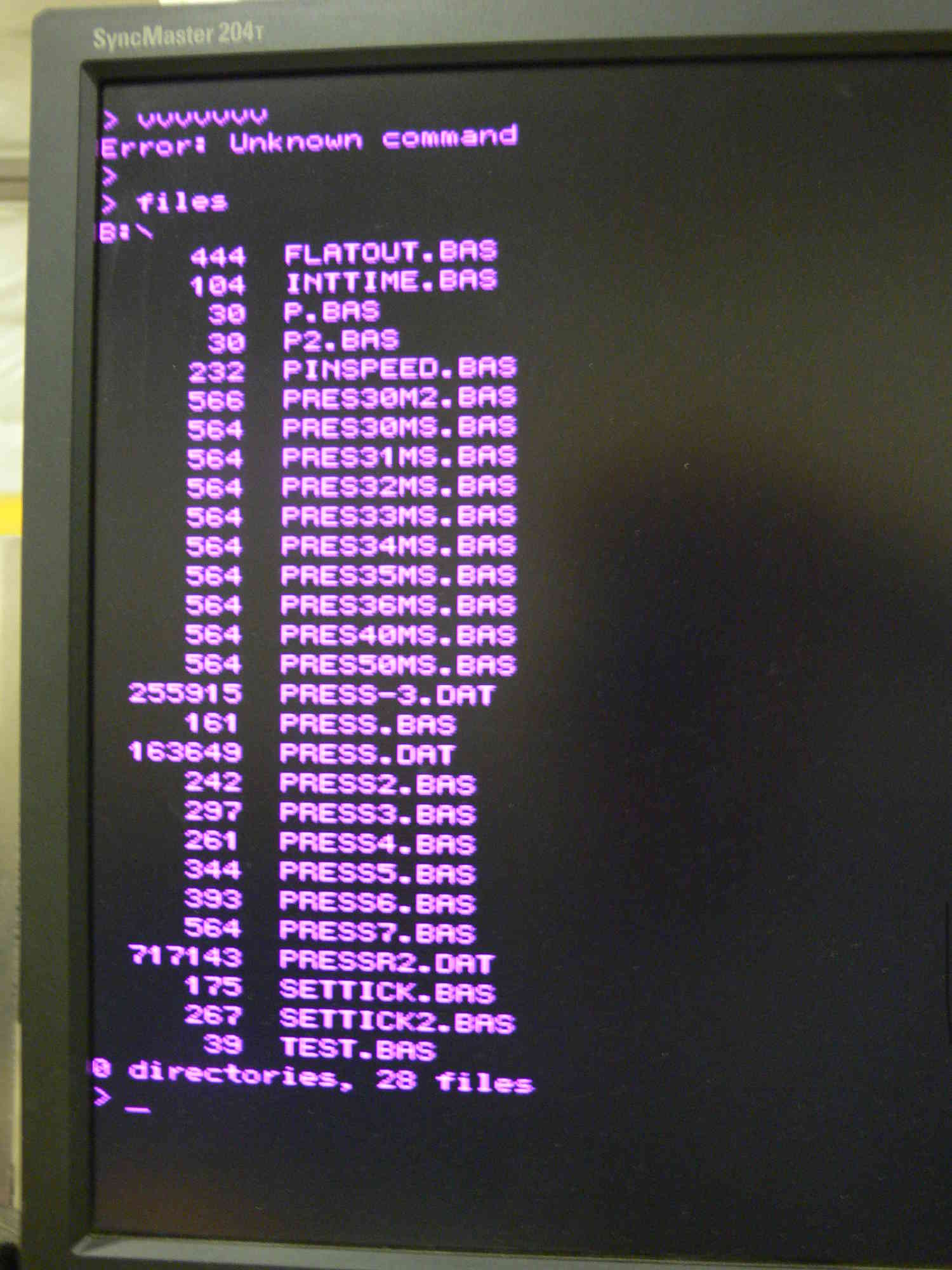
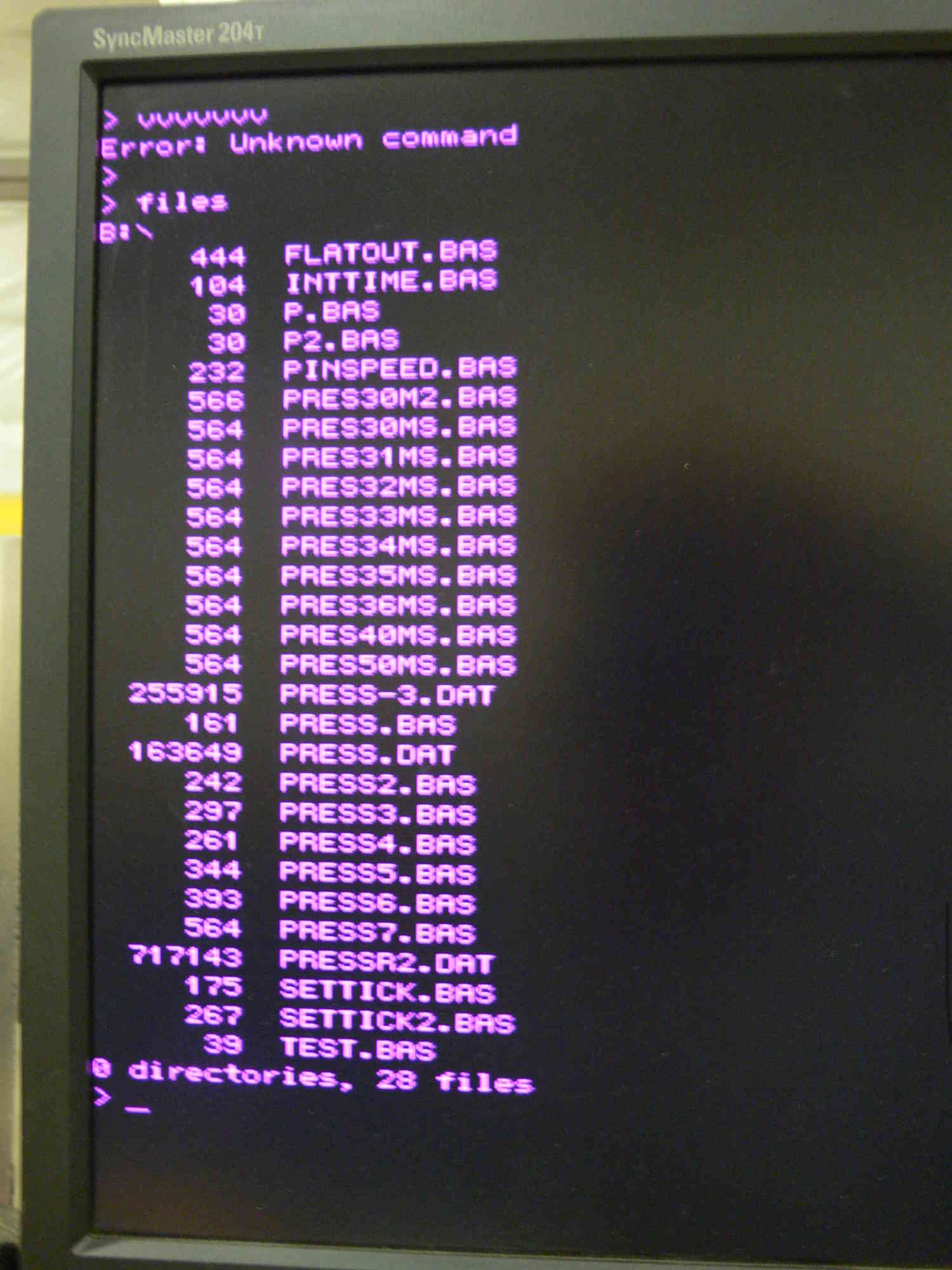
This is rotor 2. Please process with your spread sheet program.
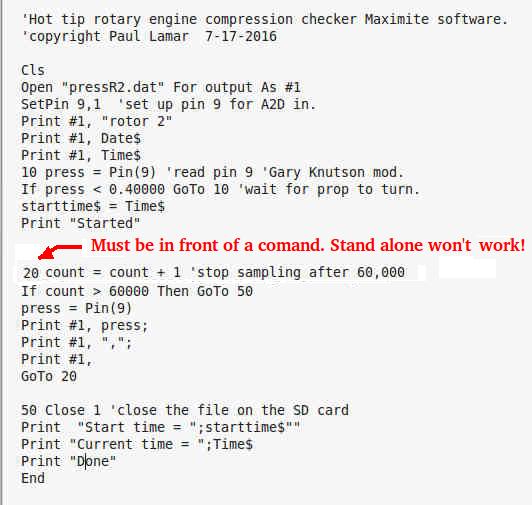
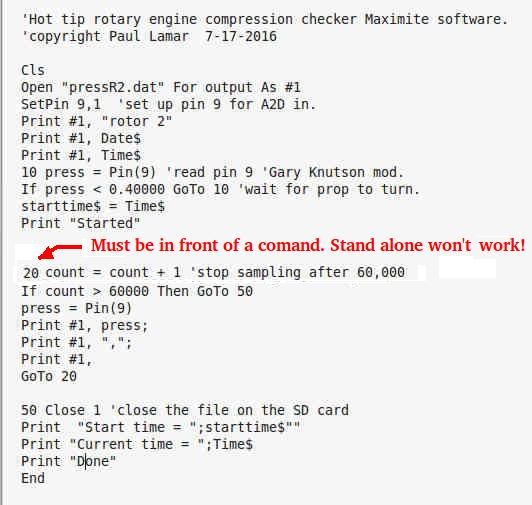
With the latest program it starts recording the instant the prop
moves. It stops after exactly one minute. This keeps the file size
down. I also edited (deleted) the last half as I only ran the starter
for about 30 seconds or less.
Paul Lamar
Hi Paul I noticed the 8 readings called by the interrupt routine are
all very different now. eg. 0.861523, 0.902881, 0.946387, 0.995801,
1.04736, 1.09141, 1.13545, 1.18916, Previously it looked like the
sample rate was faster. If I average them we will loose a great deal
of resolution. If I chart each reading the waveform is distorted as
the time between the 8 A2D readings and between the sets of 8
readings is different.
Confused Steve
I am not sure what it was doing when we had it set to 1msec.
I think it takes at least 4 msec to write to the file and the
display on the screen per sample. 8 samples 32 msec.
I will rerun both rotors recording only on the SD card and see if
that helps. I'll just run it wide open and what ever time it takes
that will be the interval. No software interrupt.
I will try to run it for one minute.
This is the program that I will use. Flat out.
Can you handle one big long comma delimited file?
Paul Lamar
OK Steve I went over there and did it right away. It took data for
one minute flat out. No print screen. 60,000 samples.
Here it is.
Paul Lamar
Hi there Paul
Here is the chart of the first few thousand data points
Looks good and consistent between chambers.
Steve
Nothing could be finer. That rear rotor is in perfect condition. That
engine did
not damage the turbo. What a relief.
I'll rerun the front rotor with this software. Screen I/O is notorious
for taking
a lot of time. That is why you need two Maximite's. One for the EFI and
another for the EFIS. Both Maximite's can be wired to the same sensor.
The Maximite is great. Mark Steitle and I were working on an auto land
system with two ultrasonic distance sensors mounted on the landing
gear of his 3 Rotor rotary powered Lancair ES. (Now for sale!)
Just a matter of getting your PID right :-)
Thanks a bunch Steve. Do you have my book "How to Cool your Wankel"?
Paul Lamar
Steve, here is the data from rotor 1.
BTW I discovered another addition to the MM software manual for Geoff.
If one puts
a line number in, one must follow it with a command. If one does not
MM will ignore it and will delete it from the saved file. The next time you
try to load and run it you will get the error message "line number not
found".
Here is what I had in mind for the MM "auto landing". Not a real auto
landing
but a landing aid consisting of a stick of LED's mounted vertically
on top of the instrument panel. The LED's starting at ( 4 meters up)
the top
sequentially lite as you get closer to the runway. The speed at which
they move down
is proportional to one's sink rate. Another LED stick along side that
one can give
sink and climb rate. It is all about PID :-)
It is all just about adjusting the fore and aft position of the control
stick to
have the correct sink rate. When the distance to the ground is about
right one flares with out decreasing the sink rate too much which
would become the climb rate or a flare.
This would be a great training aid to help people to learn to land
faster for less money :-)
http://www.hexamite.com/hxn125tr.htm
Paul Lamar
The Rotary Engine free News Letter. Powered by Linux. If you want off
the list PLEASE let me know and I will remove you. ACRE NL web
site.
http://www.rotaryeng.net You Tube
http://tinyurl.com/beqqxas
Copyright 1998-2016 All world wide rights reserved.