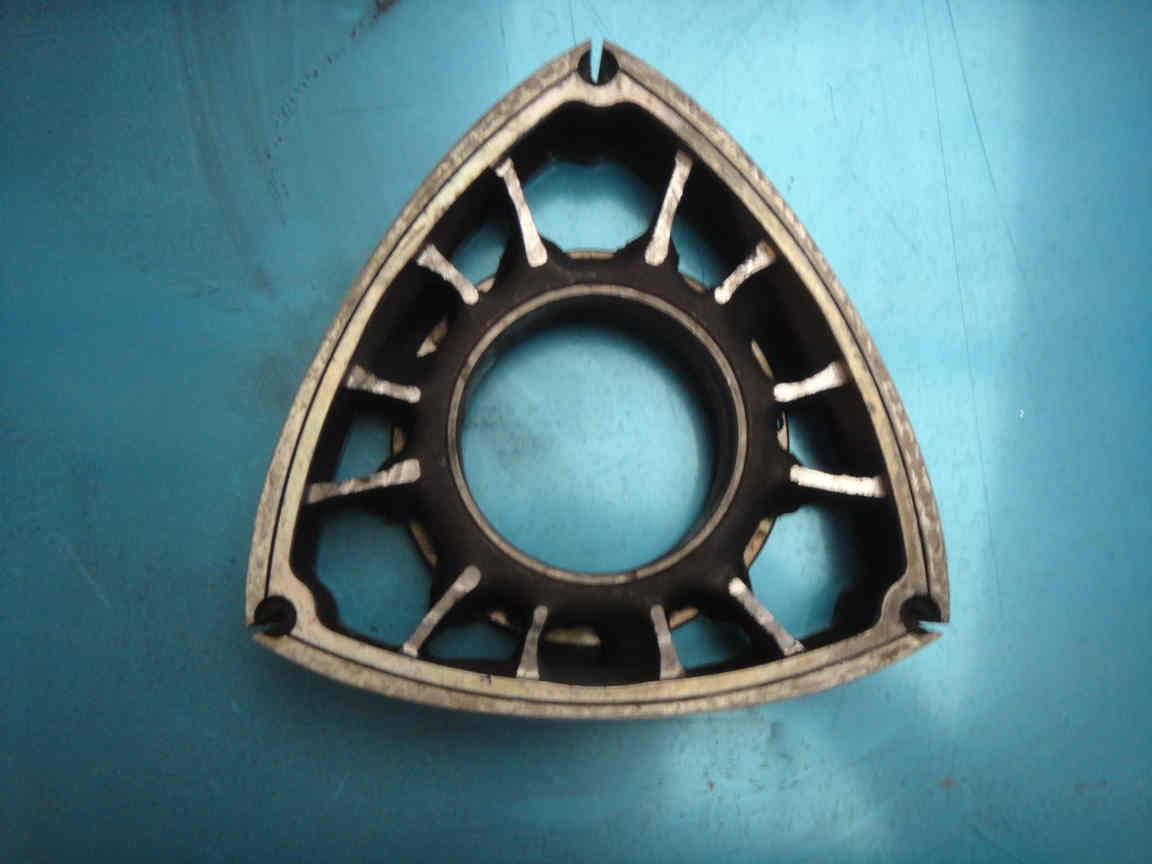
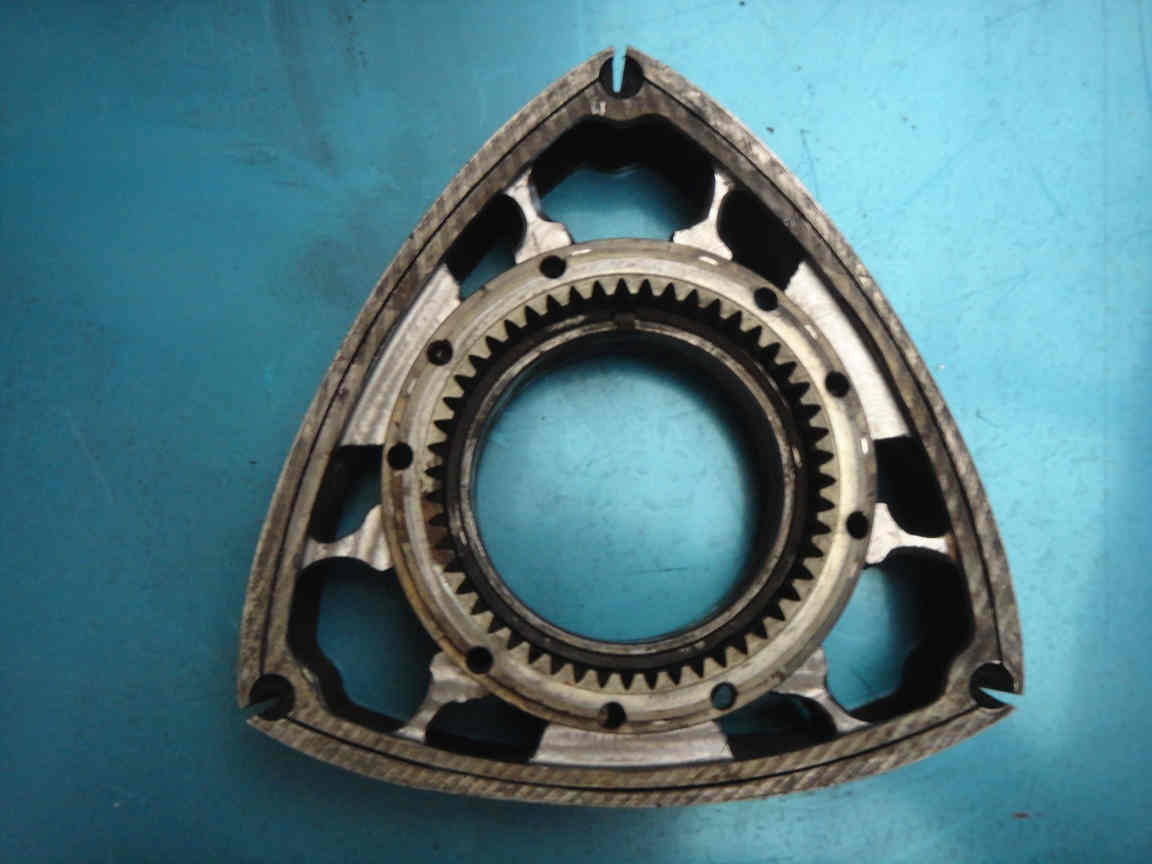
Double the thickness of the hard steel liner in the rotor housing.
This will result in a large reduction in fuel burn. BSFC.
A simple change that Mazda could do on the production line.
Paul Lamar
Hi Paul,
How does a thicker liner give a reduced fuel burn; what is the theory here?
Dave in Perth
One wants to keep as much heat (temperature) in the combustion chamber
as possible.
The steel liner acts as insulation as unusual as that sounds.
The heat transfer rate of steel is much much lower than that of
aluminum. So one would want to increase the thickness of that insulation
to prevent the aluminum from carrying away all the temperature.
As the combustion chamber rotates toward the exhaust port it is exposed
to new areas of the steel liner which are cooler and more and more
temperature is lost. When one cools off a high pressurized container
the pressure is reduced in that container. This pressure is acting on
the face of the rotor and that is what generates the torque so potential
torque is lost.
(P1 X V1) / T1 = (P2 X V2)/ T2
Change any one of those terms in the first part and that will change
the second part.
https://en.wikipedia.org/wiki/Gas_laws
It is a fundamental law of physics.
Note: in this attached chart stainless steel is 1/3 that of cast iron.
That is why Mazda
needs to find out how to make the rotors out of SS instead of cast iron.
SS would be good for the liner as well if it were possible to chrome
plate it.
Also note: In the heat transfer units it is
watts / (meters X Temp)
so the thicker material the less heat is transfered.
Thermal details like this affect the BSFC of all engines.
Hold a piece of steel on a grinding wheel with your bare hands.
Then hold a piece of the same size SS and report back :-)
Paul Lamar
What is the heat transfer and cost of a ceramic coated rotor versus a
stainless steel rotor?
As temperatures increase of the combustion chamber and sliding surfaces,
what is expected to be the next weak link? I suspect carbon buildup
would go down but will seal lubrication become an issue?
Speaking of seal lubrication, which paper addresses why the apex seals
aren't lubricated from inside the rotor?
Aron Buster
"What is the heat transfer and cost of a ceramic coated rotor versus a
stainless steel rotor?"
I have no idea. Who is doing ceramic coating on rotors? I would hesitate
to use it because if some of it came off it would destroy the wear
surface of an expensive rotor housing.
The proven Iannetti silicon nitride seals will tolerate double the
temperature of an iron seal.
I have never heard of one breaking up in 17 years of this news letter.
They are
solid silicon nitride with fiber reinforcement supposedly.
The main function of the apex seal oil is cooling the iron apex seals.
Synthetic oil will tolerate
twice the temperature of organic oils. Turbine oils are better than that.
If you use synthetic oil there is no carbon build up.
"Speaking of seal lubrication, which paper addresses why the apex seals
aren't lubricated from inside the rotor?"
You got me there. Do you know if there is such a paper?
It might work but the holes would have to be tiny and subject to
plugging up if some one used organic oils.
Also the amount of oil required is a function of horse power.
I don't know how one would control that with out a computer.
Mixing with the fuel already does that. More fuel, more oil, more power.
---------------------------------------------------------------------
BTW the stock oil "injector pump" is not really a pump at all.
It is an oil distribution device. The oil is transfered to the
compression chamber when the chamber is lower pressure than atmospheric.
The so-called injectors are open to the atmospheric pressure.
If one turbo charges the RX7 engine less apex seal oil will find its way
to the apex seals. Mazda themselves made that mistake when they turboed
the rotary back in the late 80's and all of the 90's.
If you have one of those you better be mixing oil with the fuel :-)
Some people on the Internet get it wrong. They incorrectly assume the
RX7 "pump" AKA OMP is fed from the high pressure oil system. Not true
except possibly for the RX8. It is fed from a gravity fed atmospheric
pressure oil reservoir. To prove it take the RX7 "pump" off and turn the
engine over with the starter and see if oil squirts out of the supply hole.
Paul Lamar
Hi Paul
I have looked quite a bit into ceramic coatings to act as thermal
insulation layer and as part of that I have talked to several world
experts on the subject matter
There are actually quite a few options for applying thermal coatings
onto metal surfaces and for the most part they can be applied to many
materials even some some low temp materials. Most are applied with very
high velocity impregnations. These nozzles are cnc programmed to apply a
pattern to get complete coverage
The issue is that I have not found any coaters who are able to guarantee
that the coating thickness will be uniform across the surface being
coated. This means than for the most part, the ceramic surface will need
to be lapped post coating process. This would make this process coast
prohibitive for low volume applications. Even for high volume
applications, it will be fairly expensive process because the thermal
insulating ceramics also tend to be extremely hard to to lap.
With that said, if Mazda proceeds with releasing a new rotary, I am
pretty confident that they will utilize some sort of ceramic insulating
layer to help meet the more stringent regulations
Regards
Simon Saba
Hi Simon,
The rotor would only need to be coated on the three outer surfaces,
wouldn't it ?
would they actually need to be lapped ? doesn't only the apex seal
contact the liner ?
Chris Hoskins.
Don't do it Chris. You won't even notice it as it will be less than 1%
lower fuel burn.
If a small part comes off you can kiss your engine good bye.
Also make sure you have a good air filter.
Paul Lamar
Hi Chris,
Paul is absolutely right
You can coat on the opposite surface (ie external surfaces surrounding
the chamber) and indeed you will not need to lap if on this surface
instead of the internal surface. It will still add insulation, however,
because of the excellent conductivity of the metal, the heat will
conduct sideways (ie radially) on the side plates, and axially and
rotationally on the housing. This will reduce the effectiveness of
adding the insulation. Certainly there will be an improvement but very
small relative to insulating the internal surfaces
The most effective, but unfortunately most expensive, is to insulate the
inside surfaces. On piston engines, there are several aftermarket
services that will coat the piston top and the inside surface of the
dome and it helps keep the heat inside by adding insulation and
reflecting radiated heat back in the piston. It would be an interesting
experiment for someone to coat the outer surfaces of the rotor and
quantify the impact.
Simon Saba
As long as there is no possibility of it coming off.
A piston engine will tolerate more debris.
GM patented a multi piece rotor.
Paul Lamar
The Rotary Engine free News Letter. Powered by Linux. If you want off
the list PLEASE let me know and I will remove you. ACRE NL web
site.
http://www.rotaryeng.net <http://www.rotaryeng.net/>You Tube
http://tinyurl.com/beqqxas
Copyright 1998-2016 All world wide rights reserved.