To get the 16X displacement and they also narrowed the rotor width.
They are doing that after finding out the flame
propagation does not get all the way to the
sides when the width is over 75mm. The 13B is 80mm.
To increase displacement from 1146cc (12A) which was 75mm wide
rotors, to about 1600cc the eccentricity and
radius need to be increased. E of 17.5mm
and radius of 122.5mm which is up from 15 mm and
105mm. E17.5,R 122.5, W 70 gives 1560cc. E 18,
R 126, W 70 gives 1660cc.
Either would increase torque and help the combustion efficiency.
Dale Davies
They did not try side by side plugs. Austro
engines has a wide rotor with plugs side by side.
Paul Lamar
If you pushed the rotor width to 80mm and dual s x s plugs with your
coils would give 3.6 to 3.8 liter displacement with gobs of torque.
For autos run lower RIM for a bit better fuel economy.
Dale Davies
You mean wider than 80 MM right?
The current displacement is 2,6 liters.
For 3.9 it would be 120 mm wide.
Paul Lamar
The side-by-side plugs are probably done for redundancy.
Mazda's 16X paper describes the best width and length ratios and
their effect on flame speed.
When the flame front touches the side walls or
the adjacent spark plug's flame front it slows down.
The 12A has the proper ratio. The 13 B does not. As Dale Davies just
pointed out the 16 X would return to the proper ratio.
Barry Bordes
Do you have a scanned copy of that paper?
Paul Lamar
Paul, it is from a Patent 2009 0101103 0A1
attached in a word doc.
Barry Bordes
Thanks for the patent Barry. Too big to publish just yet. I'll convert it
to a pdf and see if I can make it smaller.
No mention of side by side plugs nor are there any illustrations of
side by side by
side plugs in the patent.
The text runs on to pages and pages. It is an attempt to over whelm
the patent office with bull shit :-)
Super Tech in Germany has built some engines with narrower rotors.
I am surprised Mazda was granted a patent on it.
Here is a view of the Austro wide rotor.
Note the cooling fins inside the rotor. Will work real well with the oil
squirter. Here too is a picture of the Kantana powered with a 2 rotor.
Most of these picture were taken at the factory by Mark Wrathal
and myself.
Paul Lamar
Mazda went to the narrower rotor for 16X design to get the fuel burn to
the rotor sides with single plugs. Dual would help also especially in
aircraft. The leading/trailing is not really dual plug as certification
would go. You might be able to baffle the powers that be with BS.
Dale Davies
It will run on either one. Your can diddle with the plugs until you are
blue in
the face.
Someone needs to focus on heat loss.
A good start would be a stainless steel rotor. SS conducts heat much
less than cast
iron.
Paul Lamar
Paul,
What type of Stainless Steel works best for the Rotor as replacement of
iron?
http://www.stainlesssales.com/stainless-steel-grades.html
Anyone making SS rotors?
George F. Curtis Jr.
http://www.stainless-steel-world.net/pdf/11022.pdf
"In North America, the common designations for cast stainless steel and
nickel-base alloys are descriptive of their chemistry and purpose. This
designation system was established by the Alloy Casting Institute (ACI) and
has been adopted by ASTM."
"A designation beginning with the letter "C" indicates that the alloy is
used
primarily for corrosive service; if the first letter is "H", the alloy is
used primarily for high temperature service at or above 1200°F (649°C). The
second letter indicates the approximate nickel and chromium contents of the
alloy grade on the FeCrNi ternary diagram (ASTM A 781, Appendix X1 and
Figure X1.1). For C classifications, the single or double digit number
following the first two letters indicates the maximum carbon content of the
grade (% x 100). For H classifications, this number is the midpoint of the
carbon content range in units of 0.01 % with a ±0.05% limit. Other alloying
elements, if present, are represented by one or more letters following the
number. For example, the designation CF8M indicates that the grade is
corrosion resistant (C), contains between 17% and 21 % chromium and be tween
8% and 12% nickel (F), a maximum carbon content of 0.08% (8), and molybdenum
(M); HD indicates that the grade is heat resistant (H), and contains between
26% and 30% chromium and between 4% and 7% nickel (D)."
You would have to contact this company to get a specific number for the
alloy used
as it would change a few percentage points each way..
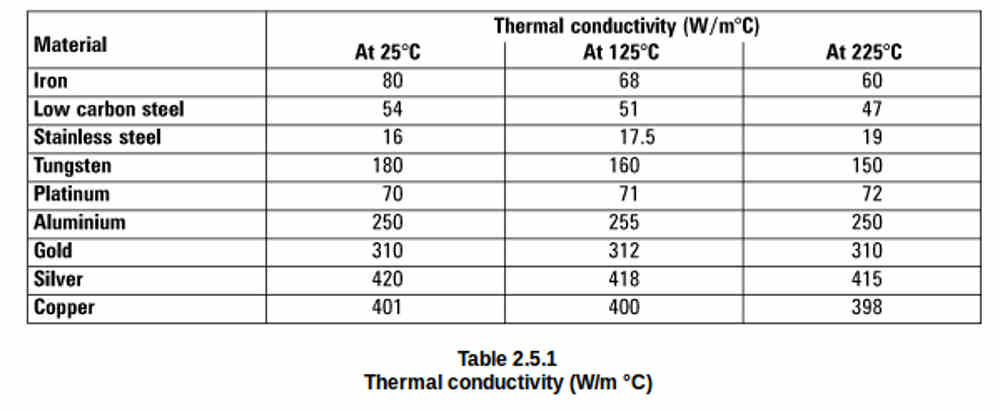
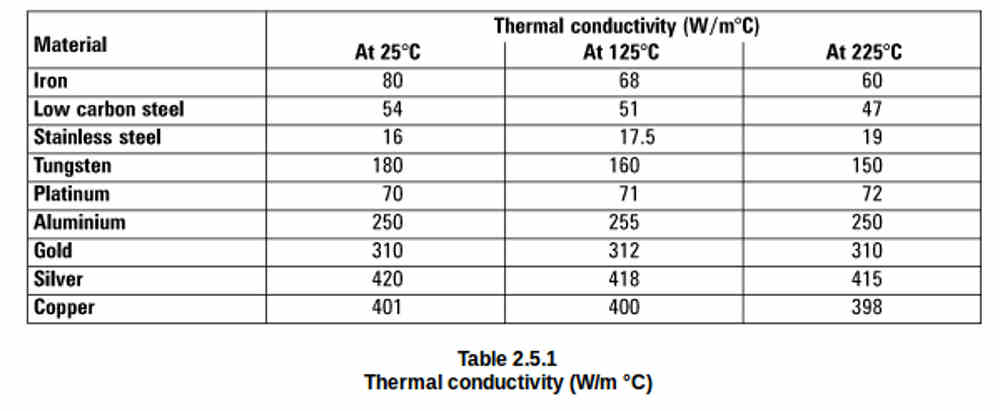
See the attached chart for thermal conductivity.
Iron is 60 and SS is 19. Very noticeable when you use SS for shielding.
Centrifugal Casting is ideal and that is the way Mazda is doing for the
RX8.
Paul Lamar
The Rotary Engine free News Letter. Powered by Linux. If you want off
the list PLEASE let me know and I will remove you. ACRE NL web
site.
http://www.rotaryeng.net You Tube
http://tinyurl.com/beqqxas
Copyright 1998-2016 All world wide rights reserved.