Just a thought to chew on. I think most folks love the old radial
engines. If you look at the max diameter of the wright engines, it
is about 54 inches.
Lets stretch our imagination and put 3 to 9 rotaries within circle
with the outside being 54 inches. They could be mounted with the
base outward easily within the 54 inch circle.
Each engine can have a gear on the output shaft driving a center gear
on the prop shaft, easily making the 3 to one gear down required for
the prop. Nine rotary engines with 2 rotors each times 650 hp each
is 5850 .hp and the same frontal area as an old radial engine. Maybe
less weight too.
Maybe an overrun clutch on the drive gears to shut a few down for
cruise.
Really good redundancy as well. Might draw one up on the cad
system.
Ken Burgess
Interesting idea.
Don't stop at 3 to one. Make it 4 or 5 or more to one and use a
really big prop or helicopter rotor. One way to get gobs of torque
out of several rotaries.
That would make a really great helicopter engine.
Paul Lamar
You would need a killer radiator to handle the cooling needs of 6000
HP worth of fire breathing rotary power. Add an energy recovery
turbine in the mix for each pair of rotary engines and you would
have an unbeatable BSFC to go along with all the other benefits of
rotary power.
Mark LaPierre
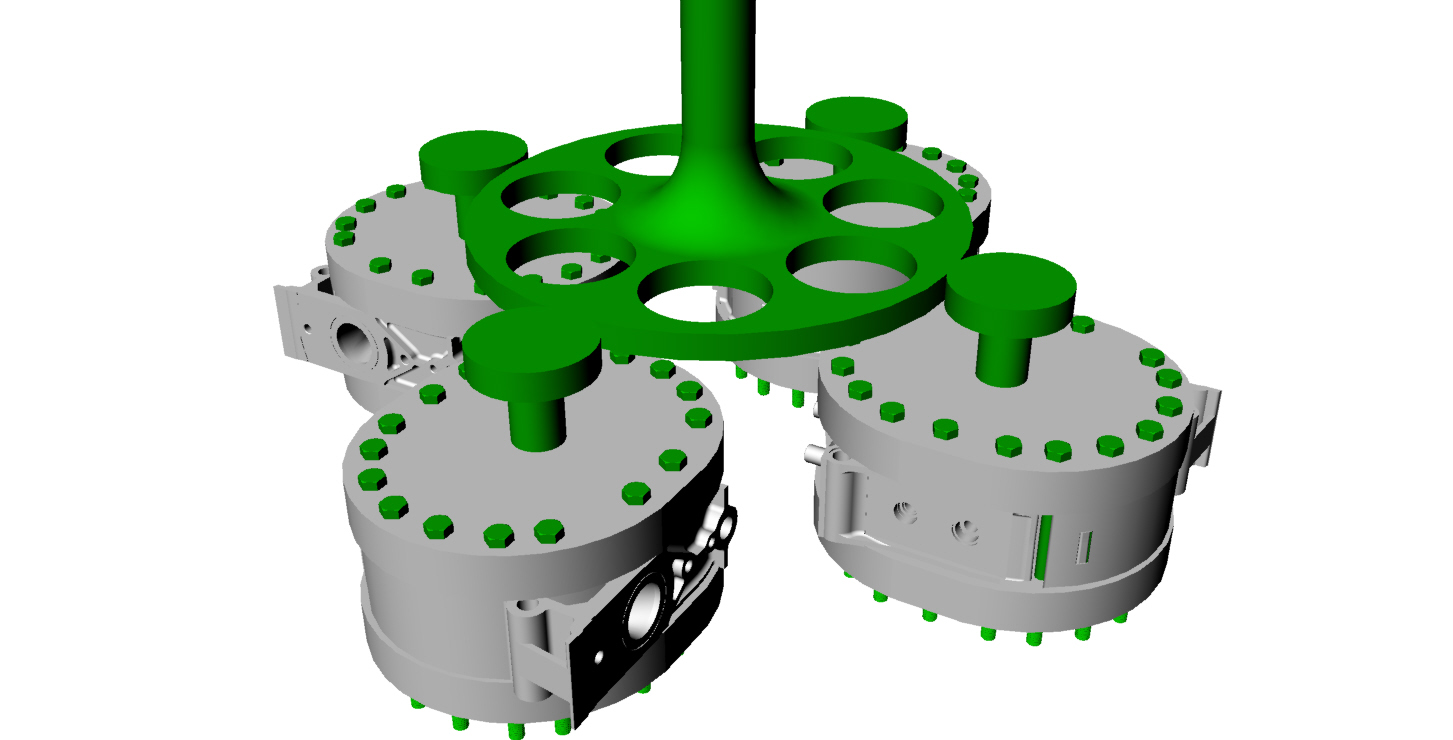
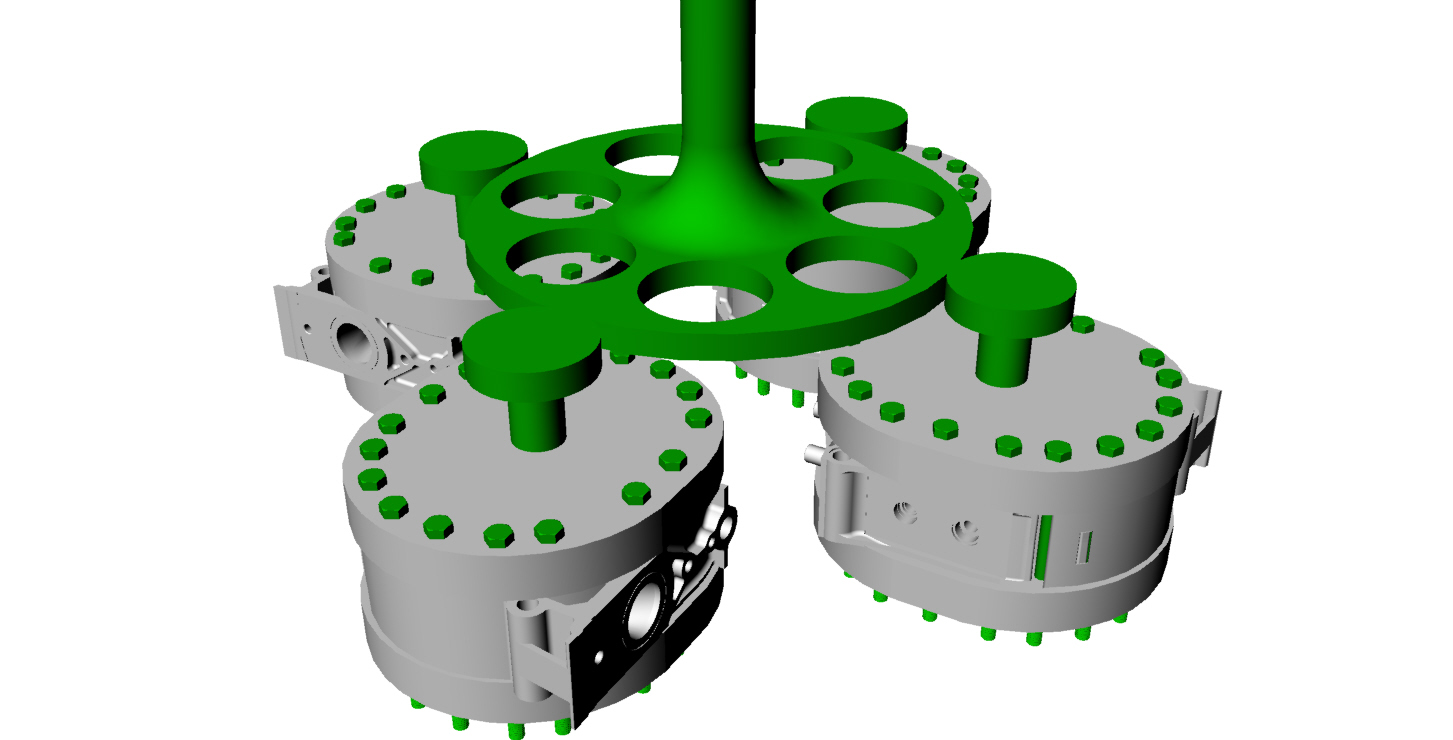
Here is what a 4 rotary radial helicopter engine might look like.
The engines are one rotor engines because lubrication is an issue
with vertically mounted 2 rotor rotaries. Sachs made a lawn mower
with a vertically mounted one rotor.
Turbo charged you would have about 1000 to 1300 HP to work with.
The lack of a traditional helicopter planetary gear box is a big
advantage.
My guess on weight is about 500 to 650 pounds. Unprecedented power
to weight ratio. Better than a PT6.
---------------------------------------------------------------------------------
Here is a better 3D of the helicopter engine using aluminum end
housings and no oil pans. I suspect the dry sump and oil pressure
pumps could be incorporated into the end housing. It is on a some
what tighter 36 inch diameter circle over all.
A corncob version with four 4 rotors would have less frontal area
than the CW R3350 used in the B29 and the P&W R4360 used in the
B36 and the Spruce Goose. HP would be 5,200 or so. The P&W was only
4200 HP.
Make a good boat engine and be easier to cool as well.
Thanks for thinking of this Ken. IMHO we have just seen the very
beginning of the Wankel engine.
Paul Lamar
Well this is s great idea, mechanically, but who in their right mind
would be the one to start it up, instant hearing loss !
steve Carlisle
Imagine a DH Beaver with one of these? About the same weight and size
as the Beaver engine. The noise would be worth it. Maybe a DH Otter
would be better suited. How about a Twin Beech? Or a DC3 on Floats?
Just mildly turbo charged. Don't throw those old DC3's away just
yet.
Paul Lamar
Those are all great ideas but unfortunately all of those aircraft
hold a type certificate. You would never get the FAA to sign them off. The
only place such a beast would ever get off the ground is in an
experimental amateur built such as the TTC Harmon Rocket.
Mark LaPierre
Someone already kinda beat you to it:
https://m.youtube.com/watch?v=Q2IFWveYBRs
Will Aldridge
I don't think that is a 12 rotor. I think it is eight rotors with
side intake ports.
Paul Lamar
No its 12. The bottom center row is mounted plugs down.
You can see the intake and exhaust tubes sticking straight up in the middle
Will Aldridge
I notice he is using the dry sump trick. Same as the TTC.
It would be a necessity in this configuration.
Here is a short clip.
Paul Lamar
The Rotary Engine free News Letter. Powered by Linux. If you want off
the list PLEASE let me know and I will remove you. ACRE NL web
site.
http://www.rotaryeng.net You Tube
http://tinyurl.com/beqqxas
Copyright 1998-2016 All world wide rights reserved.