Implementation of a Rotary Engine (Wankel Engine) in a CFD Simulation
Tool with Special Emphasis on Combustion and Flow Phenomena
2015-01-0382 Published 04/14/2015
IMHO This is the best technical paper on the Wankel so far.
Frank Herfert found it. Thanks Frank.
"In summary, the loss analysis shows that the main losses of the
Wankel engine result from the protracted and retarded combustion.
Consequently, the wall heat losses are lower than expected. "
" The mechanical losses, as well as the gas exchange losses, are
lower than comparable conventional spark ignition reciprocating
engines. The comparison between the investigated Wankel engine and a
normally aspirated, throttle-controlled gasoline engine with port
fuel injection under full load and high revolutions, is illustrated
in Figure 37."
"The largest deficits of the Wankel engine can be found in the area
of combustion (implementation loss due to incomplete implementation
of the fuel and combustion loss ) and leakage loss. The lower wall
heat release loss , compared to the conventional gasoline engine,
results from the late and delayed combustion. The lower mechanical
losses and charge exchange losses arise from the port control and
consequently, absence of the valve train."
What they did not investigate was multiple sparks on the same spark
plugs or more spark plugs. In effect, unlike a piston engine, the
combustion travels past the spark plugs. In a piston engine the
combustion moves away from the spark plugs some what.
That is where my new high speed CD ignition system comes in to play.
It is capable of firing the plugs six times.....five degrees apart
at 8000 RPM. Patent is still pending.
It can be tested now, on a dyno, using multiple MSD capacitor
discharge ignition systems fired by a high speed computer 5 degrees
apart at 6 to 8K RPM.
I do not have a dyno to test this but I can supply the control
computer. Simon Saba has a rotary engine dyno in northern
California. Please Simon, see if you can get the money to try this.
Paul Lamar
Hi!: as discussed, I requested Kevin Landers, from
RotaryResurrection, to implement the Fujikawa, Kawasaki, combustion
promoting improvement plug hole triangular extension, pointing to the
trailing side of working chamber (Patent 3848574, of 1974), but it
took over one year for the tuned 1987 13B NA the engine to arrive
from NJ to Barcelona, and it's still pending to be installed in my
1976 AMC Pacer Sedan, along with a Mazda RX-7 four speed plus reverse
automatic transmission, if the project is concluded, I'll try making
a comparative test with an ordinary 6-L 4.2 liter AMC Pacer, and let
you know results.
Thanks, have a nice 2017, best regards, + Salut †
Jose Gros-Aymerich
E-28033 Madrid, Spain
I don't think you will learn much Jose.
The best BSFC islands are in entirely different places for the Pacer and
the RX7.
The Pacer has much more frontal area and the drag coefficient is much higher
than the RX7.
Paul Lamar
Hello Paul, I think of Austro Engine because at the end of the first
paragraph of the Introduction the Austro Engine Company is called the
research partner of the Technical University of Vienna ... If you have a
look at table 2, the Vc is 404 cc - exactly the volume, Austro engine
has given in the description of 2009 - please see the enclosed
screenshot. It must be an existing engine, because they have it run on a
test bed ... But the 407 cc engine from the Wankel AG has a width of 6,5
cm, not 7,44 cm. So I've guessed, that it's the AE75R prototype ;-)
Perhaps there is yet another engine of this size - of course I do not
know all RE in the world today ;-)
But I think, that it's not very important, which engine they've analysed
in Vienna.
Their work is rearly serious - without "pink glasses".
It's a good base for further development ...
I have a "strange" idea related to the trailing section problem -
perhaps I will try to explain it with Paint, although I think, the
mechanics will not work / will not be feasible ... ;-)
Yours very truly - I wish you a perfect start into the new year
Franky / Frank Herfert
I was at the Austro engines factory in 2001.
Here are some pictures.
Paul Lamar
On that graph with blue red colors I am not sure what is meant by
'Implementation loss'.
Item 3 does not sound to be right. The wall surfaces of the Wankel are
admittedly larger than on the RPE.
Hello Franky. If you can show your idea, then pass it by us, but only if
it is not confidential. Or, if you would like, get back to me privately.
Paul may pass on my email address.
Rolf Pfeiffer
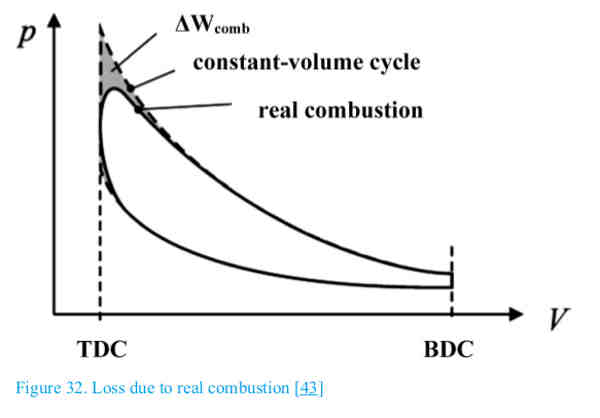
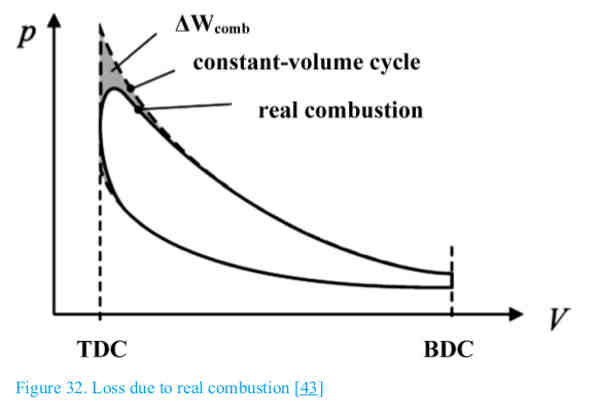
"Efficiency Loss Due to Combustion Loss
The real combustion in the engine is not isochoric and does not take
place at TDC. Thus, this loss can be divided into two.
Efficiency loss due to the center of heat release
According to. 42 it is assumed that the energy conversion takes
place isochorically, but not at the TDC, but based on the real position
of the MBF50 of combustion.
Efficiency loss due to real heat release
In this step, the real duration and shape of the heat release is
considered. In Figure 32, areas that are enclosed between isochoric
and real combustion processes are marked. These have to be
accumulated and considered as loss."
Here is fig 32.
The reason the wall loses are lower is the energy loss in the
combustion results in less heat getting into the walls compared
to a piston engine. It would probably be higher if the combustion
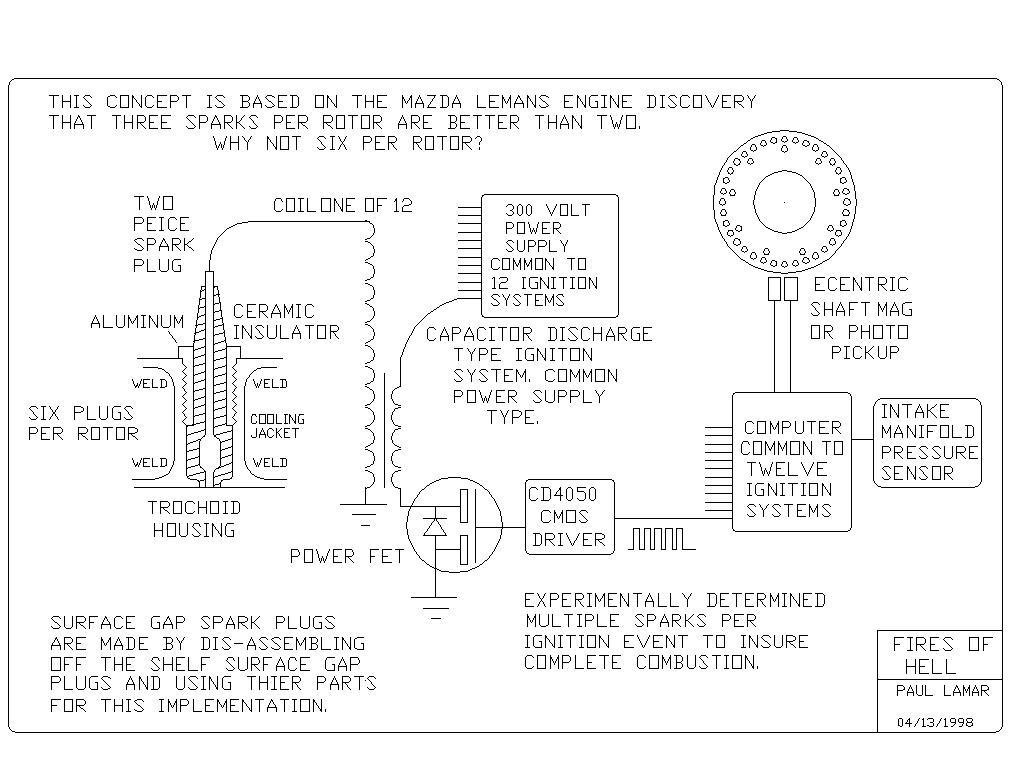
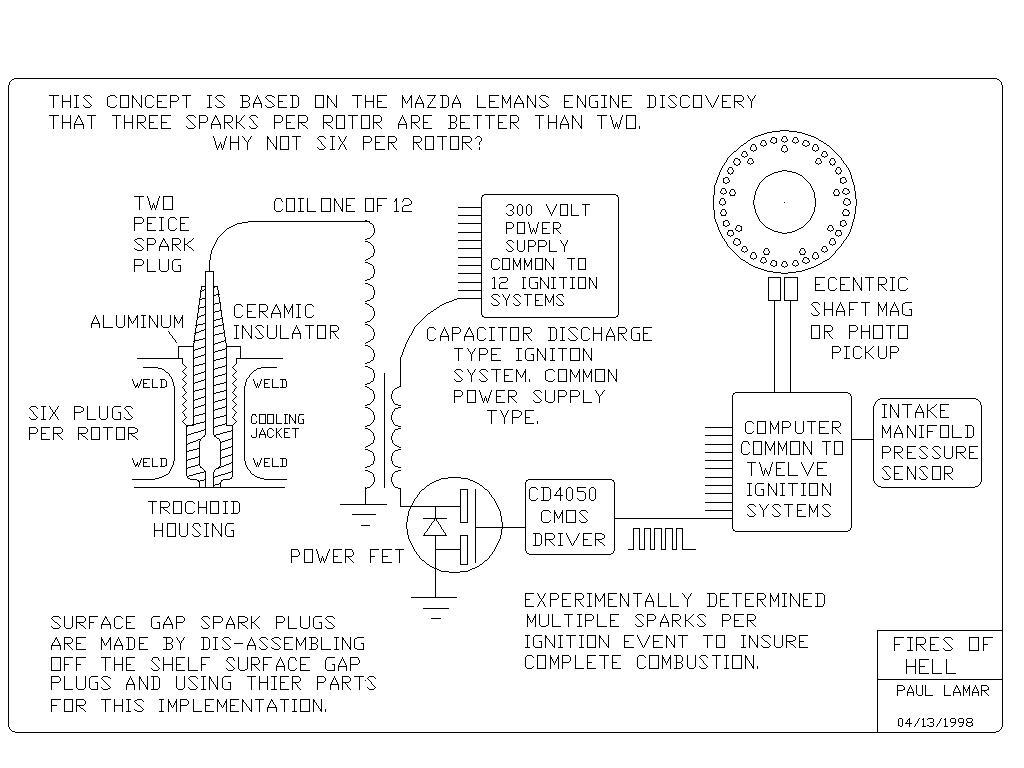
was improved. We are very close. Ignition of all the mixture
as soon as possible is the key. Surface mount spark plugs well
a head of TDC would help greatly. The Mazda Lemans had
3 spark plugs the third being head of the regular two.
I have suspected this for years. Here is a drawing I did in 1998.
Paul Lamar
The Rotary Engine free News Letter. Powered by Linux. If you want off
the list PLEASE let me know and I will remove you. ACRE NL web
site.
http://www.rotaryeng.net You Tube
http://tinyurl.com/beqqxas
Copyright 1998-2016 All world wide rights reserved.