Good evening, Paul!
My name is Jacobo and I'm from Spain. I'd like to subscribe to your
newsletter because I'm very passionate about the Wankel engine. But in
my case, I'm more interested in the automotive uses of the rotary
engine. I believe that there are some innovations in aircraft Wankel
engines that can be successfully applied to automotive Wankel engines.
I'm looking forward to your newsletter. Best regards from the other side
of the pond!
Jacobo
Well if you want to build a really high performance car the Mazda Wankel
is for you.
If you can find an RX2 made in 1972 or later or 1974 RX3 and later.
All late Mazda engines will bolt right in including the RX8 engine .
The 1973 RX2 weighed only 2000 pounds.
With our all aluminum 200 pound Mazda TTC turbo 650 HP will give a
spectacularly performance
both in acceleration and top speed. The rear axle will not be needed to
be beefed up
as the torque required is more related to the width of the rear tires.
The tires will just
spin if you apply too much HP. A high mounted rear wing will, with some
work on the
nose down force, also result in an increase in cornering G's.
Check out
http://www.rotaryeng.net/who.html There is a lot of car info
on that section
of the web site. I can help you with any changes you might want to make
on the car.
Here is a 800 HP drag racing turbo engine.
Paul Lamar
What I have in mind is building a four rotor engine suitable for both
street and endurance racing. I was originally considering going with a
naturally aspirated engine so as to not increase fuel consumption way
too much. But I've been reading about turbo-compound engines on your
website and I think it ought to be the best way to go.
I'd like to ask some questions before going ahead with the planning (and
to clarify doubts I might have). I hope you can answer them:
1. How much power can be recovered and brought back to the engine by a
turbo-compound system in terms of percentage? How much would fuel
consumption and range improve?
2. I read that you were building a turbo-compound system for rotary
engines. Did you manage to finish it and test it? If so, were the
results satisfactory?
3. How much boost can a rotary engine resist safely without breaking apart?
4. Would the use of a turbo-compound system increase heat and mechanical
stress on a wankel engine? If so, how can the engine be protected
against this heat and mechanical stress?
Looking forward to hearing from you, Paul. Best regards.
Jacobo Guimer�ns
A turbo compound version is 20 to 30 percent more power with the same
fuel burn.
I finished it but I did not run it on the dyno. I gave a talk to the F1
engineers and
they adopted a hybrid version for F1. You can read my talk at
http://www.rotaryeng.net/Oxford-Race-Tech-art-Dec-08.pdf
There are now four companies building turbo compound engines. Mercedes,
Ferrari
Renault and Honda.
Well we have had it up to 85 inches of Hg and it is still running fine.
I don't know what the max is. I'll bet it might be over 100 inches of Hg.
Turbo compound would not increase heat unless it was a hybrid version.
I don't recommend that as it increases weight and cost. It does nothing
for an airplane.
Paul Lamar
So, if we have (for example) a 400 hp engine with a fuel consumption of
25 mpg in its base form, with a turbo-compound system would be in the
range of 480-520 hp with the same 25 mpg fuel consumption. Is that correct?
I saw on your website pictures of the pieces you used for your
turbo-compound system and a render of a full turbo-compound system on a
rotary engine. Do you have pictures of the system fully assembled on the
engine? I would like to see it and see how it would look fully assembled
on an engine.
As for turbo boost, Formula One cars in the 80's managed to get boost
pressures of almost 120 inches of Hg. Pressure above that number would
be something insane on an engine, and I'm sure that insane boost would
make piston engines break apart.
There's one thing I don't understand. The power recovered by the
turbo-compound system is transmitted to the eccentric shaft, but how
does this power affect to the e-shaft? Would it spin faster or something
else? I need to clarify that.
Looking forward to your answers, Paul. Best regards.
Jacobo Guimer�ns
Very difficult to convert MPG into aircraft fuel burn.
The way to do it is rate engines in terms of pounds of fuel burned per HP
generated. This has been a world wide standard since the early 1900's.
One gallon of gasoline weighs about 6.25 pounds.
The Mazda burns about .47 pounds per HP generated.
The Continental O-470 in my Cessna C182 burns about .53 pounds per HP.
Some latter air craft engines are .43.
Surprisingly this has not changed much since 1900. A small improvement
in this
number for a particular engine is a major achievement.
A turbo compound version of any of these engine might go below .40 or
even down to .33.
Here are some more turbo compound pictures.
The TC puts more torque in the prop shaft so a higher pitch can be used or
more blade area can be added. The RPM of an aircraft engine is limited
by the tips of the prop going supersonic.
Paul Lamar
I'll research a bit more about turbo-compounding. Once I have more info,
I'll make some drawings and schematics about this hypothetical 4 rotor
street/racing engine. My goal is to create a 500 hp fuel efficient
engine, and I have a couple of ideas of how it should be.
Once I have something, I'll gladly show you what I have.
Best regards, Paul.
Jacobo Guimer�ns
Remember.... if you use the HP you will burn the gas.
My guess is 200 pounds per hour or 32 gallons an hour
on a TC engine with a BSFC of .4
Paul Lamar
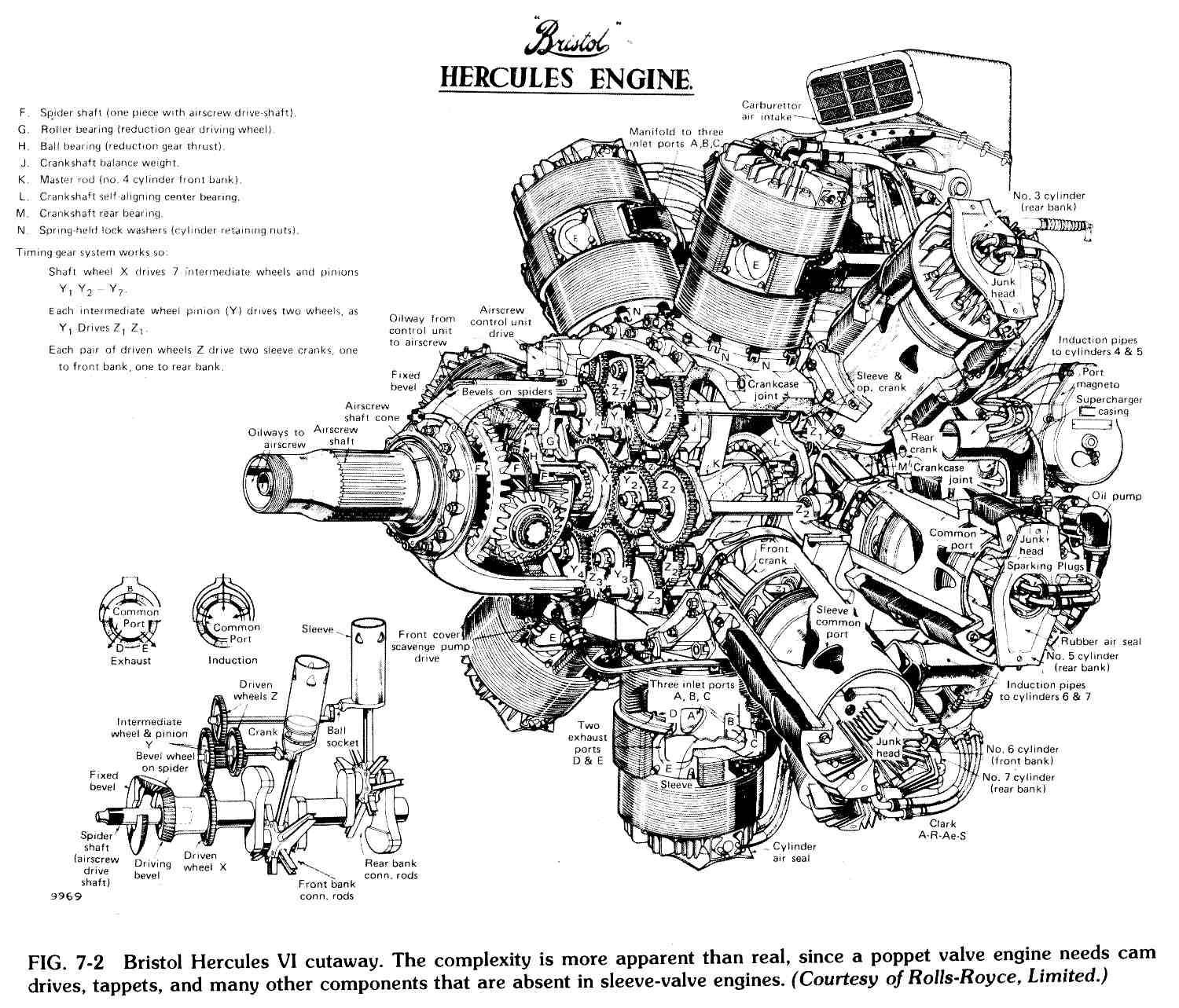
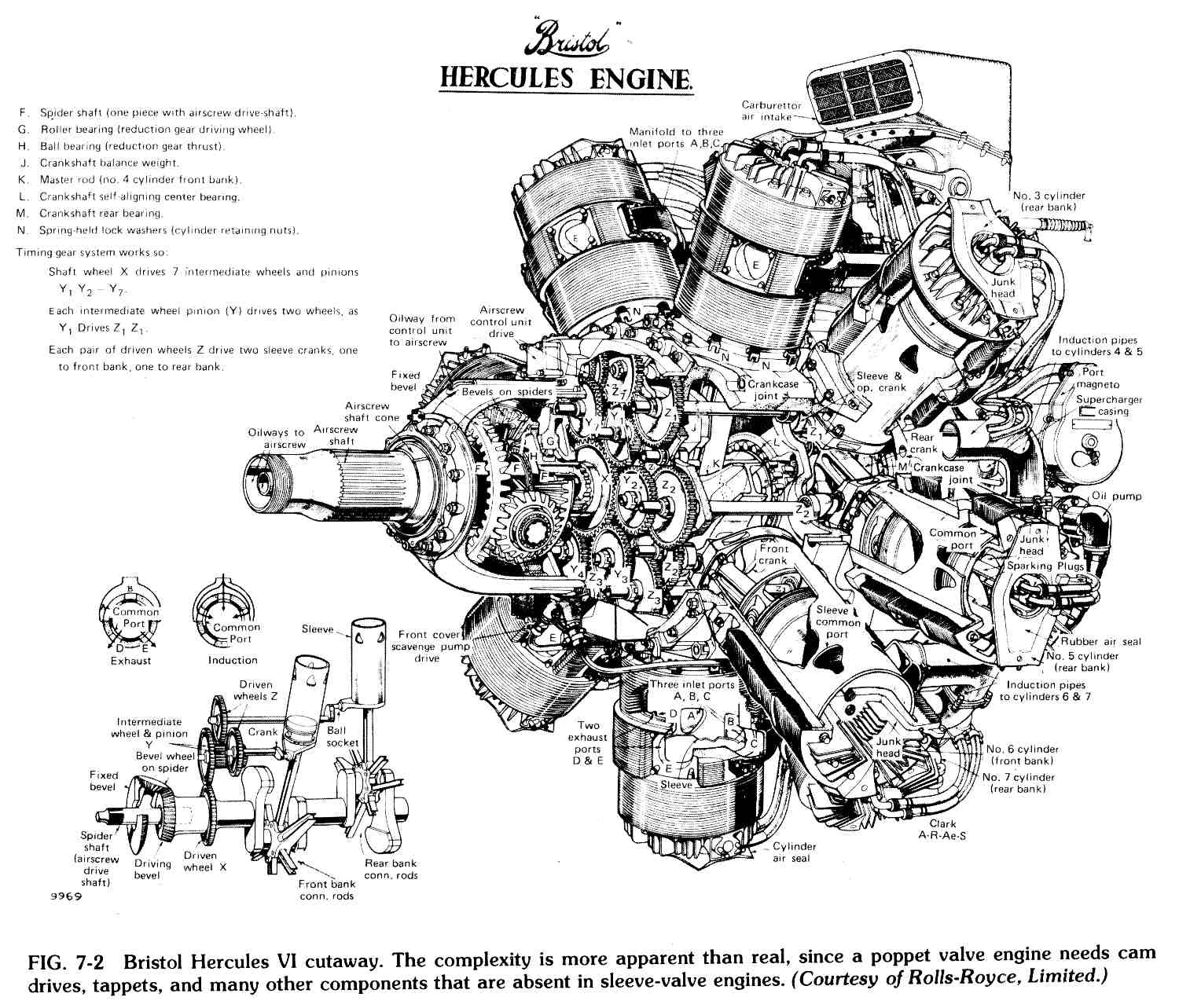
Hi for the interesting information. Beryllium, used as a neutron source
in nuclear weapons, was employed also in the inner coating of early
fluorescent tubes, which produced severe 'granuloma', nodes in skin and
hands in those who entered in contact with it, it's not an innocent
element, I'd say. About BSFC, nothing compares to my knowledge to the
Single-Sleeve Valve engines, Burt-McCollum type.
You can have an idea about its results in gasoline engines, from an
interview with Mike Hewland, published in Car&Driver, July 1974, 'A
trick up his sleeve', Charles Fox interviews Mike Hewland, reporting an
Specific Fuel Consumption of .45, in the 'economy version', .39
pounds/HP/hr, from a single cylinder, NA, liquid cooled experimental 500
cc engine, providing 70 HP, 47.5 lbft, and being able to run on
Creosote.
Even better fuel economy results are described in one of the editions of
the book by Harry Ricardo: 'The high-speed internal combustion engine',
some of it can be downloaded from the web, with a compression-ignition,
Diesel fuel, two stroke engine using the Sleeve as an annular piston
10% of main piston area, delivering 3% of total power output to
crankshaft via the Sleeve operating mechanism, this making the 'Junk
Head' redundant.
This type of distribution eliminates the poor lubrication areas in the
TDC and BDC of piston stroke, resulting in a very low wear, with a TBO
of around 3'000 hrs in the Bristol Air Cooled radial of WW II. If
finding the right alloys for air cooled cylinders was complex, in an
Iron block, an Iron Sleeve will do the work without toil.
Hewland and Logan recorded no higher temperature than 270� C in the
piston center, and none above 140� C in the Sleeve, that was transparent
to heat as long as the oil film and clearance in the outer part of
Sleeve was kept thin enough.
The oil consumption in the Knight double sleeve design seems being
solved in the Burt-McCollum prototype by Hewland with a piston ring in
the low outer part of Sleeve, but this being a reciprocating engine, it
may suffer the total failures whose almost complete absence is one of
the unrivaled advantages of Wankel RCE for aviation.
Have a good season, regards, Salut �
Jos� Gros-Aymerich
Madrid, Spain
Herschel Smith talks about this engine extensively in his book "A
history of Aircraft
Piston Engines". He mentioned the BSFC being .43 which may have been
exceptional
for the time but not in the same class as the Wright R3350 Turbo Compound at
well below .3.
Paul Lamar
The Rotary Engine free News Letter. Powered by Linux. If you want off
the list PLEASE let me know and I will remove you. ACRE NL web
site.
http://www.rotaryeng.net You Tube
http://tinyurl.com/beqqxas
Copyright 1998-2017 All world wide rights reserved.