Here are a few pictures I managed to find.
Paul Lamar
Hi Paul, that first NASA picture looks like it could be a Cessna
337, push-me pull-me !
Steve Carlisle
It certainly looks like a Duncan installed in a huff and puff. I knew
NASA flew a Wankel Unfortunately they abandoned general aviation to
focus on space soon after that
Notice it does not have p-ports. The belt drive does not look like 3
to one. My guess closer to 2 to one.
This means that it was handicapped. If Duncan and NASA did their home
work they would have a lot more HP. Some goes for Tracy to certain
extent.
It took me years to convince Tracy to go to 2.85:1 let alone 3.12:1
which was possible with the Ford parts. He never went with P-ports.
The Wankel road racers were running 11,000 RPM, p-ports and 300 HP
NA at the time. Both NASA, Tracy and Duncan ignored those facts. NASA
in particular as they employed mechanical engineers that could have
done a stress analysis on the rotors and e-shaft and in the process
determined it was capable of very high intake manifold pressure on
the order of 85 to 100 inches of mercury.
The least they could have done was consult with some aircraft piston
engine engineers still around at the time. It is kind of surprising
Curtis Wright did not explore the Wankel power producing capabilities
at the higher RPM's and turbo compound as they were the experts on
the subject. They must have fired all the piston engineers when R&D
was stopped on the R3350 TC. The greatest blunder in the history of
the aircraft engine.
When RPI took over the CW work after John Deere had it for awhile
they hired Sunstrand Corporation to do a mathematical analysis of a
Mazda model Wankel for turbo compound potential. They explored
almost all possible configurations.
Sunstrand came up with a potential 80 HP additional with little or no
additional fuel burn. Here is the pdf paper. It was attached as an
appendix to a much longer paper on a summary of all the R&D done to
date by all the participants.
This was ignored by everybody except me :-)
I did not bother to mention it at Oxford as I knew the FIA would
never allow the Wankel.
https://www.youtube.com/watch?v=yF5PgQ4ZWfU
A turbo Wankel with the same displacement as an RX7 engine would
generate F1 level power with an engine that was ONE ONE HUNDREDTH THE
COST OF ANY EXISTING F1 PISTON ENGINE AT THE TIME. Typical cost of a
F1 engine is $100,000,000. That is one hundred million for the zero
challenged :-)
Probably with a better power to weight ratio. The FIA had already in
effect banned the Wankel at Le Mans.
Imagine what would happen in the world if F1 engines were Wankels.
:-)
Paul Lamar
Pretty interesting! I'm definitely keeping that NASA paper on
turbo-compounded rotary engines. That will surely help me a lot.
Jacobo Guimeráns
Hi Paul, the Cessna 337 is referenced in this document as a ground
test platform, seems overkill to me, I think someone had the idea to
get those engines in the air with the least amount of hassle from the
FAA ! Great document !
https://www.google.ca/url?sa=t&rct=j&q=&esrc=s&source=web&cd=2&cad=rja&uact=8&ved=0ahUKEwjh9euKvJDTAhVRymMKHabaD28QFggfMAE&url=https%3A%2F%2Fntrs.nasa.gov%2Farchive%2Fnasa%2Fcasi.ntrs.nasa.gov%2F19840020722.pdf&usg=AFQjCNGAB9-AQJy9Y5cMR7VARGxHuSasmQ&sig2=8hL6C1qN1N-c3kxta70mUw
Steve Carlisle
Good work finding that Steve. I had a copy but it was too big to
publish at 20 meg. I just recently learned how to reduce the size of
PDF's so I have a bunch that will be published in the future.
Here it is in reduced file size pdf to 5.9 meg.
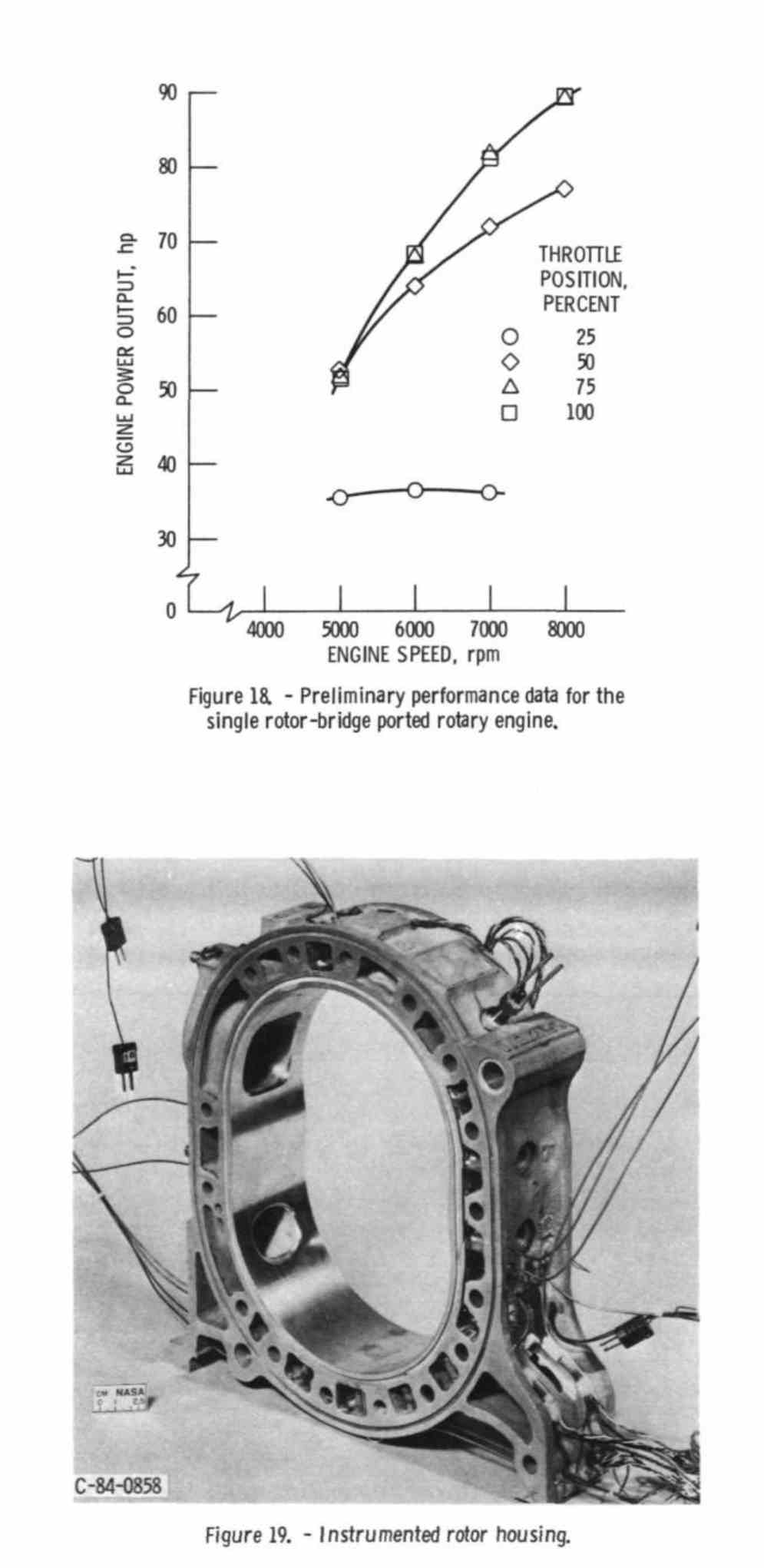
The lack of p-ports are showing the power dropping off at above 6000
RPM. The BSFC will also be worse with no p-ports.
They were very conservative with this engine at only 200 HP turboed.
It would have made a much larger impression on the world if it had
400 HP. That would have been a piece of cake with a p-port turbo.
Paul Lamar
Hey Paul,
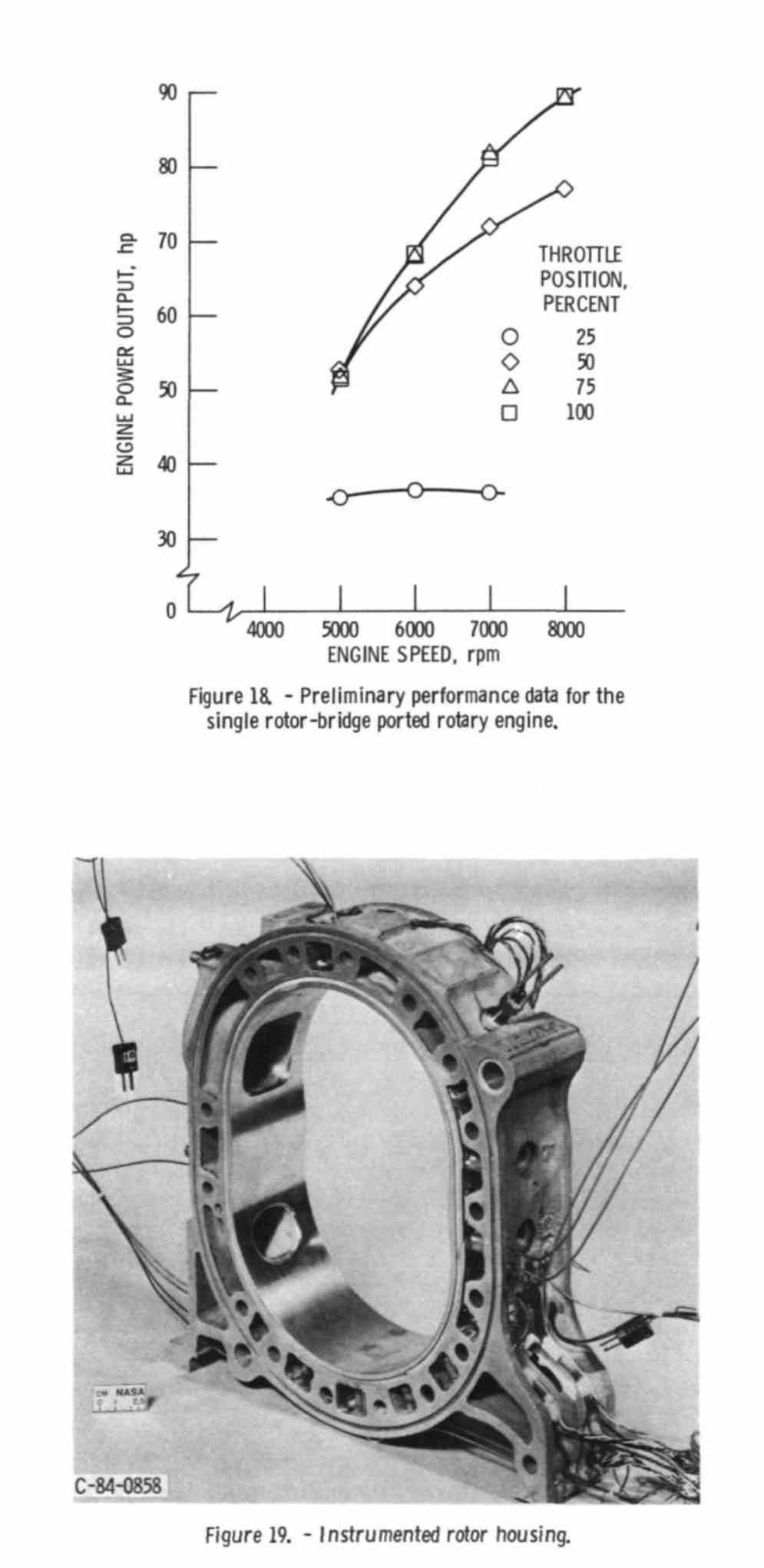
Steve's NASA link shows P-Port housing. Fig. 19.
Dan Gorsline
Yea I missed that. It was on page 20 and just above it they talked about
bridge ports. That implied the picture was of a bridge port but it
was not. The picture, as you pointed out, was a p-port.
The power out was 90 HP max. It is no problem to
get 150 HP per rotor with a p-port normally aspirated.
Obviously this paper was put together by some one not familiar
with the rotary.
I don't think they every tested a p-port. If they did they did not include
the power curve in this paper.
This paper had a correct BSFC in the apex seal temperature chart.
Some of the Curtis Wright estimations in other papers were widely
optimistic
with BSFC's below .40. I suspect they did that to help the stock price
of CW
stock in the stock market :-)
They never got the stratified charge stuff to work in a squish flow wind
storm :-)
It just blew that stratified charge down the road :-)
Some of the other stuff in other papers correctly predicted the torsional
resonance at 1800 RPM with a prop. Don't idle your engine below 2000 RPM.
We took care of that in the TTC engine with a new silicon rubber coupling.
They also mentioned silicon nitride apex seals that later proved to be a
major advance.
Some of the cooling systems shown in this paper turned out to be close
except for
a widely over volume K&L wedge diffusers. They did show thin heat
exchanger cores very thin which is
very good. That is about the time Kays and London where working on their
wonderful book
Compact Heat exchangers.
Paul Lamar
The Rotary Engine free News Letter. Powered by Linux. If you want
off the list PLEASE let me know and I will remove you. ACRE NL web
site.
http://www.rotaryeng.net You Tube
http://tinyurl.com/beqqxas
Copyright 1998-2017 All world wide rights reserved.
<rotary overview-smaller.pdf