BTW can anybody tell me why my
air passages in this rotor housing
are a bad idea? This is a quiz.
Paul Lamar
They allow high pressure
combustion gases to pass back to the intake
side. This would cause
preignition. BIG no no!
Dale Davies
Possibly but there is one other
problem.
Paul Lamar
Compression pressure bleedoff
and out the exhaust. Low cylinder
pressure and high exhaust
emissions. Dale Davies
Not exactly.
What do you mean "out the
exhaust." ?
Paul Lamar
It will blow the combustion
cycle back into the previous chamber as
apex passes inlet to bypass. And
the timing would be static. The
rotor design stays with the
combustion
Kurt Emerson
Well yes but that is not what I
had in mind. There is another factor
in play here. Can anybody think
what that is?
Paul Lamar
That the passage would cause that area
to be even hotter than it already
is, and its already a problem area.
Dan Gorsline
Not yet :-) That is not it.
It is a well known problem you should
know about.
Paul Lamar
Paul and all,
We would be bleeding pressure from the 45deg ATDC big push on the rotor.
But my problem is with the original premise... that we should divert the
hurricane flow.
And secondly that we should add surface area... both of which are a
detriment to the Rotary.
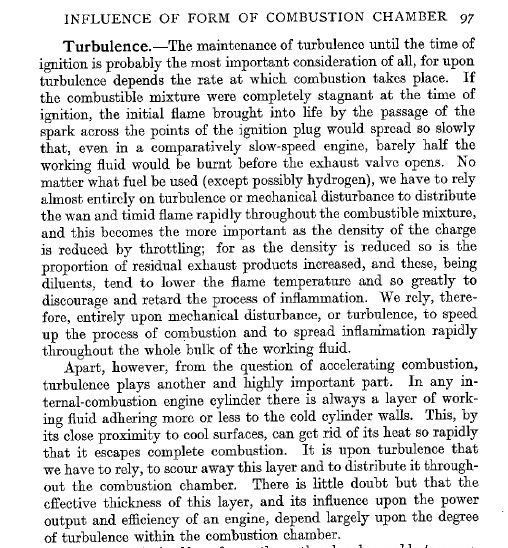
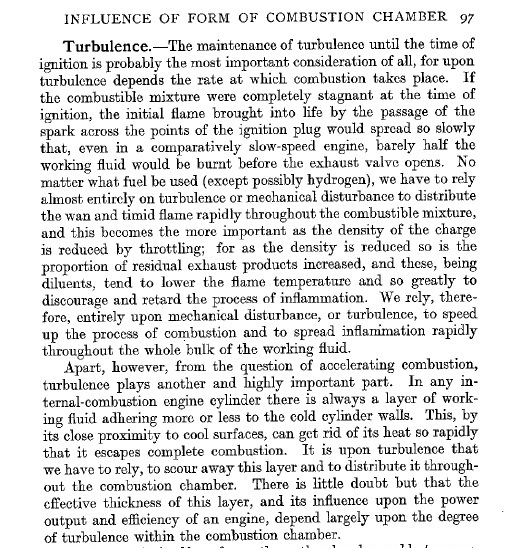
The spark kernel needs turbulence to develop quickly. It is also helped
by compression and temperature.
Attached is a quote from Sir Harry Ricardo.
On the GM patent I think if we could change the stainless by-pass
inserts to non-bypass vacuum SS inserts (think thermos bottle) to
minimize heat loss it would be a great help.
Barry Bordes
Why do you think surface area is a problem? There will be no combustion
under
a metal plate on top of the rotor. I am sure General Motors checked that
before they
applied for their patent. The area is too thin at .1 inch to support
combustion.
A very important part of this idea is to relive the high pressure in
the area where the aft part of the rotor is in close contact with the
wall of the rotor housing. That will reduce the velocity of the wind storm.
There is also not a reduction in pressure due to squish flow under the top
plate on top of the rotor. There is a slight reduction in compression ratio
but that could be made up with a shallower bath tub.
Turbulence is fine but a wind storm on top of the rotor blowing the
mixture down stream
is something else. That blows the combustion away from the optimum
e-shaft angle.
Yes I agree about a vacuum's ability to insulate but ceramic rotors have
been built
with no significant improvement in BSFC. I suspect GM found that out
when the
tested the 2 piece rotor.
It is called the adiabatic Wankel but it was a big disappointment.
The flow in the combustion chamber is the only really significant difference
between the Wankel and a piston engine.
Paul Lamar
The Rotary Engine free News Letter. Powered by Linux. If you want off
the list PLEASE let me know and I will remove you. ACRE NL web
site.
http://www.rotaryeng.net You Tube
http://tinyurl.com/beqqxas
Copyright 1998-2017 All world wide rights reserved.