Paul, Any cool area that cannot enter into the combustion process
will lead to wasted energy. An example would be the area above the
side seals.
I went the opposite way. I increased the turbulence and flow at the
sparkplug and found a measurable difference. The burn rate
increased as shown with combustion testing. It then required
removing 2 degrees of timing. (see attached)
The best solution IMHO would be a way to seed the chamber with a
catalyst-like substance that would simultaneously ignite over all
of the rotor face captured area. Barry Bordes
Yes but it is not enough to affect the BSFC by 10%. Something else
is going on. I think it is the wind in the combustion chamber.
Your catalyst might work.
You also need a way to test the BSFC. If you have a prop on the
engine and you run it at a constant RPM long enough to burn a
gallon of gas you can test the BSFC by how long it takes to burn a
gallon.
The longer it runs the better the BSFC of course.
It will be hard to measure the effect ( if any ) on that NACA
duct.
Paul Lamar
Hi Paul, Further to my thoughts on CC turbulence. It is well known
(as you know) that recip engines rely heavily on this effect. In
two valve per cylinder it relies on "swirl" as the mix comes in
through one valve and out the other. This spin effect is increased
as the piston comes up, rather like an ice skater as they move
their arms in to greatly increase their spin. In an engine with two
valves per cylinder it "tumbles" instead rather like an acrobat or
diver doing a forward roll. Possibly the turbulence could also be
improved by injecting hot air in through the trailing plug hole
(NOS would be better !) this will give a small (or even big)
supercharging effect also. Of course this will affect the mixture
and must be allowed for. Chris. p.s. no need to put this in if you
think it's all bullshit.
There is a very Fundamental difference in the moving combustion
chamber of a Wankel and the fixed combustion chamber of a piston
engine. Apples and oranges.
Paul Lamar
The trailing plug would be too late in the intake for the cooling
effect of the NOS injection to provide a "supercharging" effect.
Injecting about 45°after the intake opening in combination with
direct fuel injection as illustrated in photos from Mazda of the
16X rotor housing. Also incorporation of the Far Trailing plug as
used in the Le Mans winning engine would help with BSFC and
emissions. NOS is only good for short power bursts.
My feeling regarding hydrogen as a fuel is that it is a future
possibility. In the interim, a focus on the use of natural gas
would be more beneficial. It burns clean and can be used in
modified diesel engines. In a rotary engine, fairly high boost
pressure could be used on engines like the 10A and 13A with 3 spark
plugs. Using Paul's ignition system for very complete combustion
would provide high power and low emissions. Natural gas is
inexpensive and fueling can be done at home overnight or at quick
fill stations. Fuel costs for a year of driving should be less than
gasoline providing driving conditions and miles driven remain the
same.
Dale Davies
What does all that have to do with the squish flow?
Paul Lamar
Hi Paul, When I re-read my missive on turbulence I noticed my
second instance involving " tumble " was meant to read four valves
per cylinder not two.
Cheers Chris Hoskins
On recip engines in the early emissions days lower compression
ratios were desired thus the Big Three made use of open chamber
heads. These had larger combustion chamber volumes and tapered to
the cylinder walls. Newer research has found the quench heads
better. Ford and the others developed heart shaped combustion
chambers that enhance combustion efficiency.
As Barry explained swirl from a two valve head speeds the spread of
the flame front.I believe the air/fuel squished out between the
quench part of the head and the rising piston also promotes tumble.
Too much can be detrimental. In four valve heads tumble is more
prevalent. The Detroit Diesel two strokes had the inlet ports at an
angle to initiate swirl. Even though the rotary combustion chamber
works differently, I believe combustion theory applies as Laws of
Physics. It is just a matter of determining what works best. I
believe Barry's findings corroborate what the other auto
manufacturers are finding.
Somender Singh got a patent for "groove" technology that helps with
swirl and possivly tumble. If grooves were machined into the
trailing side of the rotor face to direct a blast of air/fuel
forward past the spark plugs to carry the flame to the front edge
and then back down the sides may help fuel burn. Using the far
trailing plug would also help if possible to incorporate. The third
plug would tend to send a jet of rapidly expanding flame along the
groove.
Dale Davies
None of the first two paragraphs is applicable to the rotary.
Apples and oranges.
Do you have any drawings or the patent itself? Or just the patent
number?
Paul Lamar
How about putting tapered reversing swirl ports in the depression to
swirl and reverse flow. They could also act as a catch to for the
flame front to thrust against the rotor. It would have to be a
catalyst surface to be self cleaning. I'm just thinking, there maybe
be a 1000 reasons why this wouldn't work but I can't think of any.
Kurt Emerson
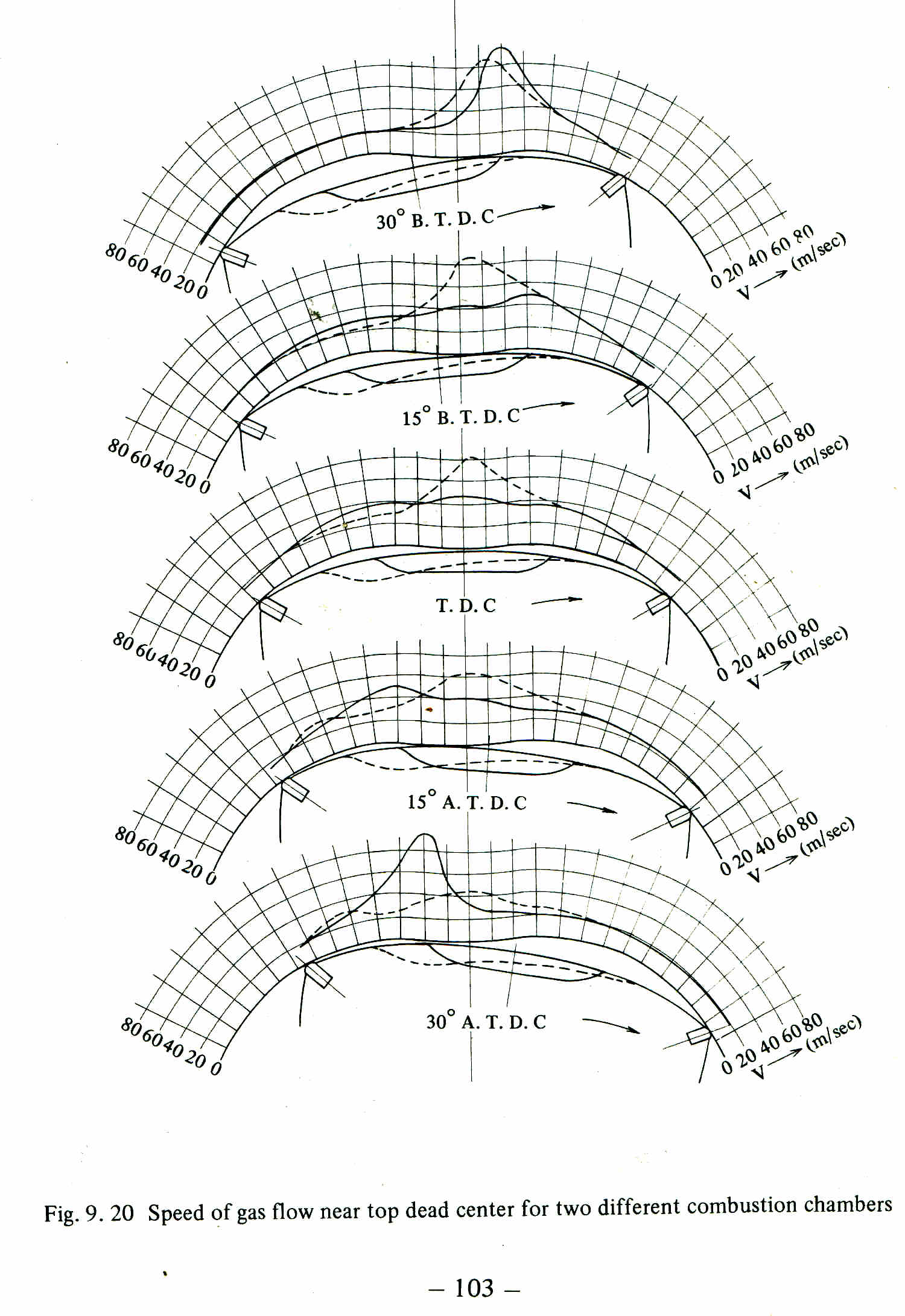
No amount of swirl, turbulence, tumbling etc. etc. is going
to help if the fire is not in the right e-shaft angle region.
It is all just blown away. The air speed in the combustion
chamber at this point is 90 meters per SECOND! That
is 270 feet per second or 184 MPH!!! Here is a chart for
two different combustion chamber shapes. The wind
direction changes. This is from Rotary Engine.
Wind in the world is created by an atmospheric difference in pressure.
The larger the pressure difference the stronger the wind. That is how they
predict weather changes in general.
The same thing happens in the Wankel combustion chamber. A large difference
in pressure is created IN THE COMBUSTION CHAMBER when
the back side of the rotor rapidly approaches the rotor housing.
The front side is rapidly moving away lowering the relative pressure.
That will force the fire away from the optimum e-shaft angle.
This is entirely different from what happens in a piston engine.
There is no reason for the fire to move relative to the spark plugs.
I suspect several surface gap plugs would help north of the upper plug
as would redirecting the wind flow.
Paul Lamar
The Rotary Engine free News Letter. Powered by Linux. If you want off
the list PLEASE let me know and I will remove you. ACRE NL web
site.
http://www.rotaryeng.net You Tube
http://tinyurl.com/beqqxas
Copyright 1998-2017 All world wide rights reserved.