For now I'm dreaming of a 70% scale carbon fiber CL-84 Dynavert with
twin quad rotor turbo compounded 26Bs. The best design to date,
better than the difficult to fly and deadly Osprey. In my opinion
anyway.
http://www.aviastar.org/helicopters_eng/canadair_dynavert.php
https://youtu.be/iCd2FqTJKs0
<https://youtu.be/iCd2FqTJKs0>https://youtu.be/tzsAuSyEOl0
https://youtu.be/dKcmjuoPQfs <https://youtu.be/dKcmjuoPQfs>Really
cool vtol/stol mix including
CL-84 and vertical take off design like Paul's.
https://youtu.be/tzsAuSyEOl0 <https://youtu.be/tzsAuSyEOl0>Best
Regards, Kurt Emerson
I would hardly say the Osprey is difficult to fly or deadly. It has
a fly by wire control system which is probably universally now used
in expensive aircraft. The F16 is inherently unstable with out it.
One must avoid the ring vortex state but all helicopters have that
problem more or less. Yes they had some fatal crashes in the Osprey
development period when the ring vortex state was not fully
understood. Now the Marines love them.
The idea of making an adiabatic internal combustion engine has been
around for years. Several have been built regardless of the
difficulty or ease of fabricating the parts. No positive BSFC
results have been reported so far. BSFC is so critical to the
function of an internal combustion engine if it had worked the
ceramic parts would have now been common.
Some claims for ceramic coatings on piston tops have been mentioned
but I don't thing that is common on production pistons either. The
risk factor is high because if it comes off the engine is toast.
AIXRO does not recommend ceramic rotor bearings for that reason. In
addition there is the initial increased cost of the ceramic bearing
itself.
Ceramic turbines in turbo charger have also been successfully tried.
However they do not dominate turbo charger turbine material. Inconel
is still preferred.
As far as turbines in turbo jets or turbo fans I have no idea if
ceramic version are widely used or not. Cost of course is less of an
issue.
Paul Lamar
Definitely the KOOL factor, but horribly complex mechanically, and
to operate !
Steve Carlisle
Steve are you talking about the CL-84 or the Osprey? The articles on
the CL-84 say it flew just like a plane. The control box was a piece
of genius. I'm sure it could be duplicated and mimicked using fly by
wire.
Kurt Emerson
It was a 2 engine copy of the LTV XC-142
https://en.wikipedia.org/wiki/LTV_XC-142
Or the Vertol VZ-2 (Model 76)
https://commons.wikimedia.org/wiki/File:Vertol_VZ-2_%28Model_76%29_NASA_GPN-2000-001732.jpg
The problem was they had too high of a disk loading for taking off
vertically with a low payload to power ratio.
They solved that problem in the Osprey. The Osprey solved that
problem with much larger diameter rotors.
Paul Lamar
I would think in the early 80,s the CL-84 was mechanical, and the
newer Osprey, similar bird, would be fly by wire, You say the control
box was a piece of genius. 2 main wing rotors and a tail rotor to
make all this act like a helicopter, and a plane. Impressive !
Steve Carlisle
Paul,
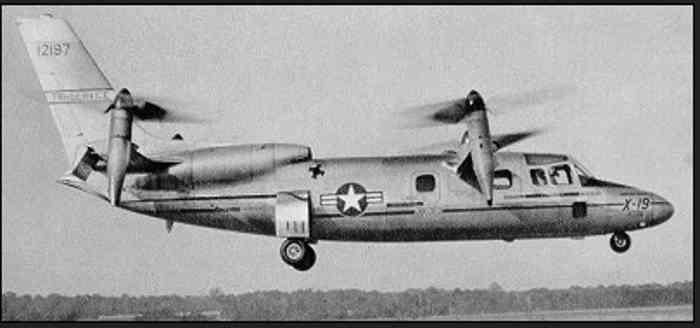
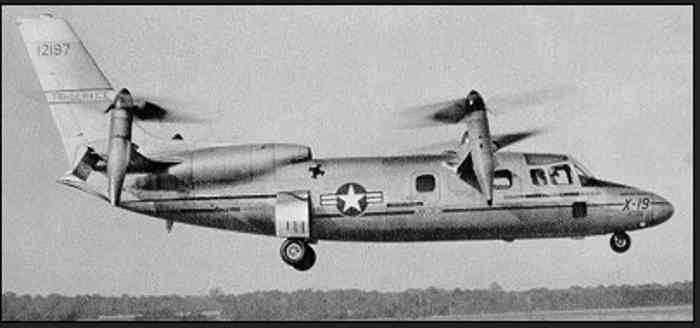
Don't forget the Curtiss X-19.
Dave James
Looks like the uber proposal except they want to lift an additional
1000 pounds of battery :-).
Paul Lamar
The Rotary Engine free News Letter. Powered by Linux. If you want off
the list PLEASE let me know and I will remove you. ACRE NL web
site.
http://www.rotaryeng.net You Tube
http://tinyurl.com/beqqxas
Copyright 1998-2017 All world wide rights reserved.