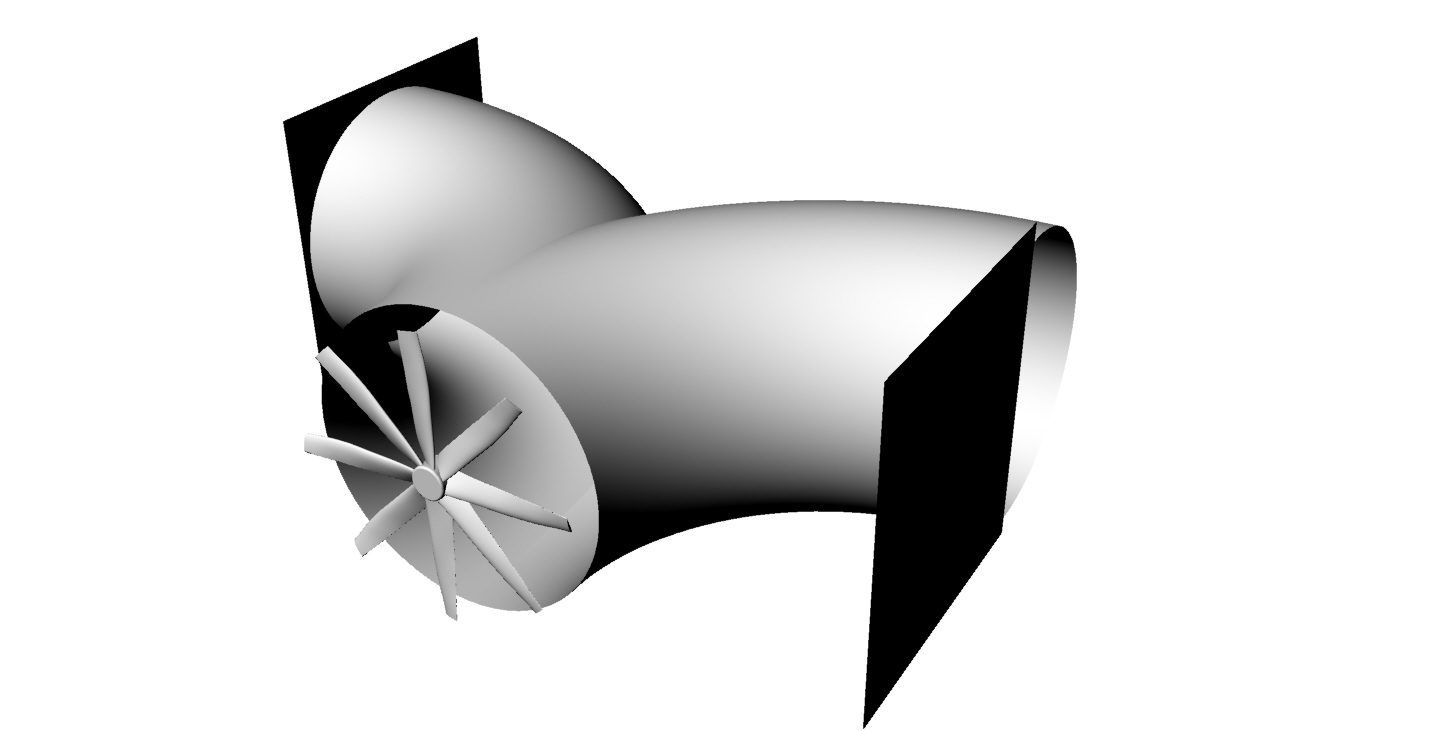
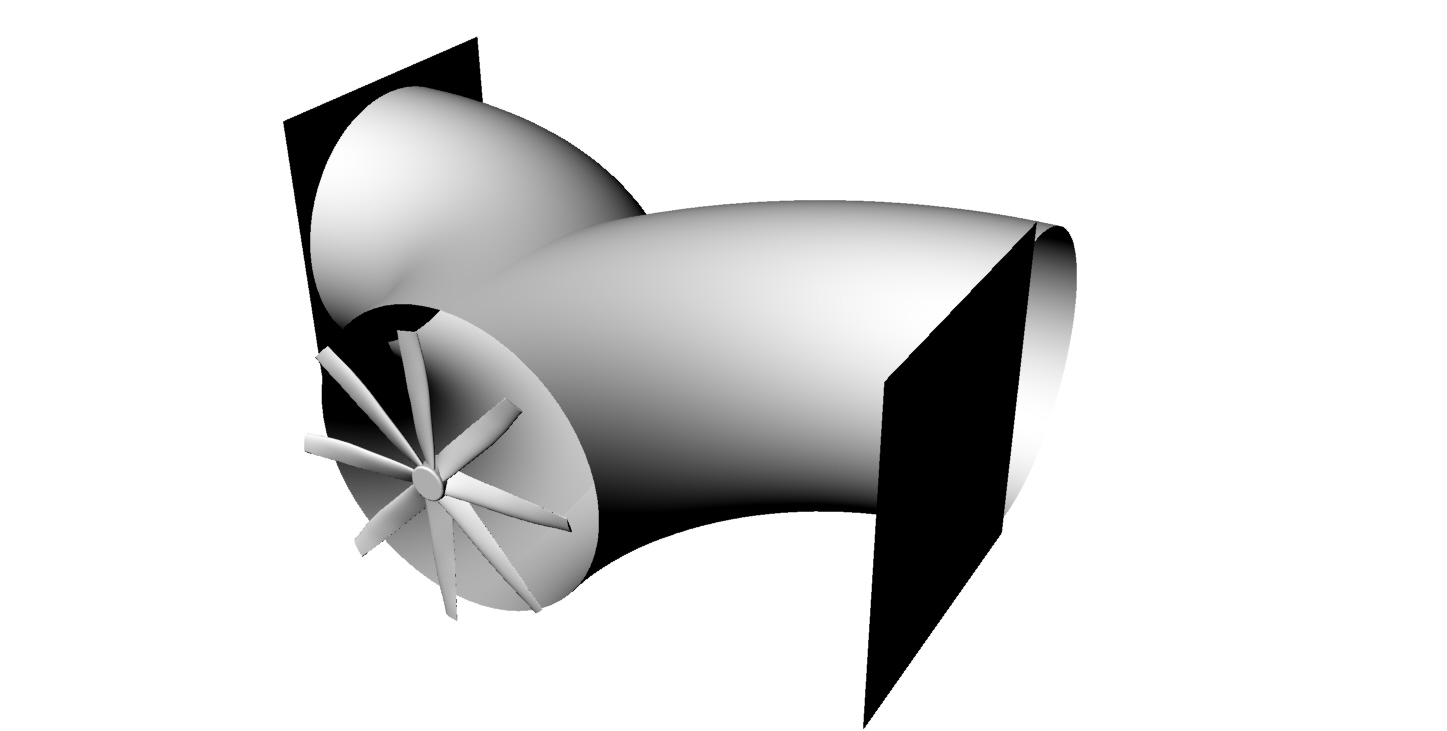
This is better than a separate duct around the fan as the fan being
buried in the fuselage there is less total skin friction drag. It
won't be as efficient as a prop but it is more efficient than a
conventional external ducted fan.
Of course with 650 HP you may not care. It looks like a jet aircraft
and goes pretty good :-)
Another advantage is there is no gear box required so that saves 30
to 50 pounds and about $3,000. The main fan is cheaper and much
lighter as it is not running at 1400 to 1800 F temperatures so it
can be made from carbon fiber.
A further advantage is the simplicity of the turbo compound feature.
Since no gear box is required this saves weight and money. In fact
most radiant waste heat from the engine, normally unrecoverable, is
used to increase the pressure in the duct slightly. Much like an
after burner.
It also heats the cockpit.
This is well before I wrote the book "How To Cool Your Wankel" so
some improvements can be made in this cooling system.
I should have gotten a patent on this thing but I was way ahead of
it's optimum time :-)
I tried to sell it to Southwest Technical Institute but they had no
vision :-)
It takes a brilliant engineer to recognize a brilliant engineer :-)
I may do some 3D's if any one is interested.
Paul Lamar
Paul, so ducted fans seem to be popular, maybe you would like this,
https://www.youtube.com/watch?v=IvAToG7GZPU
Steve Carlisle
So are opiates. That does not make them good :-)
Some of the early swing wing ducted fan airplanes were designed by
engineers that did not understand the drawbacks of ducted fans.
Ducted fans in essence increase the diameter of a rotor used to
generate a lot of low speed thrust at the great expense of
inefficiency. Ducted fans are high drag when used as horizontal
propulsion. That is why the Osprey uses large diameter rotors and NOT
ducted fans.
The Wright Brothers understood the low speed thrust efficiency of a
large diameter rotor. In essence they had two of them with just 12
HP. Remarkably it made their airplanes capably of lifting and flying
two people with VERY low HP. Years, if not decades, ahead of any
other airplanes anywhere near such low HP. It is the reason twins
climb better than single engine airplanes.
It is the reason we use and 84 inch diameter prop on the TTC.
Even the vast majority of $100 electric drones don't use ducted
fans. They use a lot of motors and props. The relevant term is called
disk loading. Google.
https://en.wikipedia.org/wiki/Disk_loading
Ducted fans are less so if they are buried in a fuselage similar to a
jet engine. The outer skin of the fuselage has drag and you need that
skin anyway no mater what.
A ducted fan at 80% of that of a prop needless to say is still not as
good as a prop which is already only 80% efficient.
There is an analogy with an electric motor and a generator. The
generator is 80% efficient and the motor is 80% efficient. So the
overall efficiency is .80 times .80 or 64%.
This is not just a good idea. It is a LAW of physics. The world
would be a better place if they started teaching physics in High
School. Then maybe I would not get such questions :-)
Paul Lamar
I would love to see it 3D awesome setup for a faux f15 or
something to
play with
Kurt Emerson
The F15 has two engines. Are you going to build one?
Are you wealthy? :-)
Paul Lamar
Paul, I've wondered if the embedded ducted fan, with a "Kitchen" (clam
shell) rudder to vector the thrust would be useful in pusher
gyro-copter
zero speed landings, which are typically done without rudder authority.
Your thoughts?
Thanks,
Boyd Thompson
It will take more HP than a pusher prop. If it takes no rudder
authority to land it
now why would you need it with a blower ? I assume most gyros use
rudder pedals
to control which way they are pointing but I am probably wrong
about that..
If that is the case then yes a movable nozzle would provide some
direction
control. The mass flow out of the tail pipe would need to equal the
mass
flow out of a prop in any event.
Paul Lamar
A gyro, in a zero speed landing, lacks adequate rudder authority because
the prop is idling and there is no forward speed to produce airflow over
the rudder. It's is one of the great vulnerabilities of gyros and the
reason for a lot of rotor strikes due to a lack of yaw control in the
last moments of a zero speed landing.
The vectored thrust from a ducted fan might fill that control gap.
Ah So I did not know that.
Thanks for the education.
How about an electric tail rotor just for landing.
Something like this. you could get about 100 amps
at 12 volts out the battery for a short period when
landing. Just about one horse at 895 watts
assuming 80% eff. for the electric motor.
a small starter motor would work.
6 to 8 inch fan. The sliding doors connected to
the rudder pedals control the direction.
Another way is use the down wash from the rotor
with a horizontally pivoted "rudder".
Paul Lamar
The Rotary Engine free News Letter. Powered by Linux. If you want off
the list PLEASE let me know and I will remove you. ACRE NL web
site.
http://www.rotaryeng.net You Tube
http://tinyurl.com/beqqxas
Copyright 1998-2017 All world wide rights reserved.