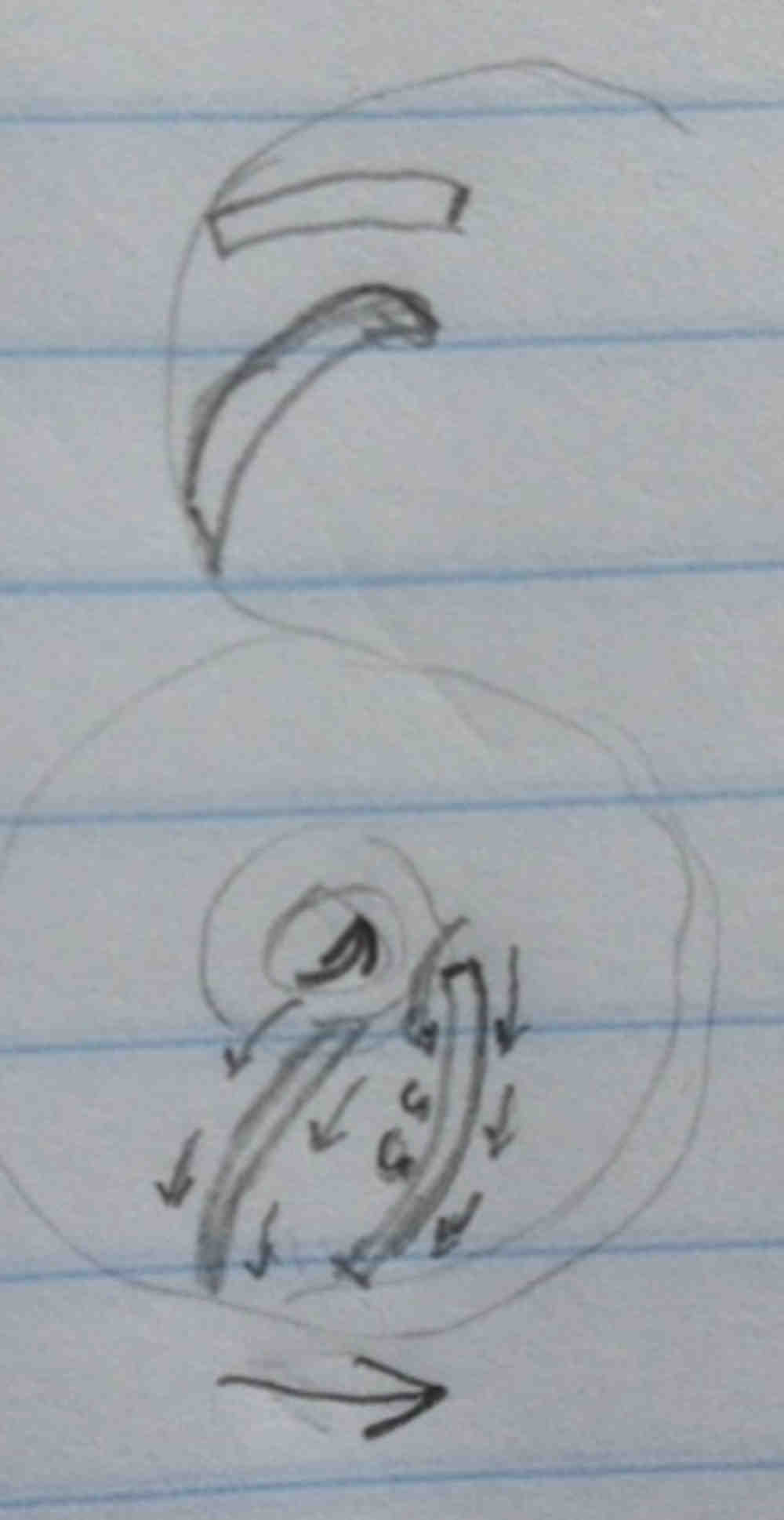
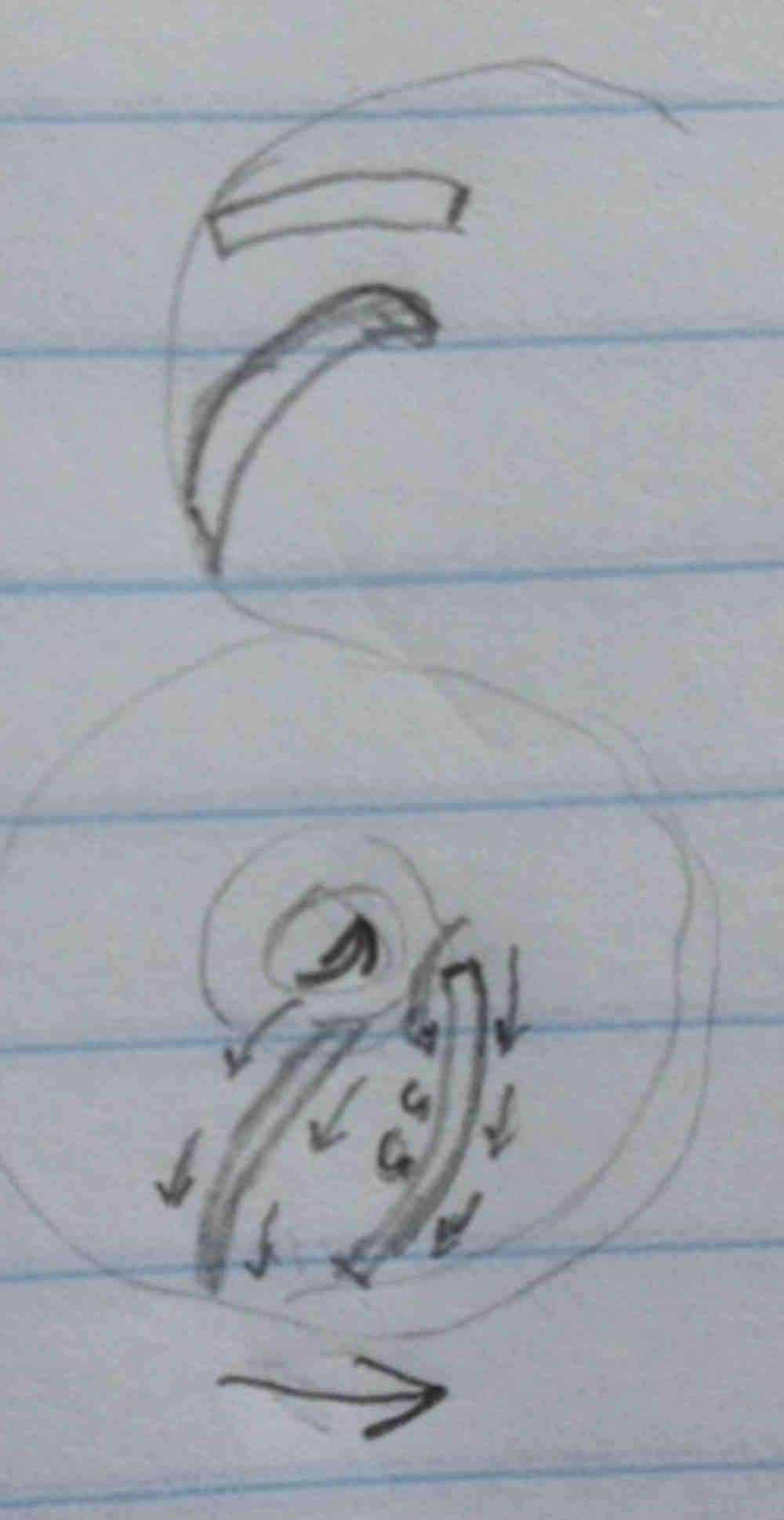
The 2nd gen RX8 is weird.
The last one looks more like a
RX7 2nd
gen
Paul
Paul,
If we think of impeller leading edge as
a wing gently entering the water
stream... and then the trailing edge
mimicking a extended wing flap...
directing as much water as possible
into the pump housing scroll.
The computer model helps us not stall
the "wing" or congest the flow at
any point on it's surface (or between
adjacent surfaces). We would like
to have each section do equal work.
Then Mazda's new design makes more
sense.
Barry Bordes
The water must make a sharp right
angle. It comes in on the same axis as
the pump shaft.
Then it must turn 90 degrees and
flow outward towards the housing scroll.
The device that does this well, using
air, is a turbo charger compressor
wheel.
I suspect a good water pump would work
the same way. I could be wrong of
course
but I would like to see some comparison
data and a CFD before I would be
convinced.
Turbo charger compressors are hard to
make. They are probably machined
on a 4 or 5 axis
NC mill. Too costly for a car.
High pressure die casting them
would be very hard to do I suspect. The
mold must be
made in perhaps multiple parts to get
the finished product out of the
mold. Very expensive.
In the case of a water pump It may be
necessary to make them in iron or
steel for long life.
That prevents high pressure die
casting.
In the case of the 2nd gen RX8 that
could be done in a simple iron or
steel sand or ceramic casting.
There are no 3D double curved surfaces.
It is probably better than the
stamped steel
first gen RX8 or 3rd gen RX7
impellers.
It remains to be seen if the aluminum
after market NC Mill impeller
will hold up for long periods.
We are using the KSE water pump on the
time to climb. How that is made I
know not.
Paul Lamar
I would like to see some quantitative data back to back with the first
gen RX8 impeller.
Should be easy to do with a 2 HP AC electric motor and a fixed orifice
say 3/8th of an inch
to simulate the restrictions in the engine block. Measure the pressure
just before the restriction.
This will give us data at one RPM unless you have a stepped puley on the
2 HP AC motor.
Paul Lamar
The Rotary Engine free News Letter. Powered by Linux. If you want off
the list PLEASE let me know and I will remove you. ACRE NL web
site.
http://www.rotaryeng.net You Tube
http://tinyurl.com/beqqxas
Copyright 1998-2017 All world wide rights reserved.