On May 9, 2017 10:43 AM, "paul lamar" <
rotaryeng@earthlink.net
<mailto:rotaryeng@earthlink.net>> wrote:
Paul and Dale, I know this has been a source of disagreement in the
past but I feel compelled to respond to the displacement narrative.
Displacement is defined as "c: the volume displaced by a piston (as
in a pump or engine) in a single stroke. All manufactures of rotary
engines use the same method as Mazda in determining displacement.
The only people that define the rotary displacement differently are
sanctioning bodies to help competitors that must compete against it!
This is also done to handicap the two stroke engine.
A second idea for consideration. If we physically take the 3.15" wide
X 7.5" long rotor (23.625 sq in) working against a very short 5/8"
stroke we get our 653 cc. When we add the 1500 psi to the above
volume we get torque.
If we could some how magically double this displacement we would
double torque and HP.
Let me concede that there is a clue that might indicate that it's
displacement is larger... and that is the way it drives a turbine
wheel causing turbo selection to be skewed larger than 4 strokes.
But in the end it is a very small and intriguing simple engine with
a very high heat load unencumbered by parasitic valve mechanisms.
My Take, Barry Bordes
The rotary is not a two stroke. It is a four stroke.
Lets turn it around. How much air would a 2.6 liter two cylinder TWO
STROKE engine pump in one revolution?
As far as HP is concerned the ONLY thing that matters is how much air
a four stroke engine pumps in ONE REVOLUTION at 100% VE. Not the
physical displacement of x number of chambers.
The definition of displacement, as far as engines are concerned, is
only valid in context with the type of stroke.
Here is what Ansdale has to say about that.
13B rotaries are raced in the 2.6 liter class world wide for a good
reason. The only reason they generate more power than a 2.6 liter
four cylinder engine is they turn faster and breath better. Lately
that is less true as the piston engine RPM has been raised by detail
development and the use of high strength to weight ratio materials
like titanium. Also four valves per cylinder has improved the
breathing. It is very rare for any 2 valve cylinder to have a VE over
one. The RX8 engine is just over one and P-ports are typically 1.2.
Formula One (2.5 liter as I recall) V8 engines were turning 19,000
RPM. At least four valves per cylinder with a very short stroke so
larger valves can be used for a given physical cylinder displacement.
You will not find the details of a competitive Formula One engine
anywhere. Its a well kept secret. However I would not be surprised if
the VE's were well over one. Applying the RPM difference to a 2.6L
p-port rotary making 340 HP at 10,000 RPM would make the Formula One
engine about 19,000/10,000 times 300 HP or 655 HP which is about
right for a Formula One engine in that period.
Paul Lamar
Paul,
It probably would be more correct to call a rotary a two sweep
engine with 4 phases: intake, compression, power, and exhaust. As you
know there is no reciprocating type stroke involved.
The only comparison to the 2 stroke that I used was that it is also
handicapped by sanctioning bodies because of its performance over a
4 stroke.
Did outlawing the peripheral port change its displacement?... no
only its competitiveness. That after the rotary was penalized by
giving the 4 strokes a double displacement advantage. This does make
sense to keep other manufactures competitive, profitable and happy.
But it doesn't change the definition of displacement.
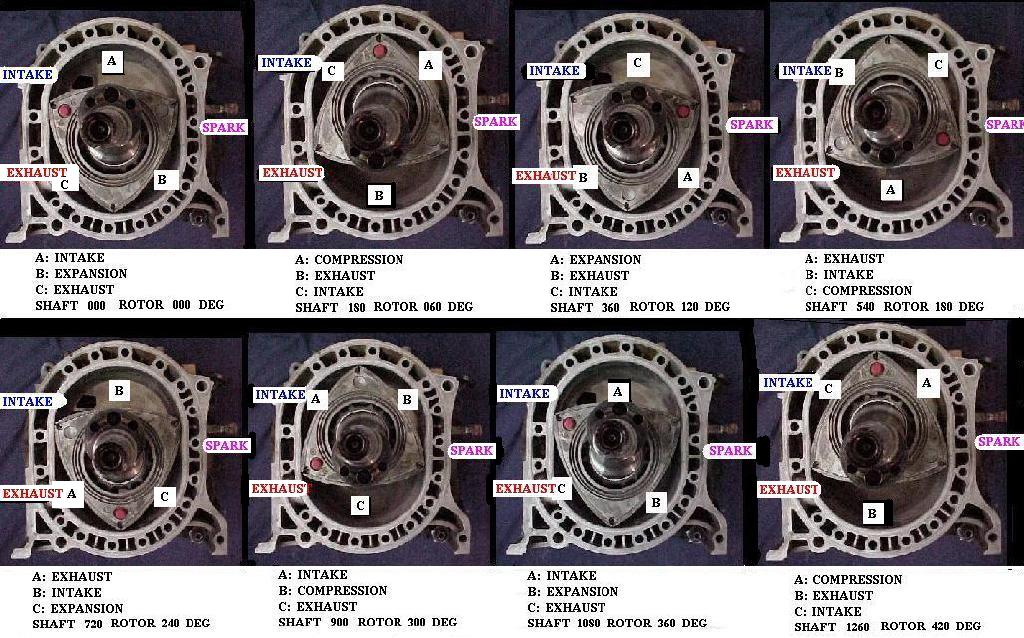
The cutaway picture of the rotary that you showed in Blue is exactly
the depiction of its displacement. Displacement is not denoted by
Ansdale's opinion... it is a dimensionally exact measurement.
Our little engines are indeed more powerful than most can envision.
Barry Bordes
The Ansdale definition of Wankel displacement is accepted by all the
world's engine engineers.. It is not an opinion. It is based on
facts. That's it period :-) You need to get his book and read it.
Paul Lamar
Barry, I have a question. Why do you state rotor dimensions in
imperial units and then state displacement in metric? All Mazda and I
would suspect almost all manufacturers use the metric system.
Ingersoll Rand may have used Imperial due to American design and the
dimensions involved.
Dale Davies
Paul and Dale, Here is a list of Rotary engines produced.
https://web.archive.org/web/20050219094802/http://www.monito.com/wankel/engines.html
<https://web.archive.org/web/20050219094802/http://www.monito.com/wankel/engines.html>
The displacement figures stated represent what? Are we to guess
that they are 1/2 or doubled or actual? This is the problem with not
using a standard for displacement. You guys want to use a different
standard... this introduces confusion. I would ask that you show one
manufacturer that uses Ansdale's method as its standard.
As for metric vs imperial units I tend to use either depending on the
majority audience. Respectfully, Barry Bordes
People have no trouble understanding that 2 cycle engines are twice
as powerful as a 4 stroke. However the Wankel is not a 2 stroke.
There in lies the problem.
Just call them rotor dimensions. Or Wankel displacements so people
that are not familiar with Wankel engines can form an equivalent to a
4 stroke piston engine in their minds.
BTW if you have Windows with Office please load HTML's in Word and
save them as a pdf's and send that to me. HTML files do not forward
well to all operating systems.
Paul Lamar
I have to add, just how many things done for power. Rotary doesn't
do a dry fire for exhaust evac. I have to agree with the two stroke
analysis. It's piston draws in combustion fires and spits it out on the
same crank revolution like a two stroke. But the intake and exhaust evac
are complete volume like a four stroke. Now add that it does that three
times per crank revolution and it should be more effective than a two
stroke if you can get the combustion efficiency worked out.
Kurt Emerson
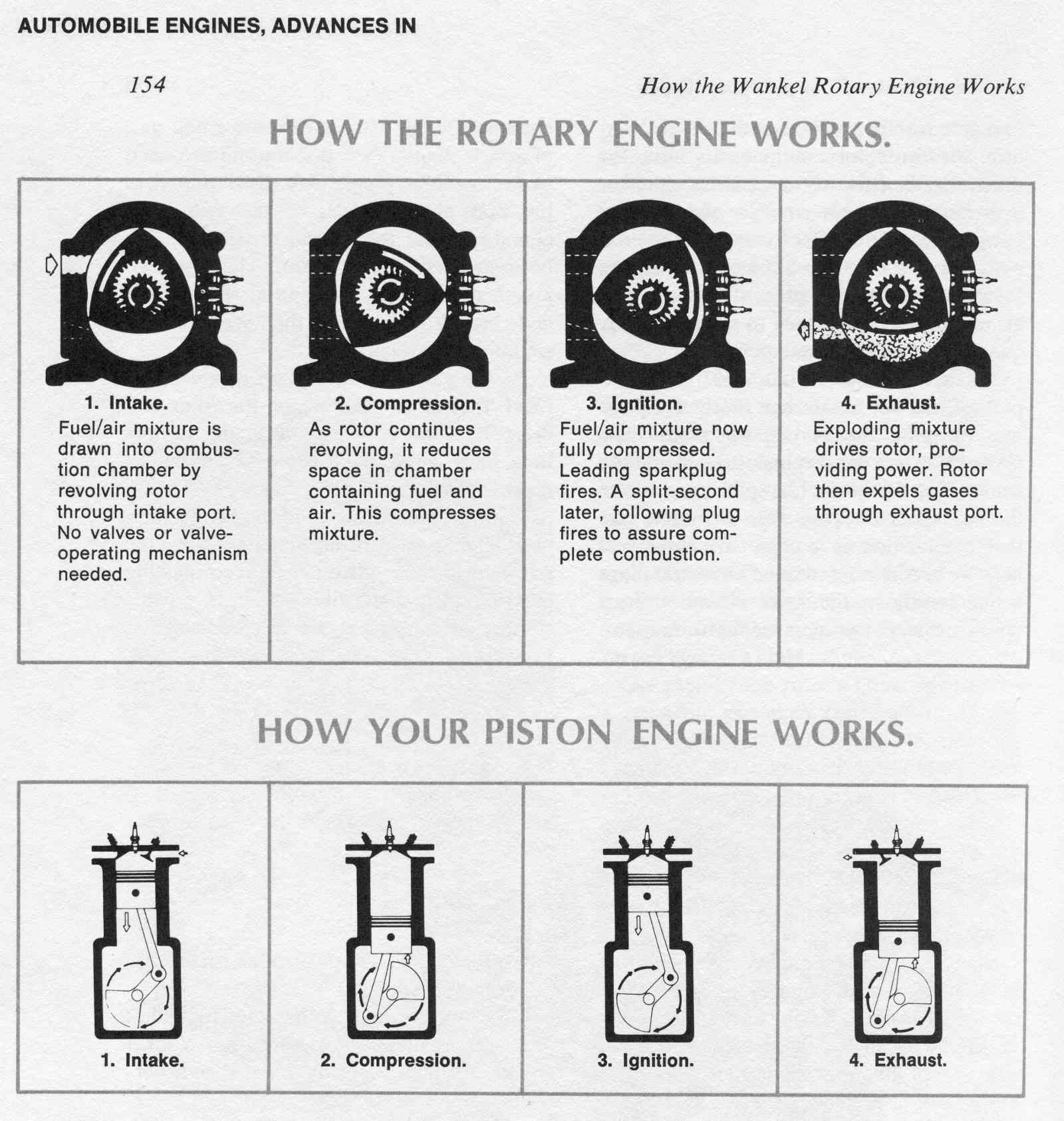
Actually Kurt, the rotary is much more like a 4 stroke cycle engine than
a 2 stroke cycle engine. On a side of the rotor the intake happens. This
is followed by compression, then ignition and the power stroke. Then
exhaust takes place. It takes three rotation of the e-shaft for all
three rotor faces to complete power cycles. A two rotor engine fires
like a four cylinder auto engine, every 180° of e-shaft rotation.
Two stroke cycle engines combine the strokes a bit. On motorcycles and
small engines, the intake is sucked into the crankcase as the piston
rises on the compression stroke. During the power stroke this is
compressed a bit as the piston comes down.
The exhaust port opens first to blow down any remaining cylinder
pressure. Then the transfer port is opened as the piston approaches BDC.
The pressurized fuel/air squirts into the cylinder helping push exhaust
out. A two stroke does not exactly have an equivalent displacement to a
four stroke due to the ports at the bottom.
Also scavenging can be not as efficient. Low RPM torque is less than a
four stroke with equivalent swept volume. They do seem to like RPM a bit
better as the conn rod is always loaded at top dead center. In four
stroke cycle engines the syratching force at TDC on the exhaust stroke
at high RPM is tremendous due to basically zero pressure on the top.
Dale Davies
The Rotary Engine free News Letter. Powered by Linux. If you want
off the list PLEASE let me know and I will remove you. ACRE NL web
site.
http://www.rotaryeng.net You Tube
http://tinyurl.com/beqqxas
Copyright 1998-2017 All world wide rights reserved.