Paul and Dale, I know this has been a source of disagreement in the
past but I feel compelled to respond to the displacement narrative.
Displacement is defined as "c: the volume displaced by a piston (as
in a pump or engine) in a single stroke. All manufactures of rotary
engines use the same method as Mazda in determining displacement.
The only people that define the rotary displacement differently are
sanctioning bodies to help competitors that must compete against it!
This is also done to handicap the two stroke engine.
A second idea for consideration. If we physically take the 3.15" wide
X 7.5" long rotor (23.625 sq in) working against a very short 5/8"
stroke we get our 653 cc. When we add the 1500 psi to the above
volume we get torque.
If we could some how magically double this displacement we would
double torque and HP.
Let me concede that there is a clue that might indicate that it's
displacement is larger... and that is the way it drives a turbine
wheel causing turbo selection to be skewed larger than 4 strokes.
But in the end it is a very small and intriguing simple engine with
a very high heat load unencumbered by parasitic valve mechanisms.
My Take, Barry Bordes
The rotary is not a two stroke. It is a four stroke.
Lets turn it around. How much air would a 2.6 liter two cylinder TWO
STROKE engine pump in one revolution?
As far as HP is concerned the ONLY thing that matters is how much air
a four stroke engine pumps in ONE REVOLUTION at 100% VE. Not the
physical displacement of x number of chambers.
The definition of displacement, as far as engines are concerned, is
only valid in context with the type of stroke.
Here is what Ansdale has to say about that.
13B rotaries are raced in the 2.6 liter class world wide for a good
reason. The only reason they generate more power than a 2.6 liter
four cylinder engine is they turn faster and breath better. Lately
that is less true as the piston engine RPM has been raised by detail
development and the use of high strength to weight ratio materials
like titanium. Also four valves per cylinder has improved the
breathing. It is very rare for any 2 valve cylinder to have a VE over
one. The RX8 engine is just over one and P-ports are typically 1.2.
Formula One (2.5 liter as I recall) V8 engines were turning 19,000
RPM. At least four valves per cylinder with a very short stroke so
larger valves can be used for a given physical cylinder displacement.
You will not find the details of a competitive Formula One engine
anywhere. Its a well kept secret. However I would not be surprised if
the VE's were well over one. Applying the RPM difference to a 2.6L
p-port rotary making 340 HP at 10,000 RPM would make the Formula One
engine about 19,000/10,000 times 300 HP or 655 HP which is about
right for a Formula One engine in that period.
Paul Lamar
Paul,
It probably would be more correct to call a rotary a two sweep
engine with 4 phases: intake, compression, power, and exhaust. As you
know there is no reciprocating type stroke involved.
The only comparison to the 2 stroke that I used was that it is also
handicapped by sanctioning bodies because of its performance over a
4 stroke.
Did outlawing the peripheral port change its displacement?... no
only its competitiveness. That after the rotary was penalized by
giving the 4 strokes a double displacement advantage. This does make
sense to keep other manufactures competitive, profitable and happy.
But it doesn't change the definition of displacement.
The cutaway picture of the rotary that you showed in Blue is exactly
the depiction of its displacement. Displacement is not denoted by
Ansdale's opinion... it is a dimensionally exact measurement.
Our little engines are indeed more powerful than most can envision.
Barry Bordes
The Ansdale definition of Wankel displacement is accepted by all the
world's engine engineers.. It is not an opinion. It is based on
facts. That's it period :-) You need to get his book and read it.
Paul Lamar
Barry, I have a question. Why do you state rotor dimensions in
imperial units and then state displacement in metric? All Mazda and I
would suspect almost all manufacturers use the metric system.
Ingersoll Rand may have used Imperial due to American design and the
dimensions involved.
Dale Davies
Paul and Dale, Here is a list of Rotary engines produced.
https://web.archive.org/web/20050219094802/http://www.monito.com/wankel/engines.html
The displacement figures stated represent what? Are we to guess
that they are 1/2 or doubled or actual? This is the problem with not
using a standard for displacement. You guys want to use a different
standard... this introduces confusion. I would ask that you show one
manufacturer that uses Ansdale's method as its standard.
As for metric vs imperial units I tend to use either depending on the
majority audience. Respectfully, Barry Bordes
People have no trouble understanding that 2 cycle engines are twice
as powerful as a 4 stroke. However the Wankel is not a 2 stroke.
There in lies the problem.
Just call them rotor dimensions. Or Wankel displacements so people
that are not familiar with Wankel engines can form an equivalent to a
4 stroke piston engine in their minds.
BTW if you have Windows with Office please load HTML's in Word and
save them as a pdf's and send that to me. HTML files do not forward
well to all operating systems.
Paul Lamar
I have to add, just how many things done for power. Rotary doesn't
do a dry fire for exhaust evac. I have to agree with the two stroke
analysis. It's piston draws in combustion fires and spits it out on the
same crank revolution like a two stroke. But the intake and exhaust evac
are complete volume like a four stroke. Now add that it does that three
times per crank revolution and it should be more effective than a two
stroke if you can get the combustion efficiency worked out.
Kurt Emerson
Kurt,
You are going to see a lot of returns on this. The rotor turns at 1/3
E-shaft speed.
Bill Jepson
Paul,
On the subject of the two stroke's displacement.
It is calculated as if the cylinder sleeve had no ports in it. It's
compression ratio would also be calculated using this theoretical model.
In actuality the trapped displacement would be formed by the stroke from
the top of the exhaust port to TDC and consequently it and the
compression ratio would be substantially lower.
If a two-stroke could have a separate action that would supercharge the
cylinder like.... say another full stroke it would make it more efficient.
That is what a four stroke does. It uses another complete revolution to
supercharge it's engine cycle.... And we do not penalize for doing this.
We actually penalize the two stroke in the rotary for not doing this.
Paul also I am sorry about my lack of computer knowledge. The above is
written on a PC and below is a HTML copy from an Internet program. Is
it any better?
A different perspective,
Barry Bordes
We will call it the Barry Bordes Displacement :-)
The text is the same. In your email program and I assume that is Outlook.
Set the auto line wrap in Outlook to at least 65 characters.
What ever it is set to now it makes a huge mess of forwarded messages.
Forward a message to your self and see what it looks like.
Paul Lamar
Paul and Barry,
You are missing a very important part of 2 stroke operation. I did some
work on 2 strokes during the heyday of the 2 stroke GP motorcycles. All
the designers were CONSTANTLY harping about crankcase volume. The reason
is that a modern 2 stroke is a double ended pump. using case reed
induction or a disk valve a lot of compression takes place in the lower
end. (crankcase)
The piston traveling down both forces and mildly compresses the volume
inside the crankcase and vigorously forces it through the transfer
ports. At Kawasaki they liked the disk or rotary valve and with a good
intake they often complained about the compression being too high! that
despite the short time all the ports were closed! I believe that a
P-port rotary does so well because the fully uncovered intake is open
for a longer time than a comparable piston engine. The rotary also
responds very well to a tuned length intake, therefore the use of the
variable length inlets on the Le Mans engine.
Bill Jepson
Ahh yes thanks Bill that was a quickie error.
Two stroke most important component is the exhaust tuned length,
diameter and cone shape. The reflected sonic wave pulses back at
the exhaust port of the cylinder effectively making it a solid wall (almost)
Kurt Emerson
I'm astonished every time I read about the equivalent stroke in a Wankel
to that of a reciprocating engine, the 'super squared' engines, cylinder
diameter dimension larger than stroke, were preferred for performance at
high rpm, and long strokes for combustion efficacy and low rpm torque,
you have to drive for many miles in a manual transmission Wankel to feel
what the response is at low load, low speeds, compared to a reciprocating.
1.2 super square engine, bore to stroke ratio, was considered audacious,
but what will be the analog figure for a Wankel?
The European, and Japanese city traffic conditions are totally different
from the USA, you pass more time waiting for a green light,
accelerating, braking, and again same path, that actually running, this
completely changes fuel economy, use of power; American cities were
built with a lot of space, and cars started along with economical
growth, that besides having an smart and industrious people, has the
unique advantage of being the richest land on Earth.
Have a good season, regards, + Salut
Jose Gros-Aymerich Medical Doctor.
You never drove in New York or LA or any other large American cities.
Typically
people spend some times hours to get to or from work.
I have driven all over Europe and Japan including your country. The
worst part is the
narrow streets. In Frankfurt it is the narrow one way streets :-)
You need to go back to college Doctor Jose and study mechanical
engineering :-).
The low speed acceleration of the car has nothing to do with the
"stroke". Formula
One engines have a very short stroke and they have no problem at
breaking the
rear tires loose :-) They have a very short stroke to make the intake
valves bigger and
that gives them higher volumetric efficiency. VE for short.
It is all in the gear box and the amount of HP. Mazda is not big enough
to build their own gear boxes
so they have to buy off the shelf gear boxes designed for bigger piston
engines.
Not many sport cars are sold in the US with only 2.6 Liter engines.
The stock RX8 beats the stock Corvette in road racing with a 2.6 liter
engine while
the Corvette has 5 liter or more all aluminum V8. They both are about
3200 pounds
plus or minus 200 for crash reasons. Both are using aluminum for chassis
and or
body parts in the case of the RX8. The RX8 has a carbon fiber drive
shaft mostly
for vibration reasons
That is the main reason Mazda is building a 3.2 liter RX9. To over come the
gear box limitations.
Stay on here for 10 years and I will award you a degree in engineering :-)
Paul Lamar
If Mazda changes eccentricity and radius to similar dimensions to the
13A engine with a wider rotor of 70mm the low speed turque should be
higher. Sort of like stroking a recip engine.
Dale Davies
The stroke will remain the same. It is like making the piston bigger
so the displacement will increase.
It will look more like a Norton. Anything about making the
displacement bigger will increase the torque.
Airplanes and cars move with HP and not torque. Torque can be anything
the gear box says
it is :-)
In a car torque is limited by driving tire traction. Once the drive
wheels are spinning that
is all the torque you need or your going to get.
Paul Lamar
Increasing the eccentricity of the e-shaft is directly equatable to
increasing the stroke of a recip engine. To retain the shape of the
epitrchoidal curve the ratio of rotor radius to eccentricity needs to ne
maintained or kept close. Thus in my mind the radius increase is part
and parcel of the "stroke" increase.
Yes increased displacement increases torque and that is more than one
way to accomplish that. My feeling is a 70mm wide rotor could function
well with two or three centered plugs as Mazda has used. When the rotor
width goes over 75mm, side by side plugs are needed which could ad up to
four or six plugs per rotor. Considering Ianetti manufactures 70mm and
80mm apex seals, either of those widths would be wise choices. If you
were to choose to vary from those a quantity order would be required.
This is why I state 17.5mm eccentricity, 125mm radius with 70mm width.
The stationary and rotor gears could be easily copied. It would be a
simple matter to copy a 13A e-shaft with minor length change
corresponding to the rotor width increase. Apex seals for the 12A would
fit. The engine would fit the Mazda dimensions as per the 16X or as we
would call a 3.2L. For an auto increased low RPM torque and in aircraft
increased power.
Dale Davies
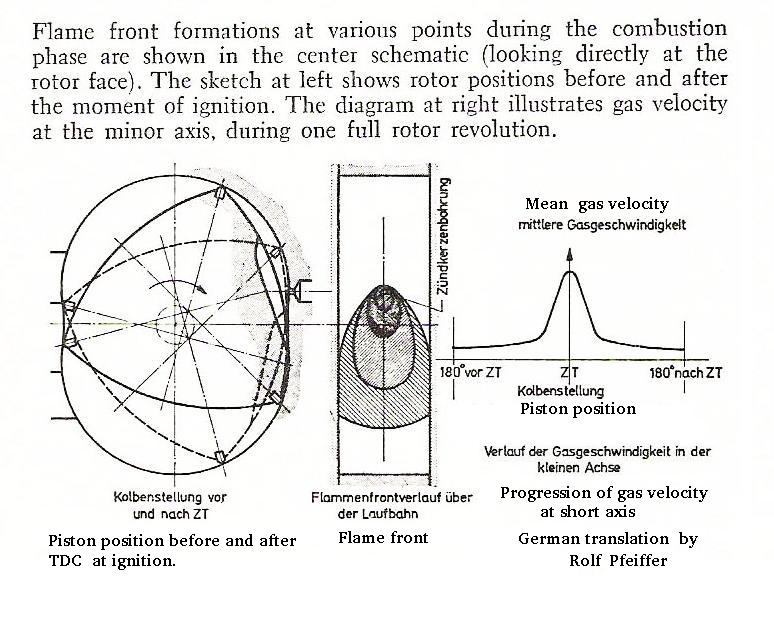
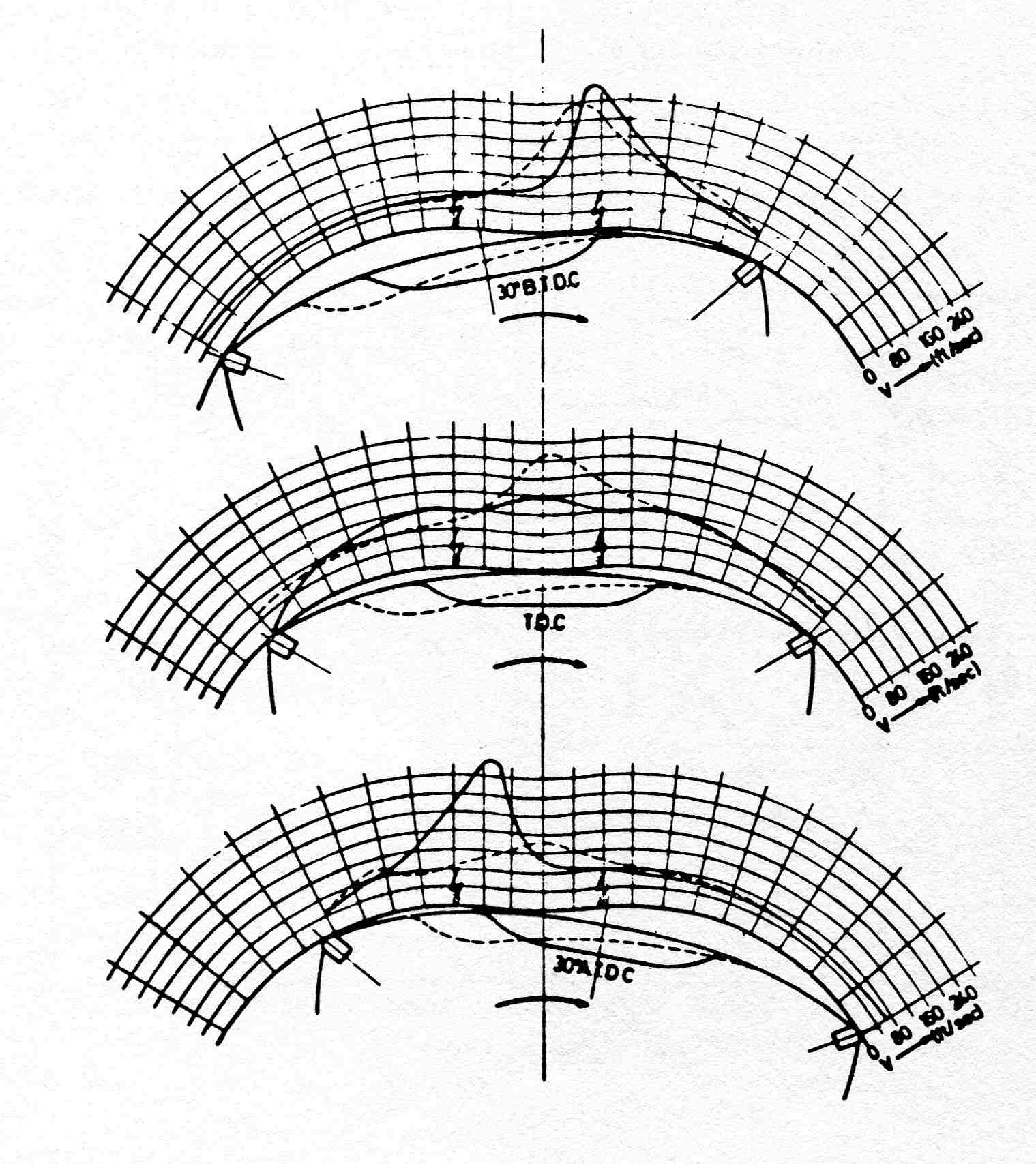
I think the jury is still out on optimum rotor width. IMHO the first
thing that needs to be done is
reduce the hurricane force winds in the combustion chamber. It is quite
obvious from
the shape of the flame front these winds are having a huge effect on the
combustion
process. Here is a jpg of the flame shape. This was known from the get
go (Norbye days) but
was not attributed to the wind.
--------------------------------------------
I still think the best way to handle the problem is let the high pressure
squish air generated at the back of the combustion chamber flow under
the combustion chamber and out the front part of the combustion chamber.
Here is my latest 3D on the solution.
Paul Lamar
The Rotary Engine free News Letter. Powered by Linux. If you want
off the list PLEASE let me know and I will remove you. ACRE NL web
site.
http://www.rotaryeng.net You Tube
http://tinyurl.com/beqqxas
Copyright 1998-2017 All world wide rights reserved.