Hi Paul,
I hope the Oshkosh experience was very good. The TTC project is
very impressive.
Im gradually working through my radiator and oil cooler issues, and
also building an exhaust header / tangential muffler. I have a
couple of questions on the latter.
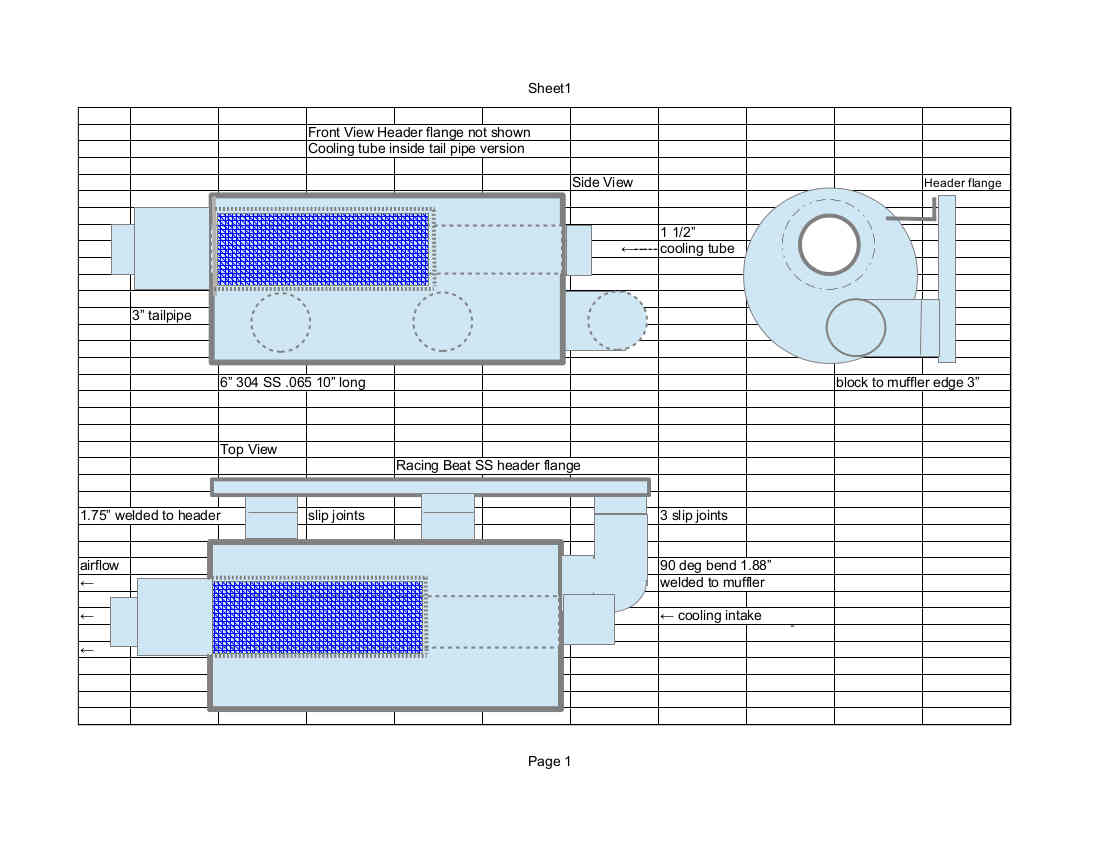
Please see the attached, although very crude, drawing.
I am using the Racing Beat SS header, with short 2.5x 1.75 OD .065
304 SS tubes welded in place. These will slip into 0.65 1.88
tubes that will in turn be welded into a 6 304 SS .065
cylinder/muffler. On the front, a 90 degree 1.88 tube is used to
reduce the length of the 6 tube and significant weight.
Due to space and other constraints, I need to bring the 3 tailpipe
(also .065 304 SS) out of the
*rear* of the muffler and up. This
gives me at least 3 options: 1. A straight 3 pipe welded to the
rear of the muffler. 2. Squeeze the 3 tailpipe into a fish mouth
(your previous drawings showed an area about 1/2 of that of the
tailpipe). Or weld up a larger fish mouth. 3. Or, allow a short
section of the 3 tailpipe to remain inside of the muffler, which
could be closed off and drilled with (e.g. 0.5) holes to arrive at
the same exit area as the fish mouth design. I am wondering if this
might be a more conventional muffler design and possibly allow better
sound reduction?
The prior concerns regarding the longevity of any metal living
inside the muffler have been noted. However, with a Renesis engine
having exhaust ports coming through the iron housings, as well as a
cooling tube, both giving lower exhaust temps, do you think this is
a concern for .065" 304?
Thanks for your input,
Scott Gettings
You are on the leading edge Scott. Nothing like this has been built
yet. The RX8 side port exhaust is a little cooler so it should work
all right. If it burns through opposite the exhaust ports you can
weld on doubler patches.
Paul Lamar
Scott, Suggest that you investigate 321 S/s as 304 is a very low
grade Stainless. Remember the exhaust temp will get up to 1800
degrees which is rather warm. Your design is similar to what I made
and is still alive, but I have not the cooling tube. Neil Unger
Nice work Neil.
Paul Lamar
Typically 309 & 310 are used for high heat applications, 309 is good
for 2000F and 310 2100F. Be sure to use the correct filler rod the
material you are working with or you will be wasting your time using
these more expensive grades. I would not call 304 a low grade steel,
they all have their place in the appropriate application. Andrew
Campbell.
Paul, do you recommend having slip joints on the pipes just after the
SS flange like Scott has, or is it ok to put these further
downstream. Reason is ask is that I wanted to duct some cooling air
around that area in flight and my concern is when going from high
power straight to a power off, high rate of descent leading to
possible uneven temps around the exhaust due to cooling air
distribution.
I want to try and minimize the risk of possible cracking. With the
space I have to duct cooling air I have to duct it from front to rear
so the front (if sitting in the cockpit) exhaust header pipe gets the
coolest shot and the rear header pipe gets the air warmed by the
other 2 further in front.
Any issues you can see using thick wall stainless tubing bends
Alex Molteno
The thicker the wall the better. There is a weight draw back of
course, .109 wall 304 and it hardly shows any problems at all. One
can buy 304 SS hand rails from
http://www.wagnercompanies.com/products-services/railing-systems-and-components/railing-components/elbows-and-wall-returns/
<
http://www.wagnercompanies.com/products-services/railing-systems-and-components/railing-components/elbows-and-wall-returns/
rfq@mailwagner.com <
mailto:rfq@mailwagner.com
You can then use the exhaust plumbing for motor mounts :-) Joking of
course. It is only the first 18 inches of a p-port or so and by that
time it has cooled. The slip joint can go there. Scott has a problem
in that it is a pusher so he has way less room in the cowl to work
with. If you can avoid it keep the muffler out of the cowl and use a
coax muffler.
Do you have an RX8 engine? Things are a lot easier and quieter as the
exhaust is a couple hundred degrees F cooler with the side exhaust.
Paul Lamar
OK thanks Paul, good to know for the parts source to use tubing
handrail. I've added a bit of extra weight already during the build
so a few extra lbs of exhaust weight will be OK for extra insurance
against cracking
Alex Molteno
Paul,
While studying the best configuration for the tailpipe on a tangential
muffler, I came across another idea that might further reduce the noise:
If the combination of the Renesis exhaust being around 1600 degrees and
a cooling tube might reasonably allow 304 metal to survive, do you think
it might work to place the cooling tube INSIDE the tailpipe and let the
exhaust augment the cooling tube air? This would allow a lot more area
for holes to be used in the muffler section of the tailpipe. The
inside of the cooling tube only gets fresh air and does not mix with
the exhaust air until after exit.
In the attached drawing both the exhaust and cooling tube go straight
back, but would ideally need to exit vertically or at least at a 45
degree upward angle. I assume to have any augmentation the cooling
tube would need to extend past the exhaust exit flow.
If this is not still too far on the bleeding edge to make an educated
guess, any suggestions are appreciated.
Thanks
Scott Gettings
Hard to say with out spending a lot of money on instrumentation and data
recording.
Paul Lamar
The Rotary Engine free News Letter. Powered by Linux. If you want off
the list PLEASE let me know and I will remove you. ACRE NL web
site.
http://www.rotaryeng.net You Tube
http://tinyurl.com/beqqxas
Copyright 1998-2017 All world wide rights reserved.