Paul, We have been here many times before and there are many trade
offs with fitting a turbo to the rotary. Pluses are in the power
obtained and noise reduction. A P port will cost at least $1000
plus fittings so that cost can go towards the turbo, Then is the
weight penalty etc.
To date with your experience in the TTC, just how viable and trouble
free is the turbo option?
Neil Unger
Don't forget we have 650 HP. No alternator or voltage regulator and
a battery too small to start it. We also have the expensive ($200
each silicon nitride apex seals. 6 needed.)
However it starts up every time just like my RX8.
No problems of any kind. The water is always less than 150 F no
matter how long we taxi around and wait to take off at a tower
airport. and the oil creeps up to 170 F but that is with 3 gallons
of oil and no oil cooler in about 20 minutes of flight
Last time we flew it a couple of days ago we got to 8000 RPM at 70%
throttle and the waste gate wide open at 5500 feet alt. The manifold
pressure got up to 60 inches of Hg.
We have had it up to 7000 RPM and 85 inches of Hg with the manual
waste gate closed.
How much HP do you want?
What ever HP you want is no problem. The rotary will handle it.
It is because of the Robust Heart of the Rotary.
There is at least one guy in Melbourne making aluminum end housing
and then the weight is less than 200 pounds with the turbo. There is
not another aircraft engine in the world other than a turbo jet that
has a better power to weight ratio. You still need the gear box. I
don't know what your gear box weighs.
It will cost about 1/10th the cost of an equivalent turboprop engine
like the PT6 and burn less fuel per HP generated.
Paul Lamar
Paul, Fair comment. What I am suggesting is that to get more HP than
stock say up to 300 HP max it can be done with a turbo without the
expense of P porting, as I said min $1000. So a saving of $1000 and
you get much more HP with a turbo. Penalties are the weight of the
turbo etc, but more Hp for little alteration to the base motor. The
turbo also negates the need for sophisticated mufflers. All
compromises, wins and losses. Look forward to continuing this
discussion when you get to OZ. Regards,
Neil Unger
Yes that is true but you pay a small fuel burn penalty with side ports.
I have been thinking about this and what the TTC proves is that... it is
possible
to build a three or four rotor version and build a six passenger pressurized
single engine airplane that will out perform the popular P&W PT6
powered versions.
Faster and higher. These airplane cost about a million dollars partly
due to the fact
the PT6 alone is a quarter million.
The PT6 runs out of ompf at about 25,000 feet. This is due to the limited
compression ratio of a gas turbine engine. During WW II the
turbo charged fighter planes like the P38 and the P47 would get up to 40,000
feet. The turbo rotary should do as well or better.
Paul Lamar
Paul, I am thinking 350hp 13b side port with a turbo. with 3.1 reduction
the max
rpm I want is 8400. the prop needs to be kept below 2700 rpm. isn't the
p port
for reasons of better breathing, higher rpm/ more hp? with the leakage of
compression at apex-pp crossover doesn't the fuel economy suffer more with
pp than the side port, not to mention the higher/rougher idle of pp?
who is the
maker of the super light end housings in melborne that you mention?
james whitehurst
Internal combustion engine intake systems are aero dynamic devices.
It takes HP to draw or pump air through an aerodynamics device just like it
takes HP to push your airplane through the air. HP burns fuel. The less HP
needed to suck air into your engine the less fuel needed.
Corners are bad news. The side port has a lot of corners. Rough cast
iron surfaces are bad news. Straight in P-ports are the lowest drag.
Mazda used p-ports on the engine that won Le Mans.
Le Mans had a limited amount of fuel available to run the race.
Mazda won the race out right beating all other piston engines
with the same amount of fuel.
If you don't mind higher fuel burn use side ports.
Paul Lamar
Paul, I was sold on the PP idea, (I used to port and polish my racing
motorcycle
engines 50+ years ago) until I spoke with some folks at a renowned
rotary shop in CA.
I was lead to believe that I would need high rpm to get hp from a PP.
the 3.1 reduction
gear seams to be the most logical. (hopefully available soon) I can't
have over 2800 prop
rpm. what is my best choice for 350 reliable HP (turbo to maintain hp
to 18,000 feet)
with the best fuel economy at 75% power side port or PP?
james whitehurst
Well I think I know who you are talking to. He is a renowned road
racer. In the classes
he raced in P-ports are outlawed. The racers do some extraordinary
things to try
to get around this. It is called bridge porting and if anything it cost more
than a welded p-port. It is a glorified side port.
75% power is going to occur about 6000 RPM with a prop RPM of roughly
2000. Perfect for a P-port. You can just about get any HP you want at
any RPM with a turbo charger.
It will be no trouble at all to get 350 HP up to 30,000 feet in case you
have oxygen.
Find the largest waste gate you can find and it can be manually
controlled or
get a Motec for automatic control or some other EFI system to control it.
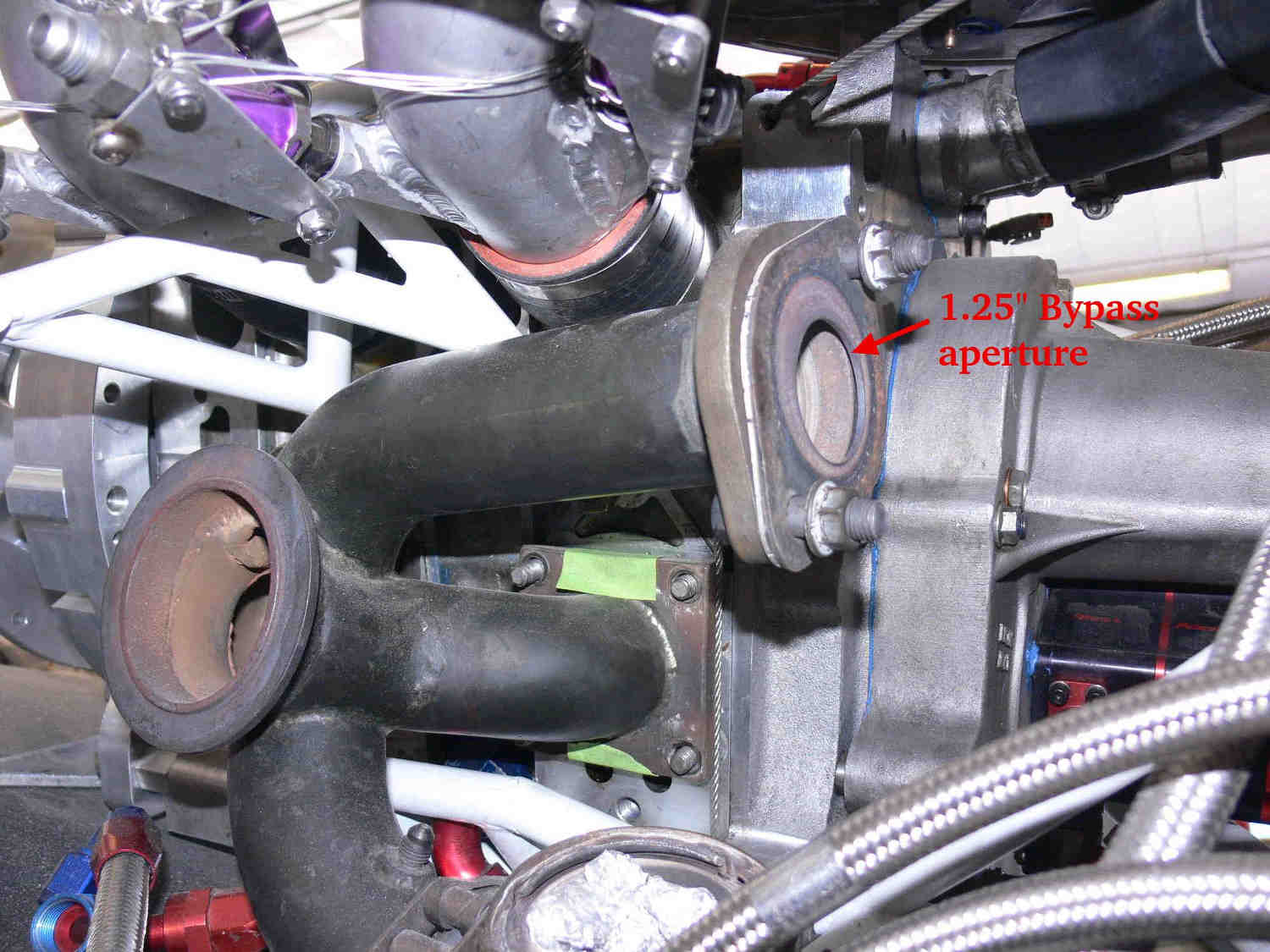
Then you won't need such a large by pass hole in the exhaust manifold.
Our current waste gate is only about 50 or 60 MM ( about 2.3 inches dia max)
and it is too small. With it wide open we are still getting 60 inches
of manifold
pressure at 70% throttle opening. 60 inches of manifold pressure
on gasoline is about 500 HP. That is based on the fact a normally aspirated
P-port running on gasoline will generate 250 HP at 30 inches Hg at sea
level atmospheric pressure.
So you will need more bypass area from the waste gate.
Don't let them talk you into a turbo charger smaller than a GT40.
You will sacrifice turbine life and risk turbo failure. You don't need
rapid
turbo RPM build up. Road racers do. A large turbine is much more durable and
longer life as it will run cooler.
Also don't forget the blow off valve set to 80 inches of Hg.
Paul Lamar
The Rotary Engine free News Letter. Powered by Linux. If you want off
the list PLEASE let me know and I will remove you. ACRE NL web
site.
http://www.rotaryeng.net You Tube
http://tinyurl.com/beqqxas
Copyright 1998-2017 All world wide rights reserved.