12 e
Paul, et al:
From the NTSB
report [WPR16LA088]:
The pilot reported that
he initially purchased the engine in 1999
from Atkins Rotary,
located in Eatonville, Washington, and that
there were no historical
records available for the engine. The
pilot subsequently
installed the turbocharger to the engine, with
its first flight being
in 2003.
This is the interesting
read from Hartzell:
https://dms.ntsb.gov/pubdms/search/document.cfm?docID=450749&docketID=59730&mkey=92906
-----
It appears that he
exceeded the EIT (Exhaust Inlet Temp) of
1650F. He had an EGT set
to warn if the Exhaust temps got to 1600F.
Not being a
turbo-charged engine operator, and knowing that this
ATP was attempting to
turbo normalize for 5000 MSL = SL, my
question is, is it this
easy to get into over-speed/over-temp
conditions?
Regards,
Steve Thompson
Tom Parke's engine is a
3 rotor. That is a lot of hot exhaust gas.
With a rotary it is wise
to use a very large turbo as a given amount
of hot exhaust gas will
do less damage to the turbine. We use a
large GT 40
on the two rotor. Tom's
is an older turbo charger as well. I would not
be surprised
if the turbine was not
made from the best material now available.
Tom also had a temp
exhaust gas sensor but for some reason he did
not see
the warning.
The turbine might have
been damaged earlier and Tom did not notice it.
Paul Lamar
------------------------------------------------
Putting the material
aside the turbine was made of there are two
features
of this installation
that contributed to the turbine failure.
The exhaust manifold was
insulated to a degree by the sheet metal
shroud.
Removing that would cool
the exhaust manifold to some degree.
The turbo bearing was
not water cooled. That is a common option
that cools the turbine
as well as the bearings.
Both of these features
led to a higher exhaust gas temperature
impacting the turbine.
It was only necessary to lower the temperature
by 200 F. Despite the
higher temperature it lived for ten years.
I don't know what
material the turbine was made from but the GT40
turbo charger we use on
the TTC is Inconel and the bearing housing
is water cooled.
Paul Lamar
One of the water
injection companies had a controller that could
use EGT as
an input that would
solve this over temp problem.
Murry Rozansky
Paul and everyone,
1650°F really isn't that high for a
rotary exhaust gas temp. In a
turbocharged version I would go so far
as to consider it common. If
that's to much for the turbine he would
be forced to change to one of
the Inconel or ceramic turbines. On the
aircraft dyno Steve Beckham's
latest stocker based P-port version
would regularly see 1600. If you are
at or near the ragged edge on any
temperature issue with the rotary it
would be wise to always default to the
highest temperature resistant
materials possible. Otherwise a few
moments of mis-adjusted mixture are
going to cause damage.
Bill Jepson
Also just cool the exhaust manifold a
little bit.
Paul Lamar
Paul,
The temperature emitted from the exhaust port can be a killer for
manifolds and turbine housings.
There are many variables that affect the temperature when the exhaust
port opens but the main ones are:
1.- Ignition timing.
2.- AFR Mixture.
3.- And excessive port timing.
Note also that the internet "safe" mixtures and timing tend to
aggravate/increase the temp at exhaust opening.
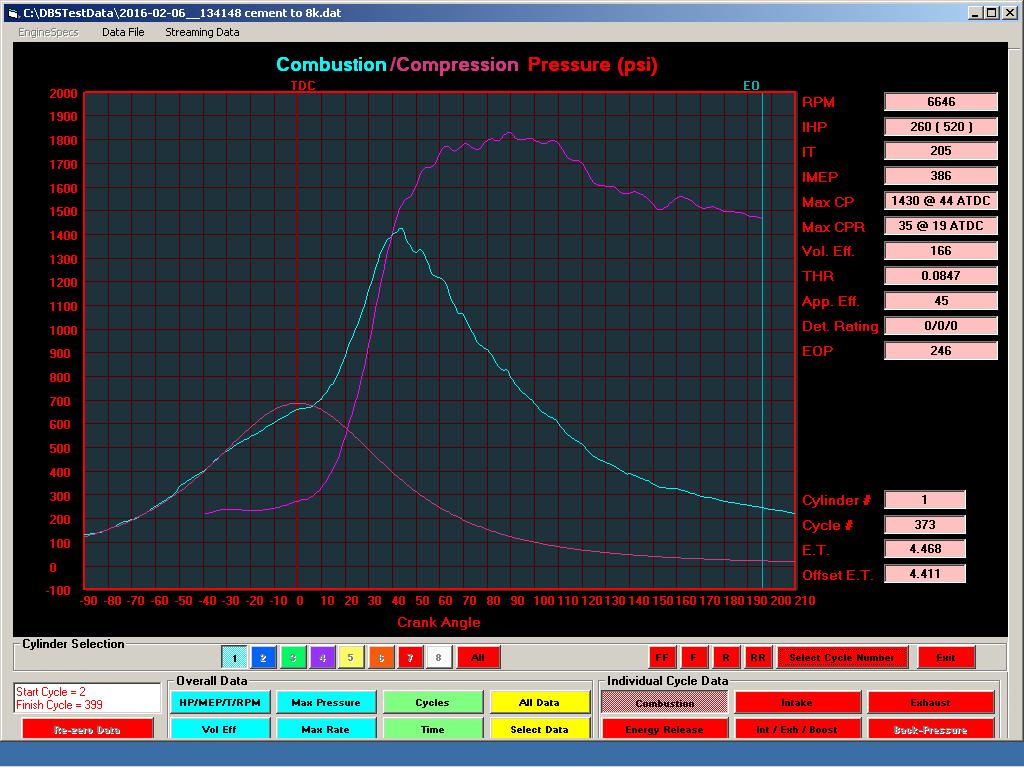
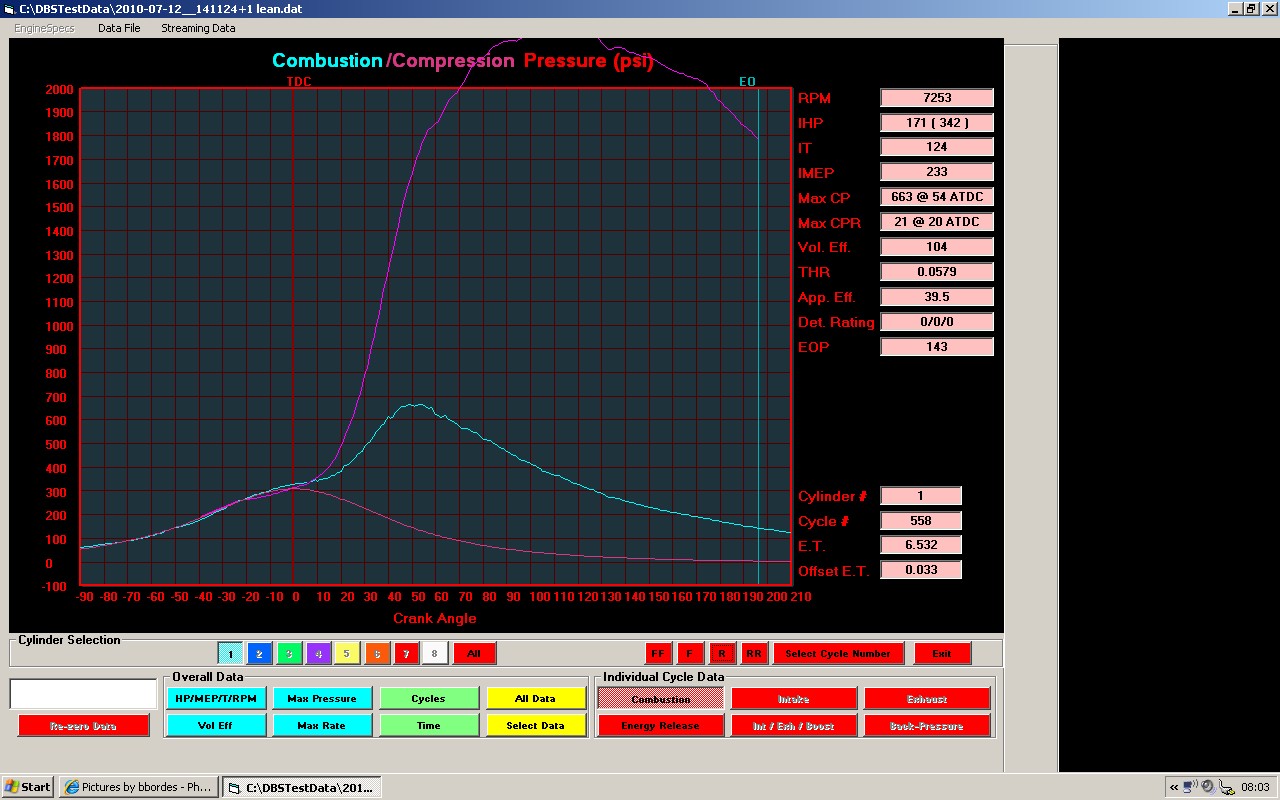
See 2 attachments.
Examine the red trace on the top right hand side at the vertical EO
(exhaust opening) temperature.
One port opens at 1790C and the other at 1460C because the timing and
burn rates differ.
The 1790C is the Internet "safe" settings (rich and retarded) and the
second one is 1460C, it is optimized from AFR and timing combustion tests.
The detonation protection of rich mixtures and retarded ignition become
a problem that has to be considered.
Turbine engines use similar but some what cooler temp limits.
800C take off.
927C never exceed.
Barry Bordes
------------------------------------------------------------------
Please add your questions or comments at the end of the thread.
Not the beginning.
I am going to enforce that rule. If people don't do that it will not be
forwarded.
My ISP changed the rules.
The Rotary Engine free News Letter. Powered by Linux. If you want off
the list PLEASE let me know and I will remove you. ACRE NL web
site.
http://www.rotaryeng.net You Tube
http://tinyurl.com/beqqxas
Copyright 1998-2018 All world wide rights reserved.