12
So Paul, which style of turbine do you think would give the best efficiency in a
single stage blown, direct coupled application. Short and deep, or tall and shallow.
C. Smith
Assume for the moment the exhaust gas velocity is 200 MPH at 1000 RPM.
Wide open throttle. Full power it would be 700 MPH.
Dynamic pressure in pounds per square foot is MPH squared times .0026 constant
so the pressure on the blades is 200 X 200 X .0026 = 104 pounds per square foot.
At 1000 RPM If the turbine is 18 inches in diameter
or a foot and a half in diameter the circumference is 4.71 feet The blade velocity is
there fore
471 feet per minute or 5.3 MPH
If the blade is 2 inches long and one inch wide
the area is 2 square inches or 2/144 = .0138 square feet.
One blade is only .0138 square feet
The total area for all 47 of the blades is .6486 square feet.
This assumes the lift coefficient of the blade is one
The lift coefficient is a function of the blade angle relative
to gas flow direction. Ideally it would change with RPM.
47 X .0138 or .648 square feet total.
So the pressure is 104 pounds per square foot.
104 X .648 or 67.4 pounds total.
The blade radius is 9 inches or .75 feet.
The total torque at 1000 RPM or roughly idle RPM wide open throttle
is 67.4 pounds times .75 feet radius or roughly 50.5 foot pounds of torque
on the E shaft. This assumes wide open throttle at 1000 RPM.
As the RPM goes up the blade keeps going faster and the exhaust gas velocity increases.
And the pressure on the blade is adjusted because the
velocity of the blade is subtracted from the exhaust gas velocity.
However the velocity of the gas increases to super sonic or
about 700 MPH at high RPM.
At 8000 RPM the gas velocity relative to the blade is only 428 MPH.
471 x 8000 RPM = 37680 divided by 88 is 428 MPH
Dynamic pressure in pounds per square foot is MPH squared times .0026 constant.
The pressure on the blade is 428 MPH x 428 MPH X .0026 or
476 pounds per square feet.
If the blade is 2 inches long and one inch wide
the area is 2 square inches or 2/144 .0138 square feet.
One blade is only .0138 square feet
so the force on just one blade is 6.57 pounds
total tangential force times is 47 blades or 308 pounds.
torque arm is only .75 feet (disk blade radius) so torque is only 231 foot pounds.
HP = torque X RPM / 5252 so the added HP at 8000 RPM is
only 231 HP.
This is typical for a one to one turbine.
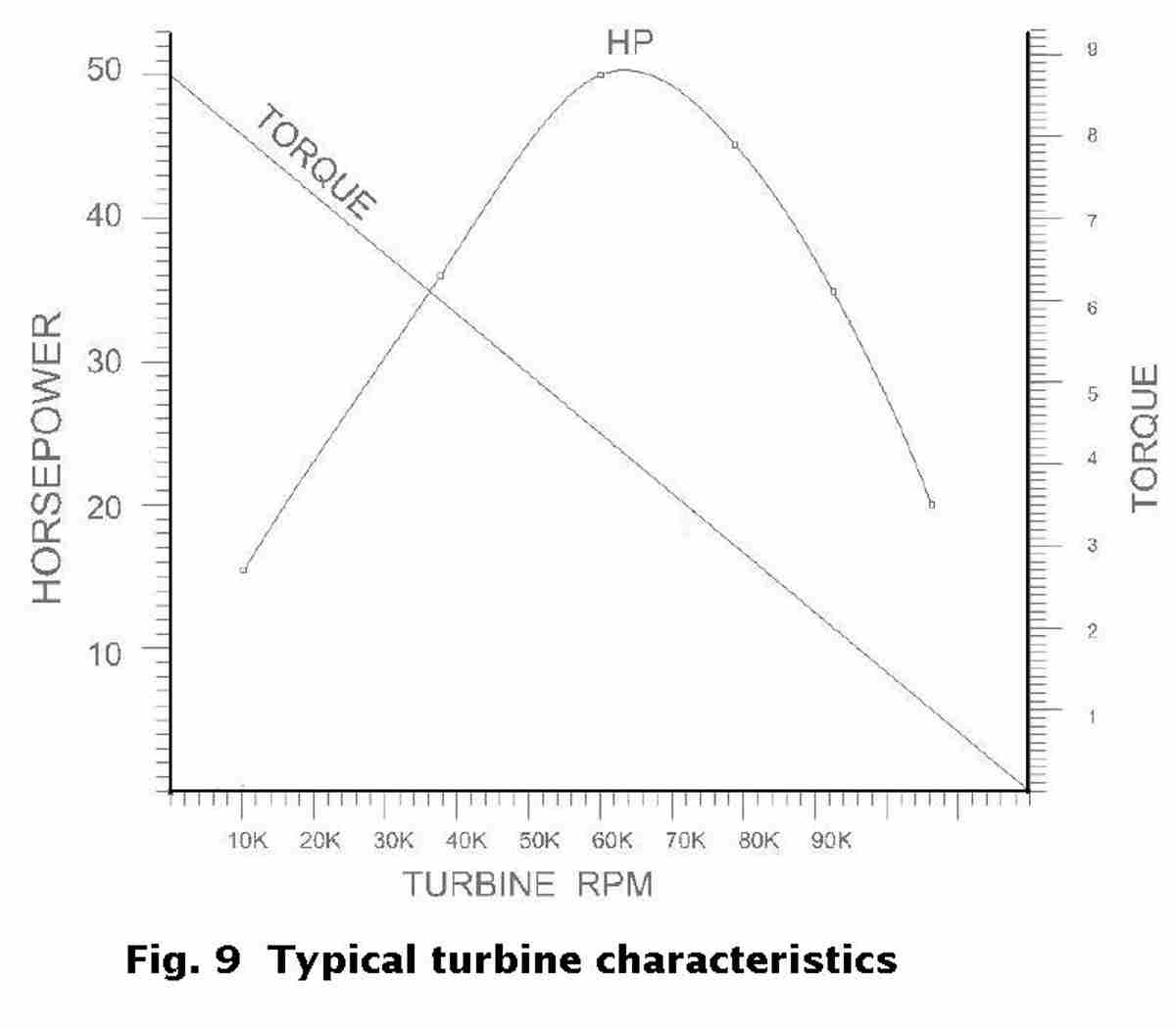
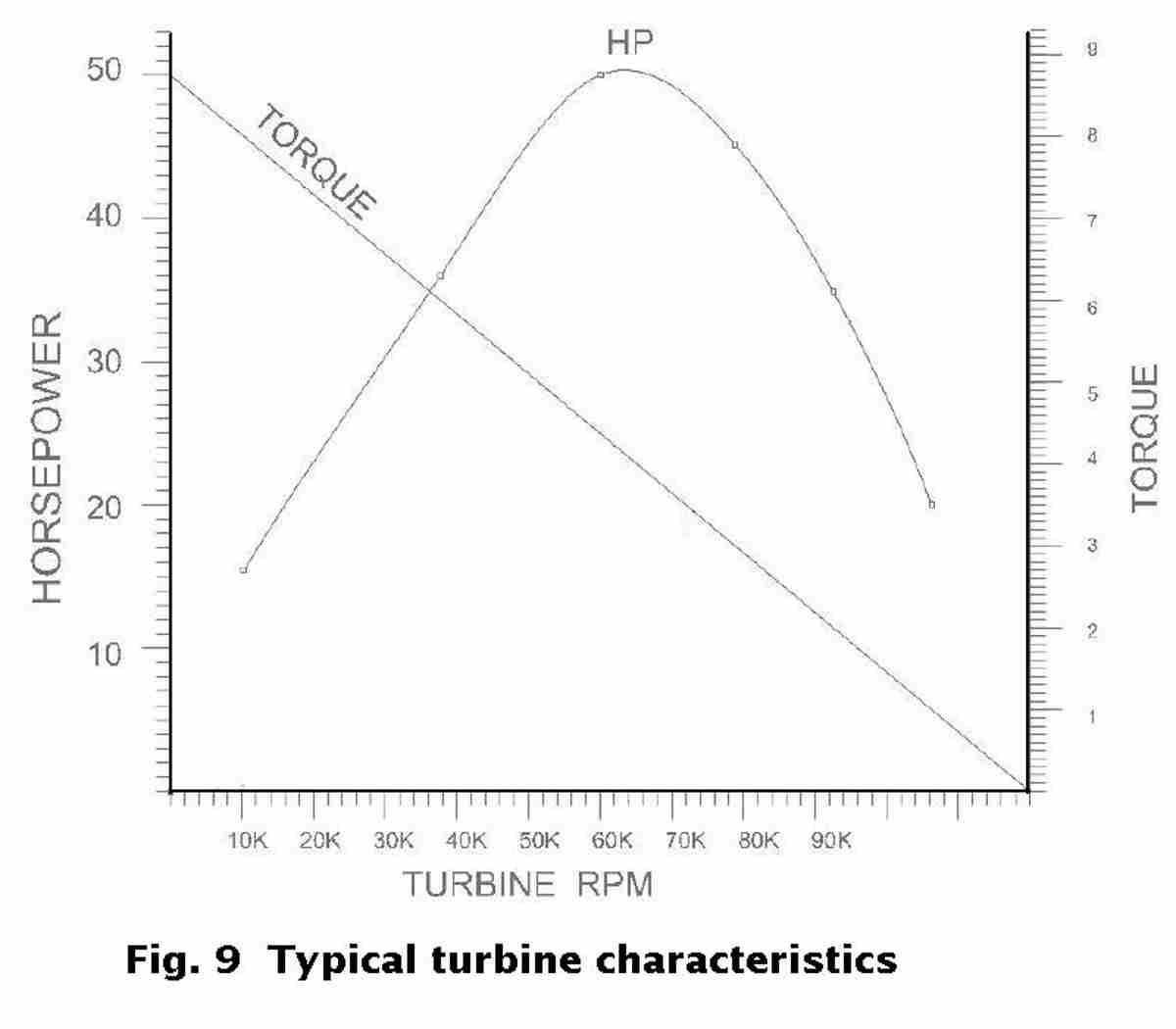
Here is a plot of the situation.
A smaller turbine would help the aircraft application.
The velocity of the blade would be slower so the pressure
would be higher.
18 inches would be fine for a car but an AC engine might need a geared turbine.
Check my logic and arithmetic. I have been none to make mistakes.
Paul Lamar
------------------------------------------------------------------
Please add your questions or comments at the end of the thread.
Not the beginning.
I am going to enforce that rule. If people don't do that it will not be published.
My ISP changed the rules.
The Rotary Engine free News Letter. 750 subscribers world wide.
Powered by Linux. If you want off the list PLEASE let me know and I will remove you.
ACRE NL web site.
http://www.rotaryeng.net
YouTube Key word "PaulLamar2". Keep clicking
this as Youtube will try to divert you to advertising.
Copyright 1998-2018 All world wide rights reserved.